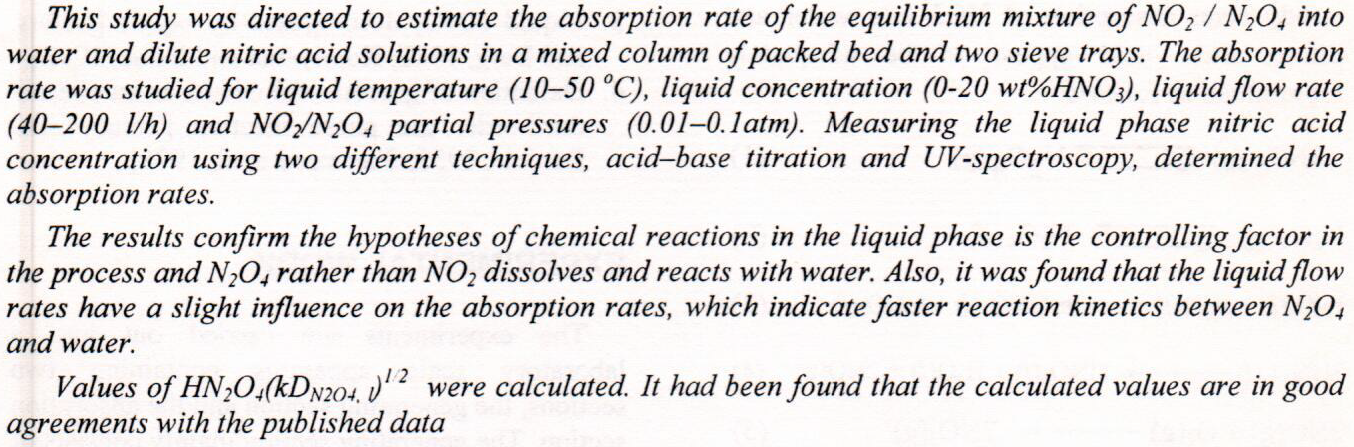
Absorption of NO2 into Water and Nitric Acid Solutions in a Fixed Column

This paper presents the thermophysical properties of zinc oxide nanofluid that have been measured for experimental investigation. The main contribution of this study is to define the heat transfer characteristics of nanofluids. The measuring of these properties was carried out within a range of temperatures from 25 °C to 45 °C, volume fraction from 1 to 2 %, and the average nanoparticle diameter size is 25 nm, and the base fluid is water. The thermophysical properties, including viscosity and thermal conductivity, were measured by using Brookfield rotational Viscometer and Thermal Properties Analyzer, respectively. The result indicates that the thermophysical properties of zinc oxide nanofluid increasing with nanoparticle volume f
... Show More (3)
(3)
 (2)
(2)


In this paper, series of new complexes of Manganese(II), Cobalt(II), Nickel (II) Cupper(II) Zinc(II), Cadmium(II) and Mercury (II) are prepared from the new ligand [2-(3-benzoylthioureido)-3-(-4- hydroxyphenyl) propanoic acid (BHP) derived from tyrosine and benzoylisothiocyanate .Chemical structures are obtained from their 1 H, 13CNMR spectra (for BHP), elemental microanalyses, molar conductance, FTIR, UV–Vis, magnetic susceptibility in addition to TGA/DTG and DSC analysis, the suggested geometry for all complexes was tetrahedral. The biological activity of BHP and its complexes has been extensively studied against two bacterial species Staphylococcus aurous (G+) and Escherichia coli (G-) by agar-well diffusion technique, where Mn(II), Co
... Show MoreThis experiment was conducted to examine the effects of injected gibberellic acid GA3 in subcutaneous of hens neck and supplemental vitamin D3 to control basal diet on productive performance and egg shell thickness ,relative weight of egg shell of aged laying hens. Two hundred and seventy Lohmann Brown laying hens at 73 weeks of age were randomly assigned to three treatments groups. Each treatment consist of three replicates (30 hens / replicate). The treatments were : T1 control were injected subcutaneous with 0.2 ml / kg of body weight of ethanol: sesame oil solution, T2 and T3 were injected subcutaneous with 0.2 ml / kg of body weight of ethanol: sesame oil solution which contained 400 μg GA3/ kg of body weight /week during 8 weeks (tre
... Show MoreGas and Downhole Water Sink, Gravity Drainage, GDWS-AGD, Enhance the Recovery of Oil
(2)
Non-Small Cell Lung Cancer (NSCLC) accounts for about 84% of all lung cancer types diagnosed so far. Every year, regardless of gender, the NSCLC targets many communities worldwide. 5-Fluorouracil (5-FU) is a uracil-analog anticancer compound. This drug tends to annihilate multiple tumour cells. But 5-FU's most significant obstacle is that it gets very easily metabolized in the blood, which eventually leads to lower anticancer activity. Therfore a perfect drug delivery system is needed to overcome all the associated challenges.
In this experiment, an attempt was made to prepare 5-FU loaded poly lactic-co-glycolic acid nanoparticles using solvent evaporation method and subsequently observed the effect of molecular weight of poly l
... Show More
(10)
(6)
A new light-weight nanocarbon prepared by spray-drying method to obtain particle size is 21.7 nm based of polylactic acid biodegradable film in antistatic packaging .Bio carbon (biochar) is obtained from plants and soils to naturally absorb and store carbon dioxide from the atmosphere . Therefor it has been used to support biodegradable polylactic acid (PLA) with to obtain 100% recyclable material.
Using plasticizer thymol of polylactic acid and biochar (bio carbon) as composites were prepared by a solution casting method with (0.5-10)wt% biochar. The composites characterized by FTIR, electrical conductivity, mechanical properties , contact angle and Colar and Brightness . Results show th
... Show More
(15)
Mixed ligand complexes of bivalent metal ions, viz ; M= Co(II),Ni(II),Cu(II), Zn(II), Cd (II), and Hg(II) of the composition [M(Anth)2(TMP)] in 1:2:1 molar ratio, (where . AnthrH= Anthranilic acid (C7H7NO2) and Trimethoprime (TMP) = (C14H18N4O3) have been synthesized and characterized by repeated melting point determination, Solubility, Molar conductivity (Λm ),determination the percentage of the metal (M%) in the complexes by (AAS), FT-IR, magnetic susceptibility measurements [μeff (BM)] and electronic spectral data. The two ligands and their metal complexes have been screened for their bacterial activity against selected microbial strains (Gram +ve) & (Gram -ve).
Mixed ligand complexes of bivalent metal ions, viz ; M= Co(II),Ni(II),Cu(II), Zn(II), Cd (II), and Hg(II) of the composition [M(Anth)2(TMP)] in 1:2:1 molar ratio, (where . AnthrH= Anthranilic acid (C7H7NO2) and Trimethoprime (TMP) = (C14H18N4O3) have been synthesized and characterized by repeated melting point determination, Solubility, Molar conductivity (Λm ),determination the percentage of the metal (M%) in the complexes by (AAS), FT-IR, magnetic susceptibility measurements [µeff (BM)] and electronic spectral data. The two ligands and their metal complexes have been screened for their bacterial activity against selected microbial strains (Gram +ve) & (Gram -ve).
The CO2-Assisted Gravity Drainage process (GAGD) has been introduced to become one of the mostinfluential process to enhance oil recovery (EOR) methods in both secondary and tertiary recovery through immiscibleand miscible mode. Its advantages came from the ability of this process to provide gravity-stable oil displacement forenhancing oil recovery. Vertical injectors for CO2 gas have been placed at the crest of the pay zone to form a gas capwhich drain the oil towards the horizontal producing oil wells located above the oil-water-contact. The advantage ofhorizontal well is to provide big drainage area and small pressure drawdown due to the long penetration. Manysimulation and physical models of CO2-AGD process have been implemented
... Show MoreOvako Working Postures Analyzing System (OWAS) is a widely used method for studying awkward working postures in workplaces. This study with OWAS, analyzed working postures for manual material handling of laminations at stacking workstation for water pump assembly line in Electrical Industrial Company (EICO) / Baghdad. A computer program, WinOWAS, was used for the study. In real life workstation was found that more than 26% of the working postures observed were classified as either AC2 (slightly harmful), AC3 (distinctly harmful). Postures that needed to be corrected soon (AC3) and corresponding tasks, were identified. The most stressful tasks observed were grasping, handling, and positioning of the laminations from workers. The construct
... Show More