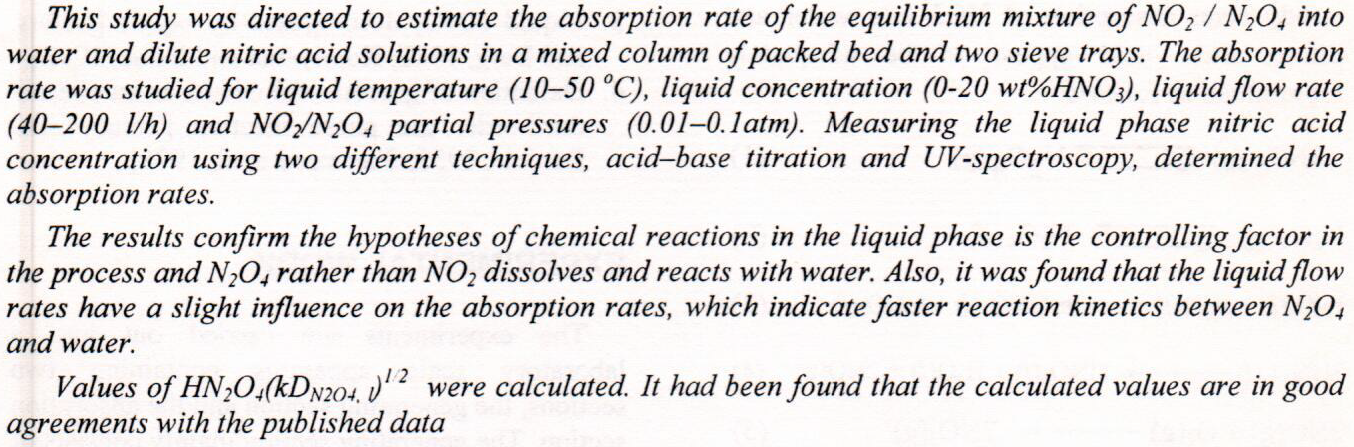
Absorption of NO2 into Water and Nitric Acid Solutions in a Fixed Column

 (1)
(1)


Surface drip irrigation is one of the most conservative irrigation techniques that help control providing water directly on the soil through the emitters. It can supply fertilizer and providing water directly to plant roots by drippers. One of the essential needs for trickle irrigation nowadays is to obtain more knowledge about the moisture pattern under the trickling source for various types of soil with various discharge levels with trickle irrigation. Simulation numerical using HYDRUS-2D software, version 2.04 was used to estimate an equation for the wetted area from a single surface drip irrigation in unsaturated soil is taking into account water uptake by roots. In this paper, using two soil types were used, namely
... Show More
 (28)
(28)
The distribution of chilled water flow rate in terminal unit is an important factor used to evaluate the performance of central air conditioning unit. A prototype of A/C unit has been made, which contains three terminal units with a complete set of accessories (3-way valve, 2-way valve, and sensors) to study the effect of the main parameters, such as total water flow rate and chilled water supply temperature with variable valve opening. In this work, 40 tests were carried out. These tests were in two groups, 20 test for 3-way valve case and 20 test for 2-way valve case. These tests were performed at three levels of valve opening, total water flow rate and water supply temperature according to the design matrices establis
... Show More
A novel metal-organic framework (MOF) sorbent based on tannic acid/copper (TA/Cu) was synthesized and characterized for the application of the anticancer drug imatinib (IMA) from biological samples. The TA/Cu MOF was prepared via a facile coordination reaction and thoroughly characterized by SEM, XRD, and FTIR techniques. Critical parameters influencing the extraction efficiency of imatinib mesylate (IMAM), including pH, ionic strength, desorption solvent, and adsorption-desorption time were optimized. With acetonitrile as the desorption solvent, the method demonstrated a broad linear range of 0.55-300 μg L-1 under ideal conditions. Limits of detection and quantification were found to be 0.16 μg L-1 and 0.55 μg L-1, respectively.
... Show More
(3)

This research includes the synthesis of some new N-Aroyl-N \ -Aryl thiourea derivatives namely: N-benzoyl-N \ -(p-aminophenyl) thiourea (STU1), N-benzoyl-N \ -(thiazole) thiourea (STU2), N-acetyl-N ` -(dibenzyl) thiourea (STU3). The series substituted thiourea derivatives were prepared from reaction of acids with thionyl chloride then treating the resulted with potassium thiocyanate to affored the corresponding N-Aroyl isothiocyanates which direct reaction with primary and secondary aryl amines, The purity of the synthesized compounds were checked by measuring the melting point and Thin Layer Chromatography (TLC) and their structure, were identified by spectral methods [FTIR,1H-NMR and 13C-NMR].These compounds were investigated as a
... Show MoreA novel metal-organic framework (MOF) sorbent based on tannic acid/copper (TA/Cu) was synthesized and characterized for the application of the anticancer drug imatinib (IMA) from biological samples. The TA/Cu MOF was prepared via a facile coordination reaction and thoroughly characterized by SEM, XRD, and FTIR techniques. Critical parameters influencing the extraction efficiency of imatinib mesylate (IMAM), including pH, ionic strength, desorption solvent, and adsorption-desorption time were optimized. With acetonitrile as the desorption solvent, the method demonstrated a broad linear range of 0.55-300 μg L-1 under ideal conditions. Limits of detection and quantification were found to be 0.16 μg L-1 and 0.55 μg L-1, respectively.
... Show More
(4)
A novel metal-organic framework (MOF) sorbent based on tannic acid/copper (TA/Cu) was synthesized and characterized for the application of the anticancer drug imatinib (IMA) from biological samples. The TA/Cu MOF was prepared via a facile coordination reaction and thoroughly characterized by SEM, XRD, and FTIR techniques. Critical parameters influencing the extraction efficiency of imatinib mesylate (IMAM), including pH, ionic strength, desorption solvent, and adsorption-desorption time were optimized. With acetonitrile as the desorption solvent, the method demonstrated a broad linear range of 0.55-300 μg L-1 under ideal conditions. Limits of detection and quantification were found to be 0.16 μg L-1 and 0.55 μg L-1, respectively.
... Show More
(4)