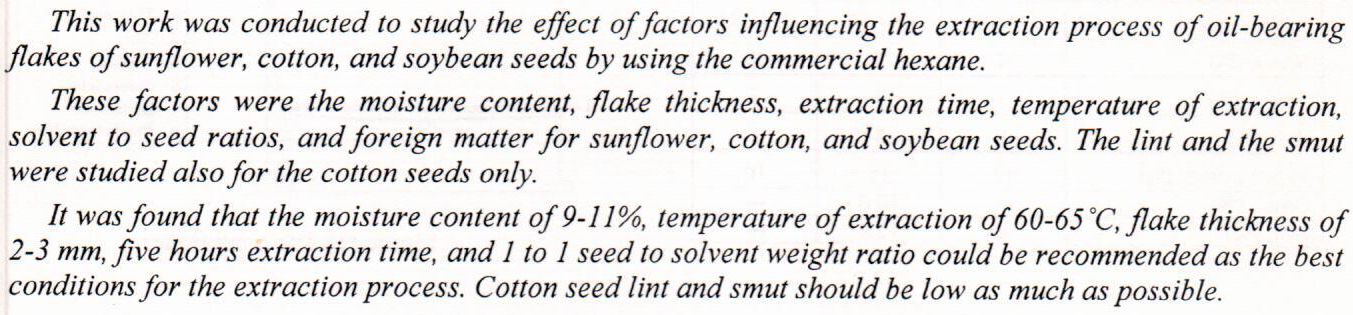
Factors Affecting the Extraction Process

 (1)
(1)


Background: DVT is a very common problem with a very serious complications like pulmonary embolism (PE) which carries a high mortality,and many other chronic and annoying complications ( like chronic DVT, post-phlebitic syndrome, and chronic venous insufficiency) ,and it has many risk factors that affect its course, severity ,and response to treatment. Objectives: Most of those risk factors are modifiable, and a better understanding of the relationships between them can be beneficial for better assessment for liable pfatients , prevention of disease, and the effectiveness of our treatment modalities. Male to female ratio was nearly equal , so we didn’t discuss the gender among other risk factors. Type of the study:A cross- secti
This research raised the strategic selection factors and dimensions of the quality of higher education and what the nature of their relationship and has been collecting a sample search from the technological University of president scientific departments and administrative and scientific associates and chiefs of branches This research aims at studying factors affecting the strategic selection effects these factors in the quality of higher education and the combination of these factors has been identified as a group of selected dimensions of quality of higher education and study link relationships and affecting factors and strategic selection of (risk, previous strategies, resources, time, considerations and internal trends) and d
... Show More
Permanent deformation (Rutting) of asphalt pavements which appears in many roads in Iraq, have caused a major impact on pavement performance by reducing the useful service life of pavement and creating services hazards for highway users. The main objective of this research is investigating the effect of some contributory factors related to permanent deformation of asphalt concrete mixture. To meet the objectives of this research, available local materials are used including asphalt binder, aggregates, mineral filler and modified asphalt binder. The Superpave mix design system was adopted with varying volumetric compositions. The Superpave Gyratory Compactor was used to compact 24 asphalt concrete cylindrical specimens. To collect t
... Show MoreThe elastic transverse electron scattering form factors have been studied for the 11Li nucleus using the Two- Frequency Shell Model (TFSM) approach. The single-particle wave functions of harmonic-oscillator (HO) potential are used with two different oscillator parameters bcore and bhalo. According to this model, the core nucleons of 9Li nucleus are assumed to move in the model space of spsdpf. The outer halo (2-neutron) in 11Li is assumed to move in the pure 1p1/2, 1d5/2, 2s1/2 orbit. The shell model calculations are carried ou
... Show More
(6)
 (2)
(2)
This essay aims to highlight the most important issues and difficulties facing implementing large projects that follow the turn-key method, considered one of the types of contractual methods in Iraq, especially for large and complex projects requiring speedy completion. The projects implemented in this way face delays and delays in completion, which led to the lack of benefit from the projects for which they were implemented, especially those affecting the lives of citizens within the health sector. The case study dealt with the construction of hospitals with multi-bed capacities within multiple governorates in Iraq, With large financial allocations within the federal budget of the Government of Iraq over several years.
... Show More
(11)
(5)
Background: Post-partum depression (PPD) is a form of postnatal depression that affects mothers. Clinical manifestations usually appear within six months after delivery. Risk factors that influence the severity of post-partum depression are not fully known in the Iraqi population.
Objectives: We aim to evaluate the risk factors and identify potential predictors that may influence the symptom levels (severity) of post-partum depression among Iraqi women from Baghdad.
Subjects and Methods: The current study is cross-sectional, and we used the Edinburgh Postnatal Depression Scale (EPDS) and a cut-off value of 13 to differentiate patients into two those with lower symptom levels (LSL) and higher symptom levels (HSL). We also explored p
(2)
(1)
Seventy of Klebsiella pneumoniae isolates had been collected from some Hospitals in Baghdad city from October to December 2017. The 70 isolates were taken from diverse clinical specimens. All K. pneumoniae isolates were identified based on API 20 E and Vitek2 compact system. Antibiotics sensitivity test was carried out toward 10 antibiotics using discs diffusion method. The level of antibiotics resistance was 81.42% for Ceftriaxone, whereas the low level of antibiotics resistance was 37.14% for Piperacillin. K. pneumoniae isolates were typed genotypically by using two different methods of amplification, multiplex-PCR and enterobacterial repetitive intergenic consensus (ERIC)-PCR typing methods. Results showed that out of 70 isolates, there
... Show More
(16)
(10)

Objective: This study goal was to screen participants from different settings in Baghdad for depression using Beck Depression Inventory (BDI) scale and identify factors influencing the levels of depression. Methods: This cross-sectional study included a convenience sample of 313 people from four settings (teaching hospital, college of medicine, college of pharmacy, and high school) in Baghdad, Iraq. The participants were screened using paper survey relying on the BDI scale during spring 2018. Using multiple linear regression analysis, we measured the association between depression scores and six participant factors. Results: The overall prevalence of depression in our sample was 57.2%. Female participants had higher BDI
... Show More
(5)