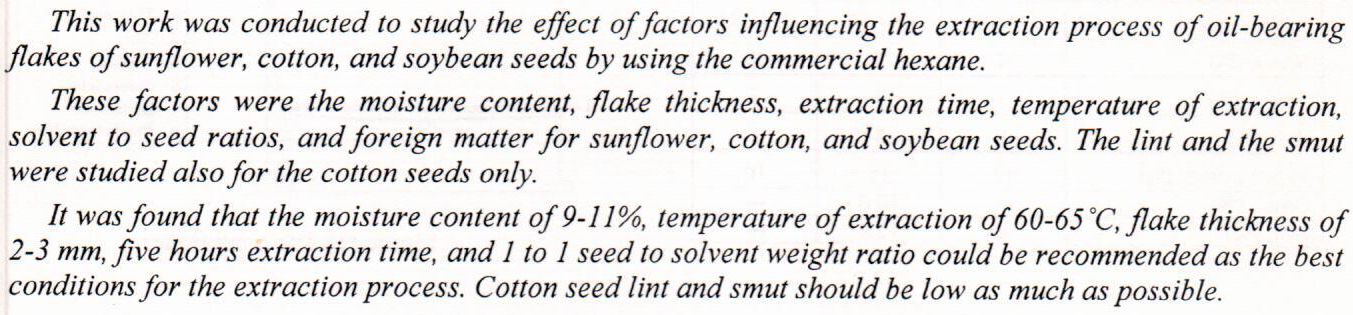
Factors Affecting the Extraction Process

Abstract Objective: The study aimed to assess the factors contributes of patient with bladder cancer and to find out the relationship between the factors of bladder cancer with certain variable. Methodology: A descriptive study to assessment of factors that contribute to bladder cancer that was carried out Al-Karama teaching hospital, Al-Kendy teaching hospital, Specialty Surgery teaching hospital and Al-Yarmok teaching hospital for the period of November 2003 to August 2004. A purposive (non-probability) sample of (100) patients with bladder cancer. An assessment from was constructed for the purpose of the st
The predisposing factors and their effect on the increasing of vulvovaginal Candidiasis have been studied in this research. The result indicated that the highest of infection with vaginal Candidias was in the age of women with age of (21-30years) with vaginal itching and discharge, also the results revealed that the pregnancy was the main predisposing factor. The percentage of the infected pregnant Ladies was 33.7% followed by the women who used the IUCD and OCP 22.1%, those who used steroids 5.2% comparing with control women (without predisposing factors).The results also indicated that the most cases of infection were during the third trimester of pregnancy (where the rate of infedion) was 53.9%.-OCP- Oral Contraceptive Pills-IUCD- Intrr
... Show More
Forward osmosis (FO) process was applied to concentrate the orange juice. FO relies on the driving force generating from osmotic pressure difference that result from concentration difference between the draw solution (DS) and orange juice as feed solution (FS). This driving force makes the water to transport from orange juice across a semi-permeable membrane to the DS without any energy applied. Thermal and pressure-driven dewatering methods are widely used, but they are prohibitively energy intensive and hence, expensive. Effects of various operating conditions on flux have been investigated. Four types of salts were used in the DS, (NaCl, CaCl2, KCl, and MgSO4) as osmotic agent and the experiments were performed at the concentration of
... Show MoreElectro coagulation treatment was used for zinc removal from electroplating wastewater of the State Company for Electrical Industries . This wastewater, here consists zinc ions with maximum concentration in solution of 90 ppm .
The parameters that influenced the wastewater treatment are: current density in the range 1-1.4 mA/cm2, pH in the range 5-10, temperature in the range 25-45°C and time in the range 10-180 minute.
The research is a laboratory experimental type using batch system for electrical process with direct current. The cell comprised of aluminum electrode as anode and stainless steel electrode as cathode. Thirty experiments and one hundred fifty sample lab tests were carried out in this research
... Show MoreThe main objective of this study is to determine the suitable excitation wavelengths for
urine components reaching to select the suitable lasers to execute the auto fluorescence due to their
high intensities. The auto fluorescence was measured at 305, 325 and 350 nm excitation wavelengths
for eleven urine samples which were also analyzed by conventional methods (chemical and
microscopic examination). Data manipulation using Matlab package programming language showed
that urine sample with normal chemical and biological components have emission peaks which are
different from the infected urine samples. Despite the complexity of the composition of urine,
fluorescence maxima can be observed. Most likely, the peaks obser
The present work aims to study the possibility of utilization a forward osmosis desalination process as an alternative method to extract water from brine solution rejected from reverse osmosis process.
Experiments conducted in a laboratory–scale forward osmosis (FO) unit in cross flow flat sheet membrane cell yielded water flux ranging from (0.0315 to 0.56 L/m2 .min) when using CTA membrane,and ranging from (0.419 to 2.785 L/m2 .min) for PA membrane under 0.4 bar. Two possible membrane orientations were tested. Sodium chloride with high concentrations was used as draw solution solute. The effect of membrane orientation on internal concentration polarization (ICP) was studied. Two regimes of ICP; dilutive and concentrative were desc
 (5)
(5)
Cadmium is one of the heavy metal found in the wastewater of many industries. The electrocoagulation offers many advantages for the removal of cadmium over other methods. So the removal of cadmium from wastewater by using electrocoagulation was studied to investigate the effect of operating parameters on the removal efficiency. The studied parameters were the initial pH, initial concentration, and applied voltage. The study experiments were conducted in a batch reactor with with two pairs of aluminum electrodes with dimension and 2mm in thick with 1.5 cm space between them. The optimum removal was obtained at pH =7, initial concentration = 50 mg/L, and applied voltage = 20 V and it was 90%.
(10)
The main objective of this study is to determine the suitable excitation wavelengths for
urine components reaching to select the suitable lasers to execute the auto fluorescence due to their
high intensities. The auto fluorescence was measured at 305, 325 and 350 nm excitation wavelengths
for eleven urine samples which were also analyzed by conventional methods (chemical and
microscopic examination). Data manipulation using Matlab package programming language showed
that urine sample with normal chemical and biological components have emission peaks which are
different from the infected urine samples. Despite the complexity of the composition of urine,
fluorescence maxima can be observed. Most likely, the peaks obser
Mass transfer was examined at a stationary rectangular copper electrode (cathode) by using the reduction of cupric ions as the electrochemical reaction. The influence of electrolyte temperature (25, 45, and 65 oC), and cupric ions concentration (4, 8, and 12 mM) on mass transfer coefficient were investigated by using limiting current technique. The mass transfer coefficient and hence the Sherwood number was correlated as Sh =