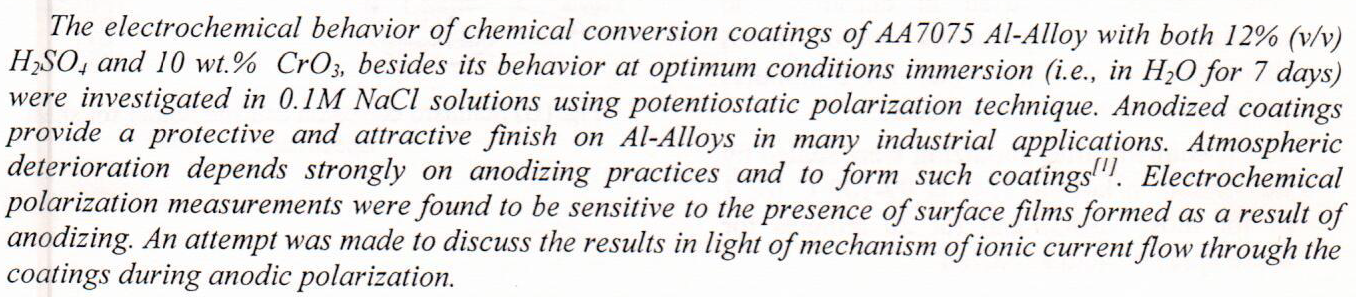
Electrochemical behavior of Anodized AA7075 Aluminum Alloy in 0.1M NaCl Solution as Investigated by Potentiostatic Polarization Ttechnique

In this work we study the influence of the laser pulse energy and ablation time on the aluminum nanoparticles productivity during nanosecond laser ablation of bulk aluminum immersed in liquid.
Aluminum nanoparticles were synthesized by pulsed laser ablation of Al targets in ethanol for 3-8 minutes using the 1064 nm wavelength of a Nd:YAG laser with energies of 300-500 mJ per pulse.The laser energy was varied between 300 and 500 mJ/pulse, whereas the ablation time was set to 5 minutes. UV-Visible absorption spectra was used for the characterization and comparison of products.
 (1)
(1)



Econazole nitrate (EN) is considered as the most effective agent for the treatment of all forms of
dermatomycosis caused by dermatophytes. This study was carried out to formulate a stable
Econazole nitrate solution for a topical use through preparation of different formulas and selected
the most suitable one. The results indicated that the use of propylene glycol and ethanol as a vehicle
for EN which is very slightly soluble in water gave amore stable formula as EN topical solution,
with a shelf life of about 3.15 years .The data also indicated that the light accelerated the
degradation of EN, while the type of container (glass or plastic) had no effect on the rate of drug.
The overall results of this study suggest t
The change in the optical band gap and optical activation energy have been investigated for pure Poly (vinyl alcohol)and Poly (vinyl alcohol) doped with Aluminum sulphate to proper films from their optical absorption spectra. The absorption spectra were measured in the wave range from (200-700) nm at temperature range (25-140) 0C. The optical band gap (Eg) for allowed direct transition decrease with increase the concentration of Aluminum sulphate. The optical activation energy for allowed direct transition band gap was evaluated using Urbach- edges method. It was found that ?E increases with increasing the concentration of Al2 (SO4)3 and decreases when temperature increases.
In this research we investigated the corrosion behavior of the commertialy pure titanium and Ti-6Al-4V alloy that coated with hydroxyapatite by electrochemical deposition with applied voltage (6,9,12) Volt from aqueous solution containing Ca(NO3)2.H2O =7.0 gm/l , (NH4)2HPO4 =3.5 gm/l , Na(NO3)2 = 8.5 gm/l in order to improve the bonding strength of hydroxyapetite and medical metals and alloys and increasing the biocompatibility. The coating layer morphology was investigated by XRD, Optical microscope , and SEM tests, the corrosio tests was made by use senthesys simulated body fluid (SBF) , and we found that the propreate voltage for coatint on Ti was 9 Volt and for Ti-6Al-4Vwas12Volt.
Large quantities of contaminated carwash wastewater are produced per day from carwash places. Extensively it contains large quantities of chemicals from detergents, oil, grease, heavy metals, suspended solids, types of hydrocarbons, and biological contents. A novel electrocoagulation treatment by foil electrodes was conducted to remove COD, turbidity, Total Dissolved Solids (TDS) from contaminated carwash wastewater and decrease its Electrical Conductivity (EC). A thin layer of aluminum foil is used as an electrode in this treatment process. The effects of different voltage and treatment times were studied. The best result was found at a voltage of 30 volts and treatment time 90 minute where the removal efficiency of COD
... Show More
(8)
(5)
One of the most essential components of asphalt pavements is the filler. It serves two purposes. First, this fine-grained material (diameter less than 0.075 mm) improves the cohesiveness of aggregate with bitumen. Second, produce a dense mixture by filling the voids between the particles. Aluminum dross (AD), which is a by-product of aluminum re-melting, is formed all over the world. This material causes damage to humans and the environment; stockpiling AD in landfills is not the best solution. This research studies the possibility of replacing part of the conventional filler with aluminum dross. Three percent of dross was used, 10, 20, and 30% by filler weight. The MarshallMix design method was adopted to obtain the op
... Show More (3)
(2)
(3)
(2)
This research deals with the effects of welding variables using MIG/MAG spot by using Argon (Ar) gas and CO2 to show their effect on the mechanical characteristics and microstructure of low alloy steel type DIN15Mo3 and determine the optimum condition for the process of welding ; current & time. The results show the possibility of using CO2 and also Ar in low alloy steel welding with a little decrease in the shear force of not more than 13% for 4mm thickness and time 2sec. The shear force increased when using Ar instead of CO2 to be , The shear force reach 36KN when using Ar at 2mm thickness time of 8 sec and current of 220 Amp. , when used CO2 instead of Ar d
... Show MoreIn the present study, a powder mixture of elements Ti and Ni was mechanically alloyed in a high energy ball mill. Microstructure of the nanosized amorphous milled product in different stages of milling has been characterized by X- ray diffraction, scanning electron microscopy and differential thermal analysis. We found that time of mechanical alloying is more significant to convert all crystalline structure to the amorphous phase. Nanocrystalline phase was achieved as a result of the mechanical alloying process. The results also indicates that the phase transformation and the grain size occurs in these alloys are controlled by ball milling time