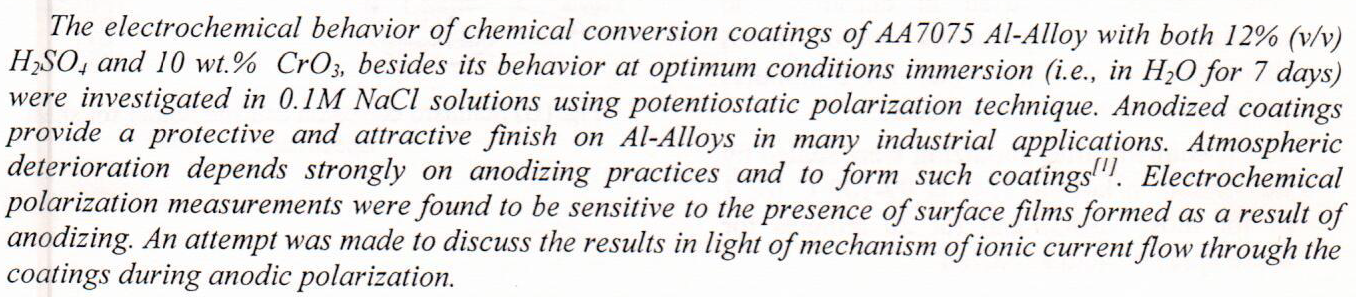
Electrochemical behavior of Anodized AA7075 Aluminum Alloy in 0.1M NaCl Solution as Investigated by Potentiostatic Polarization Ttechnique

 (5)
(5)
 (3)
(3)



The topic area of that’s research dealing with values which adopted by Iraqi people since 1980, many changes and variables which make many situations and skills which the life is suitable in war and conflicts times. That’s values like traditional and ordering, traditionalism mean the conservation about values s and tradition which society adopted its. The Iraqi society suffering from many changes since 1980-2003, the consequently of that’s changes make Iraqi citizen more interested about luxury needs like clothes, while decreasing the interested about liberty of thought, beauty, show evidence of identity, and openness of mind. The processing of values changes associated with political behavior of Iraqi people which lead to weaken o
... Show More
Adsorption of Chlorophenol compounds in aqueous solution on Iraqi siliceouns rocks powder have been investigated. UV technique has been used to determine the adsorption isotherms. The results showed that the adsorption isotherms obeyed Freundlich adsorption equation. The adsorption was endothermic process, increasing temperature leads to increasing adsorption. H, S, G were calculated. The results showed that the adsorption increases with increasing acidity of solutions
Electrochemical Grinding (ECG) process is a mechanically assisted electrochemical process for material processing. The process is able to successfully machine electrically conducting harder materials at faster rate with improved surface finish and dimensional control. This research studies the effect of applied current, electrolyte concentration, spindle speed and the gap between workpiece and tool on hardness and material removal rate during electrochemical grinding for stainless steel 316. The characteristic features of the electrochemical grinding process are explored through Taguchi-design-based experimental studies. The better hardness can be obtained at 10 A of the current, 150 g/l of the electrolyte concentration, 0.3 mm of gap an
... Show MoreIonic liquids (ILs) and deep eutectic solvents (DESs) have been found to be highly effective as electrolytes in TiO2 NTAs-graphite cells when combined with additives that enhance conductivity by reducing the viscosity of these liquids. The presence of CaCl2.6H2O: Acetamide DES with DI water as an additive resulted in a cell voltage of 1.31V and an internal resistance of 19 ohm. This can be attributed to the concentration and quality of the ionic species. The cells exhibited an interesting response to the AlCl3-chloroacetamide IL with dichloromethane DCM as an additive, with a cell voltage of 1.81V and an internal resistance of 5.0 ohm. Once again, this is influenced by the quality and concentration of the ionic species. Furthermore,
... Show More
(1)
(8)
(8)
Ti6Al4V alloy is widely used in aerospace and medical applications. It is classified as a difficult to machine material due to its low thermal conductivity and high chemical reactivity. In this study, hybrid intelligent models have been developed to predict surface roughness when end milling Ti6Al4V alloy with a Physical Vapor Deposition PVD coated tool under dry cutting conditions. Back propagation neural network (BPNN) has been hybridized with two heuristic optimization techniques, namely: gravitational search algorithm (GSA) and genetic algorithm (GA). Taguchi method was used with an L27 orthogonal array to generate 27 experiment runs. Design expert software was used to do analysis of variances (ANOVA). The experimental data were
... Show More
(9)
(7)
The investment decision, a critical decision for each investor as it involves risks and uncertain returns, so investors should avoid cases of uncertainty associated with the final decisions they are involved, and the problem of research in individual differences and differences in the behavior of individual investors and reflect the impact of this investment decision in the Iraqi market for securities. Therefore, the research aims to understand and analyze the impact of determinants of investor behavior as an independent variable in investment decision-making as a dependent variable in the Iraqi market for securities, and the research started from two main hypotheses to explore the influence and correlation between research varia
... Show More
(1)
English has for long been one of the most widely used media of communication globally, especially in the Malaysian universities. It has been termed as a Lingua Franca because it is shared with other languages which are considered first languages by different speakers. For this reason, English as a Lingua Franca (ELF) has attracted a number of researchers to investigate its variety via other languages in various communities. The objective of this paper is therefore to establish the strategies which are employing by the international students at the National University of Malaysia/ UniversitiKebangsaan Malaysia (UKM) as an example of one of the Malaysian universities; when they e
... Show More