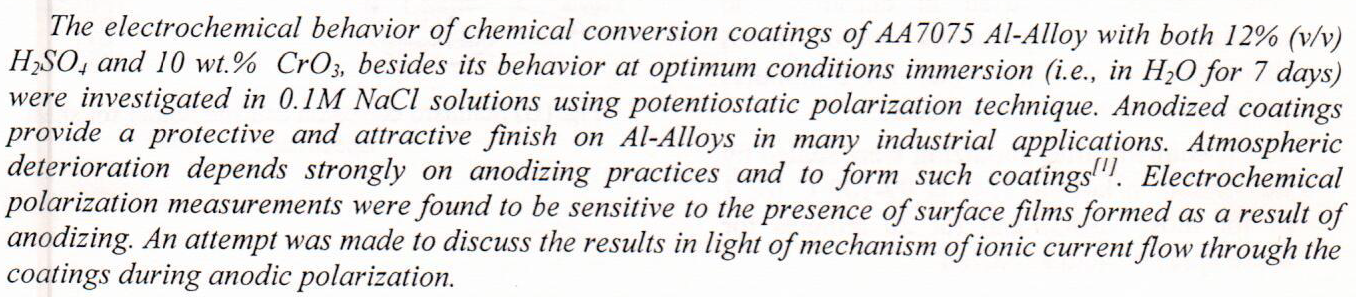
Electrochemical behavior of Anodized AA7075 Aluminum Alloy in 0.1M NaCl Solution as Investigated by Potentiostatic Polarization Ttechnique

Improving the accuracy of load-deformation behavior, failure mode, and ultimate load capacity for reinforced concrete members subjected to in-plane loadings such as corbels, wall to foundation connections and panels need shear strength behavior to be included. Shear design in reinforced concrete structures depends on crack width, crack slippage and roughness of the surface of cracks.
This paper illustrates results of an experimental investigation conducted to investigate the direct shear strength of fiber normal strength concrete (NSC) and reactive powder concrete (RPC). The tests were performed along a pre-selected shear plane in concrete members named push-off specimens. The effectiveness of concrete compressiv
... Show MoreThis paper describes flexural behavior of two spans continuous rectangular concrete beams reinforced with mild steel and partially prestressing strands, to evaluate using different prestressing level and prestressing area in continuous prestressed beams at serviceability and ultimate stages. Six continuous concrete beams with 4550 mm length reinforced with mild steel reinforcement and partially prestressed with two prestressing levels of (0.7fpy or 0.55fpy.) of and different amount of 12.7 mm diameter seven wire steel strand were used. Test results showed that the partially prestressed reinforced beams with higher prestressing level exhibited the narrowest crack width, smallest deflection and strain in both steel and concrete at ul
... Show MoreIn this work, the effect of aluminum (Al) dust particles on the DC discharge plasma properties in argon was investigated. A magnetron is placed behind the cathode at different pressures and with varying amounts of Al. The plasma temperature (Te) and density (ne) were calculated using the Boltzmann equation and Stark broadening phenomena, which are considered the most important plasma variables through which the other plasma parameters were calculated. The measurements showed that the emission intensity decreases with increasing pressure from 0.06 to 0.4 Torr, and it slightly decreases with the addition of the NPs. The calculations showed that the ne increased and Te decreased with pressure. Both Te and ne were reduced by increasing
... Show More

The language that consists of only twenty-eight letters, but it is so broad that we are unable to understand it from all sides and this expansion is mainly caused by imagination, so Arab imagination, whose language goes in all directions And as it always responds to our ears, ancient critics divide imagination into holistic and partial But the language is not limited to these parts only. Do we wonder, where is the structural method of wishing, hope, questions and other methods of all this? In this paper, we try to show the importance of the method of writing in moving imagination in an interactive way, and what is related to human feelings in most, if not all, of its methods By studying the poetry of the believers in the Ahl al-Bayt, pea
... Show More (1)
(1)
 (13)
(7)
(13)
(7)
This study aimed to evaluate the surface changes of commercial pure Titanium disks (CP Ti) and the Ti 13Nb 13 Zr (Alloy) with a zigzag pattern of laser surface treatment. In vitro, experimental study of CNC Laser treatment on the CP Ti and Alloy disks. Texturing the surfaces of CP Ti and Alloy disks via CNC laser, the sample disks were analyzed using surface roughness, wettability and FESEM. The FESEM revealed a proper increase in the surface texturing and roughness on macro and micro measures without crack formation or dramatic change of the core substance of the CP Ti and Alloy disks. The CNC laser is an effective and suitable method for surface texturing CP Ti and Alloy for dental implantology. Keywords: Commercial pure Titanium;
... Show More
(1)
The wear behavior of alumina particulate reinforced A332 aluminium alloy composites produced by a stir casting process technique were investigated. A pin-on-disc type apparatus was employed for determining the sliding wear rate in composite samples at different grain size (1 µm, 12µm, 50 nm) and different weight percentage (0.05-0.1-0.5-1) wt% of alumina respectively. Mechanical properties characterization which strongly depends on microstructure properties of reinforcement revealed that the presence of ( nano , micro) alumina particulates lead to simultaneous increase in hardness, ultimate tensile stress (UTS), wear resistances. The results revealed that UTS, Hardness, Wear resistances increases with the increase in the percentage of
... Show MoreNowadays, most of the on-chip plasmonic single-photon sources emit an unpolarized stream of single photons that demand a subsequent polarizer stage in a practical quantum cryptography system. In this paper, we numerically demonstrated the coupling of the light emitted from a quantum emitter (QE) at 700 nm wavelength to the propagation mode supported by an on-chip hybrid plasmonic waveguide (HPW) polarization rotator. Our results proved that the light emitted is linearly polarized at 0º, 45º/−45º, and 90º with propagation lengths of 5 μm, 3.3 μm, and 3.9 μm, respectively. Moreover, high power-conversion efficiency was obtained from an applied transverse magnetic (TM) mode (0º-polarization) to a transverse electric (TE) (90º-polari
... Show More
(4)
(4)
