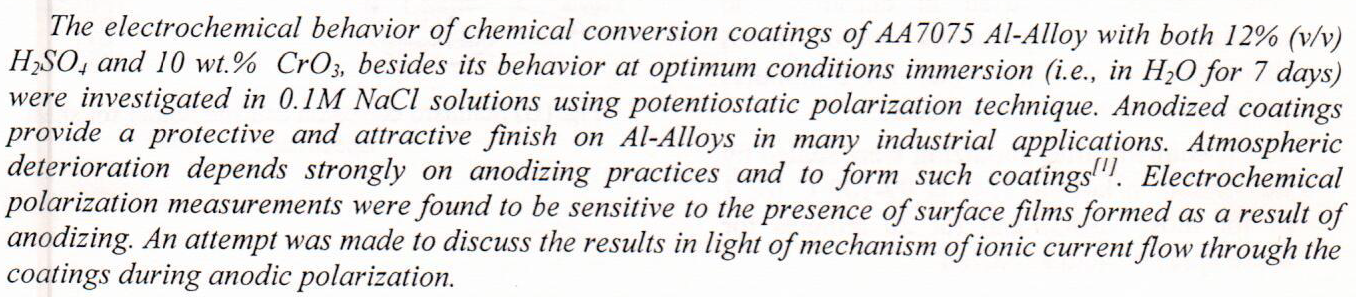
Electrochemical behavior of Anodized AA7075 Aluminum Alloy in 0.1M NaCl Solution as Investigated by Potentiostatic Polarization Ttechnique

Rainwater harvesting could be a possible solution to decrease the consequences of water scarcity and energy deficiency in Iraq and the Kurdistan Region of Iraq (KRI). This study aims to calculate the water and energy (electricity) saved by rainwater harvesting for rooftops and green areas in Sulaimani city, KR, Iraq. Various data were acquired from different formal entities in Sulaimani city. Moreover, Google Earth and ArcMap 10.4 software were used for digitizing and calculating the total rooftop and green areas. The results showed that for the used runoff coefficients (0.8 and 0.95), the harvested rainwater volumes were 2901563 and 12197131 m³ during the study period (2005 – 2006) and (2019-2020). Moreover, by compa
... Show More (1)
(1)

 (49)
(42)
(49)
(42)


Fourier Transform-Infrared (FT-IR) spectroscopy was used to analyze gasoline engine oil (SAE 5W20) samples that were exposed to seven different oxidation times (0 h, 24 h, 48 h, 72 h, 96 h, 120 h, and 144 h) to determine the best wavenumbers and wavenumber ranges for the discrimination of the oxidation times. The thermal oxidation process generated oil samples with varying total base number (TBN) levels. Each wavenumber (400–3900 cm−1) and wavenumber ranges identified from the literature and this study were statistically analyzed to determine which wavenumbers and wavenumber ranges could discriminate among all oxidation times. Linear regression was used with the best wavenumbers and wavenumber ranges to predict oxidation time.
... Show More
(21)
(21)
A comparative study was done on the adsorption of methyl orange dye (MO) using non-activated and activated corn leaves with hydrochloric acid as an adsorbent material. Scanning electron microscopy (SEM) and Fourier Transform Infrared spectroscopy (FTIR) were utilized to specify the properties of adsorbent material. The effect of several variables (pH, initial dye concentration, temperature, amount of adsorbent and contact time) on the removal efficiency was studied and the results indicated that the adsorption efficiency increases with the increase in the concentration of dye, adsorbent dosage and contact time, while inversely proportional to the increase in pH and temperature for both the treated and untreated corn leav
... Show More
(25)
Water pollution as a result of contamination with dye-contaminating effluents is a severe issue for water reservoirs, which instigated the study of biodegradation of Reactive Red 195 and Reactive Blue dyes by E. coli and Bacillus sp. The effects of occupation time, solution pH, initial dyes concentrations, biomass loading, and temperature were investigated via batch-system experiments by using the Design of Experiment (DOE) for 2 levels and 5 factors response surface methodology (RSM). The operational conditions used for these factors were optimized using quadratic techniques by reducing the number of experiments. The results revealed that the two types of bacteria had a powerful effect on biodegradable dyes. The regression analysis reveale
... Show More
(52)
A comparative study was done on the adsorption of methyl orange dye (MO) using non-activated and activated corn leaves with hydrochloric acid as an adsorbent material. Scanning electron microscopy (SEM) and Fourier Transform Infrared spectroscopy (FTIR) were utilized to specify the properties of adsorbent material. The effect of several variables (pH, initial dye concentration, temperature, amount of adsorbent and contact time) on the removal efficiency was studied and the results indicated that the adsorption efficiency increases with the increase in the concentration of dye, adsorbent dosage and contact time, while inversely proportional to the increase in pH and temperature for both the treated and untreated corn leaves. The equi
... Show More
(25)
Because of the quick growth of electrical instruments used in noxious gas detection, the importance of gas sensors has increased. X-ray diffraction (XRD) can be used to examine the crystal phase structure of sensing materials, which affects the properties of gas sensing. This contributes to the study of the effect of electrochemical synthesis of titanium dioxide (TiO2) materials with various crystal phase shapes, such as rutile TiO2 (R-TiO2NTs) and anatase TiO2 (A-TiO2NTs). In this work, we have studied the effect of voltage on preparing TiO2 nanotube arrays via the anodization technique for gas sensor applications. The results acquired from XRD, energy dispersion spectro
... Show More
(3)
Because of the quick growth of electrical instruments used in noxious gas detection, the importance of gas sensors has increased. X-ray diffraction (XRD) can be used to examine the crystal phase structure of sensing materials, which affects the properties of gas sensing. This contributes to the study of the effect of electrochemical synthesis of titanium dioxide (TiO2) materials with various crystal phase shapes, such as rutile TiO2 (R-TiO2NTs) and anatase TiO2 (A-TiO2NTs). In this work, we have studied the effect of voltage on preparing TiO2 nanotube arrays via the anodization technique for gas sensor applications. The results acquired from XRD, energy dispersion spectroscopy (EDX), and field emission scanning electron microscopy
... Show More
(3)
(24)
(13)
The accelerating effect of 1,4- phenylenediamine (PDA) additions in 1M hydrochloric acid solution at temperature rang (20-60) C° has been studied by weight losses measurement during ranging time (1-260) h and by following the pb2+ concentration in solution after several times by using Atomic absorption spectroscopy (AAS) . The volume of hydrogen gas involving was followed also in presence and absence of (PDA) in the corrosive solution .Accelerating enhanced by adding (NaCl , NaBr , NaI ) was also investigated.