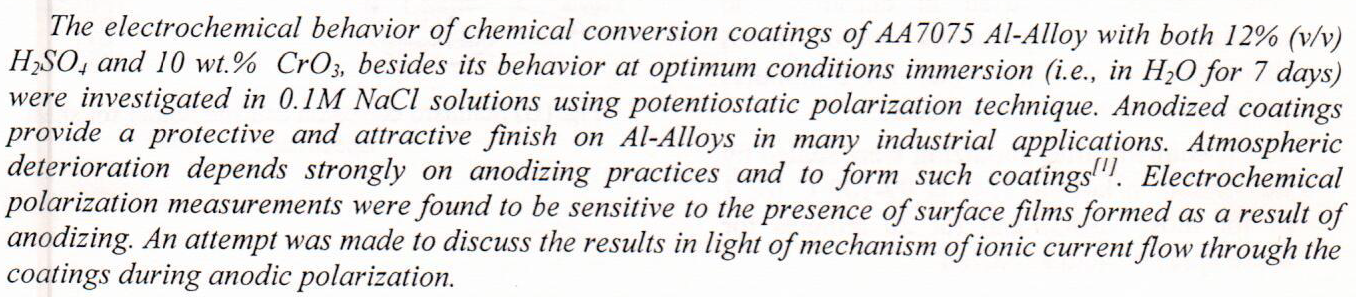
Electrochemical behavior of Anodized AA7075 Aluminum Alloy in 0.1M NaCl Solution as Investigated by Potentiostatic Polarization Ttechnique

Creep testing is an important part of the characterization of composite materials. It is crucial to determine long-term deflection levels and time-to-failure for these advanced materials. The work is carried out to investigate creep behavior on isotropic composite columns. Isotropy property was obtained by making a new type of composite made from a paste of particles of carbon fibers mixed with epoxy resin and E-glass particles mixed with epoxy resin. This type of manufacturing process can be called the compression mold composite or the squeeze mold composite. Experimental work was carried out with changing the fiber concentration (30, 40 and 50% mass fraction), cross section shape, and type of composite. The creep results showed that th
... Show More (1)
(1)

The Messengers and the Imam of the God-fearing, Muhammad is God, his family, and all of his companions. As for what comes after... Fainting is one of the involuntary symptoms and states that occur to a person when carrying out his life’s tasks suddenly due to his loss of sense and movement, so he loses consciousness for a period of time that is short or may be long, and the person is held accountable and responsible for every moment of his life. He is required to perform duties specified by Sharia law, such as prayer, fasting, and Hajj...and fainting prevents him from performing these actions. We must consider the opinions of jurists and know the legal implications resulting from it. It was said that a person has a capacity that enable
... Show MoreThe evaluation of residual stresses (RS) induced by the friction stir welding (FSW) process is crucial in anticipating the performance of the welded structure. The existence of such residual stresses within a friction stir welded structure may lead to excessive distortion and weakness to afford the applied external loads. To assess quantitatively the effect of these residual stresses generated by FSW process, the current paper implements a Coupled Eulerian–Lagrangian (CEL) finite element simulation to analyze both thermal and subsequent resulted remaining stress environments in dissimilar friction stir welding of AA6061-T6 and AA2024-T3 alloys. The thermal analysis step was conducted first and followed by a mechanical analysis step in whi
... Show More (67)
(45)
(67)
(45)

For aspirin estimated, a molecularly imprinted polymer MIP-ASP electrodes were generated by electro-polymerization process, the electrodes were prepared by combining the template (aspirin) with (vinyl acetate (VA), 1-vinylimidizole (VIZ) as a functional monomer and N, N-methylene bisacrylamide (MBAA) as crosslinkers using benzoyl peroxide (BPO) as an initiator. The efficiency of the membrane electrodes was analyzed by differential pulse voltammetry (DPV). Four electrodes were synthesized using two different plasticizers, di-butyl sebacate (DBS), di-octyl phthalate (DOP) in PVC matrix. Scanning electron microscopy (SEM) was used to describe the generated MIP, studying the electrodes properties, the slope, detection limit, and life
... Show MoreIn this paper, the ability of using corn leaves as low-cost natural biowaste adsorbent material for the removal of Indigo Carmen (IC) dye was studied. Batch mode system was used to study several parameters such as, contact time (4 days), concentration of dye (10-50) ppm, adsorbent dosage (0.05-0.25) gram, pH (2-12) and temperature (30-60) oC. The corn leaf was characterized by Fourier-transform infrared spectroscopy device before and after the adsorption process of the IC dye and scanning electron microscope device was used to find the morphology of the adsorbent material. The experimental data was imputing with several isotherms where it fits with Freundlich (R2 = 0.9937) and followed pseudo second order kinetic. The hi
... Show More
(8)
(6)
This paper presents the ability to use cheap adsorbent (corn leaf) for the removal of Malachite Green (MG) dye from its aqueous solution. A batch mode was used to study several factors, dye concentration (50-150) ppm, adsorbent dosage (0.5-2.5) g/L, contact time (1-4) day, pH (2-10), and temperature (30-60) The results indicated that the removal efficiency increases with the increase of adsorbent dosage and contact time, while inversely proportional to the increase in pH and temperature. An SEM device characterized the adsorbent corn leaves. The adsorption's resulting data were in agreement with Freundlich isotherm according to the regression analysis, and the kinetics data followed pseudo-first-or
... Show More
(5)
In this paper, the ability of using corn leaves as low-cost natural biowaste adsorbent material for the removal of Indigo Carmen (IC) dye was studied. Batch mode system was used to study several parameters such as, contact time (4 days), concentration of dye (10-50) ppm, adsorbent dosage (0.05-0.25) gram, pH (2-12) and temperature (30-60) oC. The corn leaf was characterized by Fourier-transform infrared spectroscopy device before and after the adsorption process of the IC dye and scanning electron microscope device was used to find the morphology of the adsorbent material. The experimental data was imputing with several isotherms where it fits with Freundlich (R2 = 0.9
... Show More
(8)
(6)
This paper presents the ability to use cheap adsorbent (corn leaf) for the removal of Malachite Green (MG) dye from its aqueous solution. A batch mode was used to study several factors, dye concentration (50-150) ppm, adsorbent dosage (0.5-2.5) g/L, contact time (1-4) day, pH (2-10), and temperature (30-60) The results indicated that the removal efficiency increases with the increase of adsorbent dosage and contact time, while inversely proportional to the increase in pH and temperature. An SEM device characterized the adsorbent corn leaves. The adsorption's resulting data were in agreement with Freundlich isotherm according to the regression analysis, and the kinetics data followed pseudo-first-order kinetic with a correlation
... Show More
(5)
In this work, lead oxide nanoparticles were prepared by laser ablation of lead target immersed in deionized water by using pulsed Nd:YAG laser with laser energy 400 mJ/pulse and different laser pulses. The chemical bonding of lead oxide nps was investigated by Fourier Transform Infrared (FTIR); surface morphology and optical properties were investigated by Scanning Electron Microscope (SEM) and UV-Visible spectroscopy respectively, and the size effect of lead oxide nanoparticles was studied on its antibacterial action against two types of bacteria Gram-negitive (Escherichia coli) and Gram-positive (Staphylococcusaurus) by diffusion method. The antibacterial property results show that the antibacterial activity of the Lead oxide NPs was
... Show More
(21)
(13)