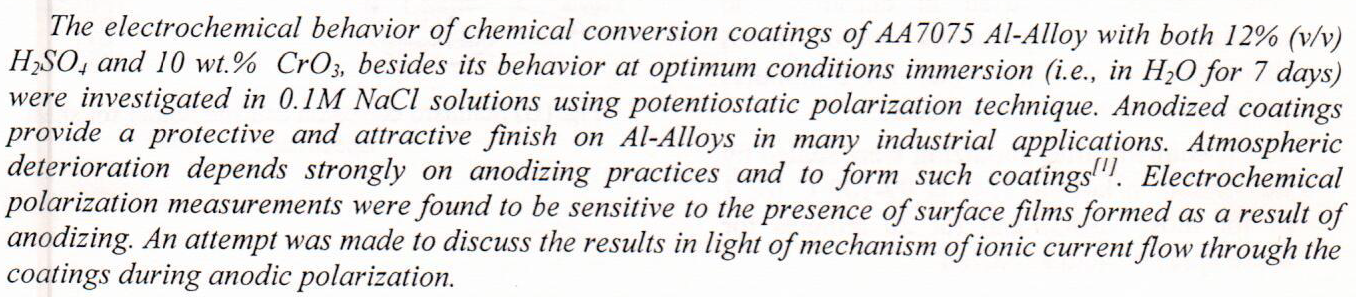
Electrochemical behavior of Anodized AA7075 Aluminum Alloy in 0.1M NaCl Solution as Investigated by Potentiostatic Polarization Ttechnique

The research aims to answer the questions that revolve in the mind of mankind about how to create creation, how it existed prior to creation, who created existence, and the characteristics of that presence. The researcher also wanted to show that the culture of Imam Ali (peace be upon him) In the book of Adam, peace be upon him, God has punished Adam (peace be upon him) for not having sinned. Because his wife is the one who fed him the fruit of the tree, and this is contrary to what was stated in the sermon of Imam (peace be upon him) who Z Adam (peace be upon him) is the one who trusted Satan and Gwighth.
We note that the approach of the rhetoric has pointed to the creation of angels and did not refer to
... Show MoreThe research aims to answer the questions that revolve in the mind of mankind about how to create creation, how it existed prior to creation, who created existence, and the characteristics of that presence. The researcher also wanted to show that the culture of Imam Ali (peace be upon him) In the book of Adam, peace be upon him, God has punished Adam (peace be upon him) for not having sinned. Because his wife is the one who fed him the fruit of the tree, and this is contrary to what was stated in the sermon of Imam (peace be upon him) who Z Adam (peace be upon him) is the one who trusted Satan and Gwighth.We note that the approach of the rhetoric has pointed to the creation of angels and did not refer to the creation of Eve and the class
... Show MoreThe cement slurry is a mixture of cement, water and additives which is established at the surface for injecting inside hole. The compressive strength is considered the most important properties of slurry for testing the slurry reliability and is the ability of slurry to resist deformation and formation fluids. Compressive strength is governed by the sort of raw materials that include additives, cement structure, and exposure circumstances. In this work, we use micro silica like pozzolanic materials. Silica fume is very fine noncrystalline substantial. Silica fume can be utilized like material for supplemental cementations for increasing the compressive strength and durability of cement. Silica fume has very fine particles size less
... Show More
Intrinsic viscosities have been studied for polyethylene oxide in water which has wide industrial applications. The polyethylene oxide samples had two different structures, the first one was linear and covers a wide range of molecular weight of 1, 3, 10, 20, 35, 99, 370, 1100, 4600, and 8000 kg/mol and the second one was branched and had molecular weights of 0.55 and 40 kg/mol.
Intrinsic viscosities and Huggins constants have been determined for all types and molecular weights mentioned above at 25ºC using a capillary viscometer. The values of Mark-Houwink parameters (K and a) were equal to 0.0068 ml/g and 0.67 respectively, and have not been published for this range of molecular weight in as yet.
Abstract: When it comes to applications in welding, cutting, and surface engineering, the utilization of high-power fiber-delivered beams from solid-state lasers offers several benefits. This paper addresses the issue of cleaning the surface of the samples with different spot sizes (50, 100 and 200) (industrial ytterbium fiber laser) to prepared it to be welded. Angular laser cleaning with incident angles (5, 10, 15, 20, 25, 30) ° with different powers (3, 5, 7, 10) W and hatch distance 0.001 was use for implemented.
 (10)
(10)
 (8)
(8)

In this study many specimen s were prepared from 2024-T3 Aluminum alloy for corrosion test by the dimensions of (15*15*3) mm according to ASTM G71-31 and then subjected to shot peening process at different time (15, 30, 45) minutes using steel ball having a diameter of 2.75 mm and Rockwell Hardness of 55RC to induce compressive residual stress which were measured using X-Ray diffraction method, surface roughness and hardness were tested before and after peening. Electrochemical corrosion test by Tafel extrapolation method was carried out in an environment of 3 .5% NaCl solutions (sea water) where Corrosion rate calculated using Tafle equation.
The obtained results show a favorable influence of SP treatment
... Show MoreCommercial graphite (CGT) powder was used as an adsorbent surface for cationic dye, Janus green (JG), from aqueous solutions. This study aims to highlight the practical significance of using inexpensive CGT as an efficient adsorbent for the removal of JG dye from industrial wastewater. CGT was characterized by Fourier transform infrared spectroscopy, scanning electron microscopy, and X-ray diffraction. The adsorption process was investigated by examining parameters like the weight of the adsorbent, contact time, and temperature. Pseudo-second-order kinetic (PSO), pseudo-first-order, and intraparticle diffusion were used for analyzing the kinetic data. JG dye's adsorption kinetics fit the PSO kinetic model well (R2= 0.999). Furthermo
... Show More