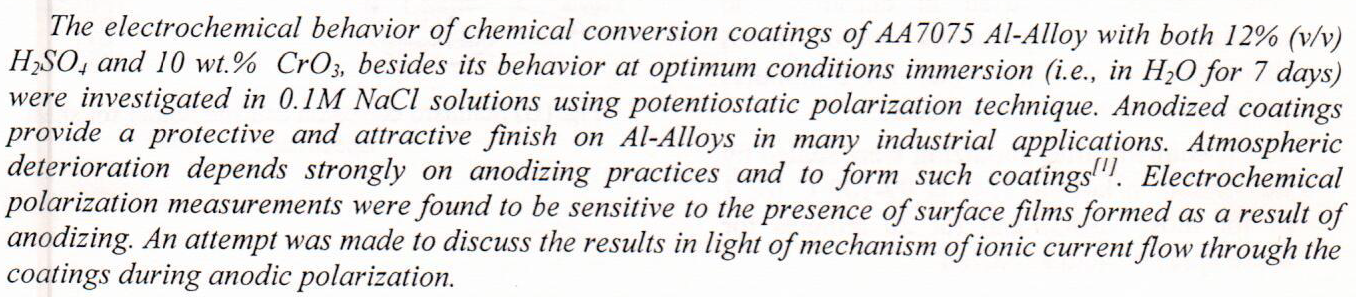
Electrochemical behavior of Anodized AA7075 Aluminum Alloy in 0.1M NaCl Solution as Investigated by Potentiostatic Polarization Ttechnique

This paper presents the Taguchi approach for optimization of hardness for shape memory alloy (Cu-Al-Ni) . The influence of powder metallurgy parameters on hardness has been investigated. Taguchi technique and ANOVA were used for analysis. Nine experimental runs based on Taguchi’s L9 orthogonal array were performed (OA),for two parameters was study (Pressure and sintering temperature) for three different levels (300 ,500 and 700) MPa ,(700 ,800 and 900)oC respectively . Main effect, signal-to-noise (S/N) ratio was study, and analysis of variance (ANOVA) using to investigate the micro-hardness characteristics of the shape memory alloy .after application the result of study shown the hei
... Show More (8)
(8)

In this paper, split-plate airlift electrochemical reactor as an apparatus with new configuration for wastewater treatment was provided. Two aluminum plates were fixed inside the reactor and present two functions; first it works as split plates for internal loop generation of the airlift system (the zone between the two plates acts as riser while the other two zones act as downcomer) and second it works as two electrodes for electrocoagulation process. Simulated wastewater contaminated with zinc ions was used to test the performance of this apparatus for zinc removal by studying the effect of different experimental variables such as initial concentration of zinc (50-800 ppm), electrical current density (2.67-21.4 mA/cm2), init
... Show MoreElectrochemical oxidation in the presence of sodium chloride used for removal of phenol and any other organic by products formed during the electrolysis by using MnO2/graphite electrode. The performance of the electrode was evaluated in terms fraction of phenol and the formed organic by products removed during the electrolysis process. The results showed that the electrochemical oxidation process was very effective in the removal of phenol and the other organics, where the removal percentage of phenol was 97.33%, and the final value of TOC was 6.985 ppm after 4 hours and by using a speed of rotation of the MnO2 electrode equal to 200 rpm.
 (6)
(3)
(6)
(3)


The present investigation aims to study the effect of heat treatment by quenching in different quenching media (salt water, water and oil) following by tempering on wear resistance of EN25 steel. EN25 steel is an alloy of medium carbon low alloy steel which is used for many applications requiring high tensile strength and wear resistance such as connecting rods, adapters and in power sectors extensively. The specimens are machined to 20 mm in length and 10 mm in diameter. This study is done by two stages: The first stage is done by austenitizing EN25 steel to 850 for 1 hr by quenching the specimens in three different quenching media and then tempered at 300 in air. While the second stage is performed by wear
... Show MoreHighly plastic soils exhibit unfavorited properties upon saturation, which produce different defects in engineering structures. Attempts were made by researchers to proffer solutions to these defects by experimenting in practical ways. This included various materials that could possibly improve the soil engineering properties and reduce environmental hazards. This paper investigates the strength behavior of highly plastic clay stabilized with brick dust. The brick dust contents were 10%, 20%, and 30% by dry weight of soil. A series of linear shrinkage and unconfined compression tests were carried out to study the effect of brick dust on the quantitative amount of shrinkage experienced by highly plastic clay and the undra
... Show More
(6)
(3)
(3)
Adsorption techniques are widely used to remove organics pollutants from waste water particularly, when using low cost adsorbent available in Iraq. Al-Khriet powder which was found in legs of Typha Domingensis is used as bio sorbent for removing phenolic compounds from aqueous solution. The influence of adsorbent dosage and contact time on removal percentage and adsorb ate amount of phenol and 4- nitro phenol onto Al-Khriet were studied. The highest adsorption capacity was for 4-nitrophenol 91.5% than for phenol 82% with 50 mg/L concentration, 0.5 gm. dosage of adsorbent and pH 6 under a batch condition. The experimental data were tested using different isotherm models. The results show that Freundlich model resulted in the best fit also
... Show MoreKE Sharquie, AA Noaimi, S Adnan, AM Al-Niddawi, WK Aljanabi, American Journal of Dermatology and Venereology, 2020 - Cited by 2
This studies deals with investigated the potential of a Iraqi bentonite clay for the adsorption of bromo phenol red dye from contaminated water. Impulse adsorption experiments were performed. The contact time influence of initial dye concentration, temperature, pH, ionic strength, partical size adsorbent and adsorbent dosage on bromo phenol red adsorption are investigated in a series of batch adsorption experiments. Adsorption equilibrium data were analyzed and described by the Freundlich, Langmuir and temkin isotherms equations. Thermodynamic parameters inclusive the Gibbs free energy (∆G• ), enthalpy (∆H• ), and entropy (∆S• ), were also calculated. These parameters specified that adsorption of bromo phenol red onto bentonite
... Show More