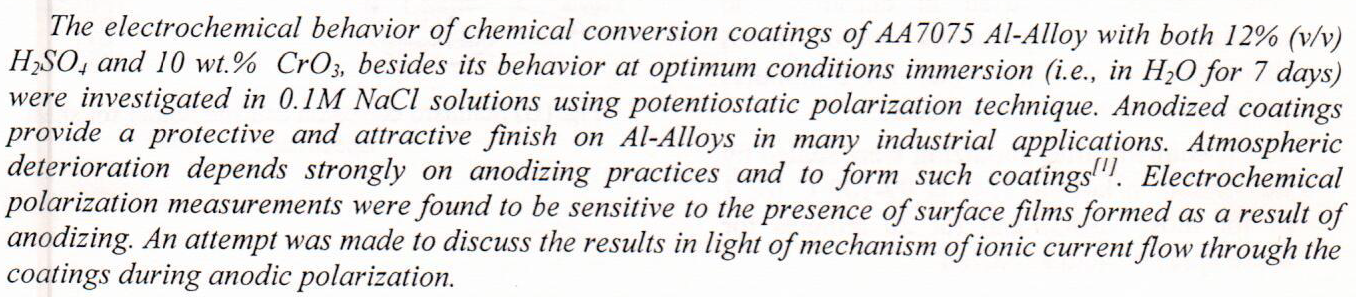
Electrochemical behavior of Anodized AA7075 Aluminum Alloy in 0.1M NaCl Solution as Investigated by Potentiostatic Polarization Ttechnique

 (1)
(1)

Axial spondyloarthritis (axSpA) is a chronic rheumatic inflammatory disease affecting mainly the spine and sacroiliac joints. Since the copper-to-zinc ratio (Cu/Zn) indicates an inflammatory response, the change in ratio is expected to correlate with axSpA. This study compared levels of Cu/Zn in the serum of axSpA patients. Serum samples were obtained from 53 patients with axSpA divided according to biological treatment into cohorts A and B, and 28 healthy control as cohort C. Serum levels of Cu and Zn were determined first by a fully automated chemistry analyzer TC-Matrix Plus, then the ratio was obtained. The elevated serum Cu concentration means of cohort B (189.32 ± 13.808 µg/dL) compared to cohort A (168.85 ± 7.244 µg/dL) a
... Show More
(2)

This study explored the development and qualities of the response of electrochemical properties of enrofloxacin-selective electrodes using precipitation based on producing phosphotungstic, after utilizing a matrix of polyvinyl chloride (PVC) and dibutyl phthalate or dibutyl phosphate as a plasticizer. The resulting membrane sensors were an enrofloxacin-phosphotungstic electrode (sensors 1) and an ENR-DOP-PTA electrode (sensors 2). Linear responses of (ENR-DBPH-PTA) and (ENR-DOP-PTA) within the concentration ranges of 2.1×10⁻⁶-10-1 and 3.0×10⁻⁶-10-2 mol. L-1, respectively, for both sensors were observed. Slopes of 51.61±0.24 and 39.40± 0.16 mV/decade and pH ranges equal to 2.5-8.5
... Show More
Aim: The present study aims to improve the poor water solubility of zaltoprofen which is a non-steroidal anti-inflammatory drug (NSAIDs) with a potent analgesic effect using solid dispersion then formulate it as a hollow type suppository to be more convenient for geriatric patients. Materials and Method: Zaltoprofen solid dispersions were prepared by solvent evaporation technique in different zaltoprofen: Soluplus® ratios. Results: Among the formulations tested, zaltoprofen solid dispersion preparation using 1:5 (zaltoprofen: Soluplus®) ratio showed the highest solubility and selected for further investigation. Solid dispersion characterization was evaluated by differential scanning calorimetry (DSC), X-ray diffraction study (XRD) and Fou
... Show More
(61)
 (56)
(56)

Diabetes is a complex set of diseases require continuous medical care, to control blood sugar and prevent complications is .The aim of this research is to determine the effect of administration of L carentin to diabetics on the lipid profile. The research was conducted on sixty diabetic patients were selected from endocrinology and diabetes center / Al-Rusafa, within selected criteria. The patients divided into 3 groups (control group of healthy people and two groups of patients with diabetes who were on metformin and glibenclamide, one group took a L carnitine in a dose of 1000 mg twice daily and a group dealing with a placebo for a period of 3 months continuously). The study found that patients who took Lc
... Show More
Background: Determination of sex from an unknown human bone is an important role in forensic and anthropology field. The mandible is the largest and hardest facial bone, that commonly resist postmortem damage and forms an important source of information about sexual dimorphism. Mandibular ramus can be used to differentiate between sexes and it also expresses strong univariate sexual dimorphism. This study was undertaken to assess the usefulness of mandibular ramus as an aid in sex differentiation using CT scanning among Iraqi population. Materials and methods: 3D reconstructed computed tomography scanning of 140 Iraqi Arab subjects, (7 0 males and 70 females) were analyzed with their age range from 20-60 years old. The linear measurements w
... Show More
In this work, the dyes Rhodamine B and Coumarin 102 containing titanium dioxide nanoparticles were used as scattering centers to fabricate a random gain medium. The laser dye was dissolved in hexanol and methanol solvent respectively. The titanium dioxide nanoparticles were synthesized by DC reaction magnetron spraying technique. The random-gain medium was made by adding 2.5 mg of titanium dioxide nanoparticles to Rhodamine and coumarin 102 dyes by coating the glass cell with two-sided titanium dioxide with high spectral efficiency and low production cost. A narrow line optical emission was detected at 565 nm for Rhodamine B and 534 nm for coumarin 102, where it was found that rhodamine B dye has FWHM 8 nm and coumarin dye 102 has FWHM 9 nm
... Show More
(11)
(10)