Catalytic Reduction of NOx using Locally Prepared Catalysts with Ammonia
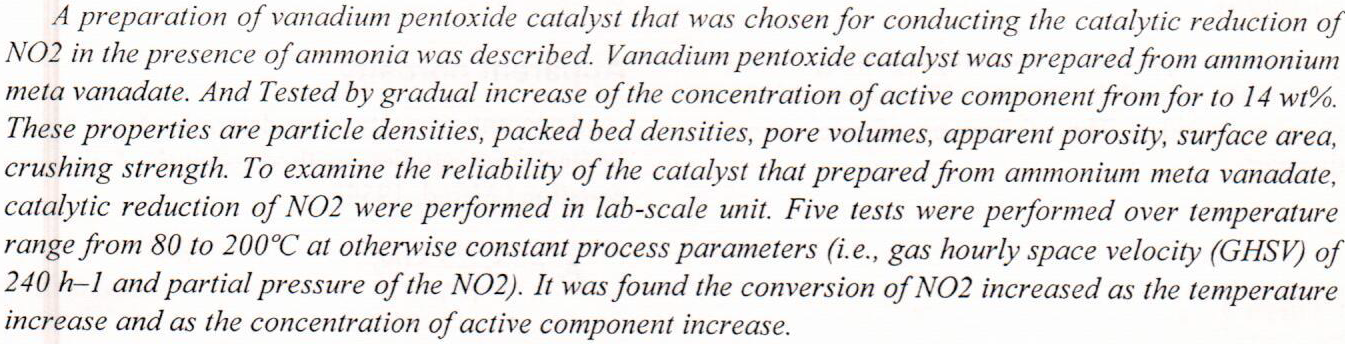

Autorías: Wafaa Sabah Mohammed Al-Khafaji, Fatimah Hameed Kzar Al-Masoodi, Suadad Ibrahim Suhail Al-Kinani. Localización: Revista iberoamericana de psicología del ejercicio y el deporte. Nº. 3, 2023. Artículo de Revista en Dialnet.
Modified unsaturated polyester (MUPE) was blended with Cellulose (Cls) and with ethyl cellulose (ECls) at ambient conditions in the presence of ethyl methyl ketone peroxide (EMKP) as hardener. The blends containing different weight percentages (5-25 %) of Cls or ECls. Mechanical properties (impact strength, hardness, and bending) and dielectric constant were determined. The results observed that Cls increases the impact strength, hardness, and dielectric constant and decreases the bending of the MUPS, while ECls causes an increase in the three mechanical behaviours and a decrease in the dielectric constant of the MU-PS.
Some parameters for advancement of Leishmania tropica infection were examined in three groups of golden hamsters, Group (1) inoculated with autoclaved killed Leishmania tropica , Group (2) inoculated with BCG vaccine alone while Group (3) Inoculated with mixed vaccine (autoclaved killed Leishmania with BCG). The follow up of experimentally infected animals with virulent isolation of Leishmania tropica was done for 90 days, the animals inoculated with mixed vaccine (autoclaved killed Leishmania with BCG) showed the minimum average in each of foot pad thickness (2.3 ± 0.05) mm after (60) days of infection, spleen enlargement (1.13±0.38) after (45) days of infection, spleen length (23.9±0.08) mm after (30) days of infection, liver weight(3.
... Show More
Background: Coronavirus disease 2019 (COVID-19) is an emerging zoonotic disease caused by the new respiratory virus SARS-CoV2. It has a tropism in the lung tissues where excess target receptors exist. Periostin plays a role in subepithelial fibrosis associated with bronchial asthma. Since the Coronavirus's target is the human respiratory system, Periostin has been recently described as a valuable new biomarker in the diagnosis and evaluation of disease in patients with COVID-19 lung involvement. Objectives: To assess the level of Periostin in the serum of COVID-19 patients and to correlate its role in disease severity and prognosis. Subjects and Methods: Periostin serum levels were measured for 63 patients attending three main COVID
... Show More (1)
(1)

Chronic Hepatitis B(CHB) is a serious sequel after Hepatitis B Virus infection, although the rate of chronicity is inverse with age but it may be associated with a significant proportion of deaths related to cirrhosis and liver cancer. HBV serology and measurement of hepatocytic enzymes with viral load can predict disease prognosis and response to treatment. HBeAg refers to a high viral replication and associated with more infectivity to others. This study aimed to determine the impact of HBeAg status in chronically infected patients on various baseline tests. A total of 90 patients with CHB infection who were included in this study. Several standardized measures used for liver function tests, viral load and hepatitis B serological
... Show More
(4)
 (1)
(1)
The aim of this paper is to determine the feasibility of using fluorometric methods as an indicator for quality and contamination of milk with E.coli bacteria, and selection the suitable wavelength to be used with laser induced auto fluorescence. Three groups of milk samples were used in this study: Fresh pasteurized milk samples, milk samples containing different concentration of E.coli bacteria which were added artificially, and milk samples that were kept in refrigerator for 3-5 days. Thirteen excitation wavelengths were used to get the emission spectra for all milk samples using spectroflourometer .The results showed that the emission spectra at 275nm excitation wavelength gave a good differentiation between these three groups.
... Show More
The frequent and widespread use of medicines and personal care products, particularly in the residential environment, tends to raise concerns about environmental and human health impacts. On the other hand, carbon dioxide accumulation in the atmosphere is a problem with numerous environmental consequences. Microalgae are being used to bioremediate toxins and capture CO2. The current study aimed to confirm the possibility of removing pharmaceutical contaminant (Ranitidine) at different concentrations by using the Chlorella Sorokiniana MH923013 microalgae strain during the growth time. As part of the experiment, carbon dioxide was added to the culture medium three times per week. Explanatory results revealed that gas doses directly affect
... Show More
(1)
The aim of this work is to study reverse osmosis characteristics for copper sulfate hexahydrate (CuSO4.6H2O), nickel sulfate hexahydrate (NiSO4.6H2O) and zinc sulfate hexahydrate (ZnSO4.6H2O) removal from aqueous solution which discharge from some Iraqi factories such as Alnasser Company for mechanical industries. The mode of operation of reverse osmosis was permeate is removed and the concentrate of metals solution is recycled back to the feed vessel. Spiral-wound membrane is thin film composite membrane (TFC) was used to conduct this study on reverse osmosis. The variables studied are metals concentrations (50 – 150 ppm) and time (15 – 90 min). It was found that increasing the time results in an increase in concentration of metal in p
... Show MoreNanotechnology has shown a lot of promise in the oil and gas sectors, including nanoparticle-based drilling fluids. This paper aims to explore and assess the influence of various nanoparticles on the performance of drilling fluids to make the drilling operation smooth, cost effective and efficient. In order to achieve this aim, we exam the effect of Multi Wall Carbon Nanotube and Silicon Oxide Nanoparticles as Nanomaterial to prepare drilling fluids samples.
Anew method for mixing of drilling fluids samples using Ultra sonic path principle will be explained. Our result was drilling fluids with nano materials have high degree of stability.
The results of using Multiwall Carbon Nanotube and Silicon Oxide show t
... Show More