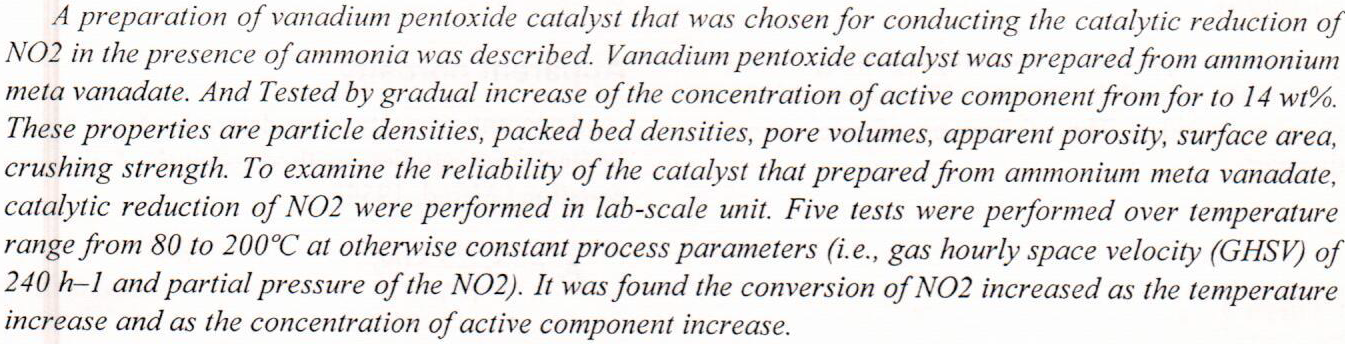
Catalytic Reduction of NOx using Locally Prepared Catalysts with Ammonia

In this paper Hermite interpolation method is used for solving linear and non-linear second order singular multi point boundary value problems with nonlocal condition. The approximate solution is found in the form of a rapidly convergent polynomial. We discuss behavior of the solution in the neighborhood of the singularity point which appears to perform satisfactorily for singular problems. The examples to demonstrate the applicability and efficiency of the method have been given.
This current study aims to:
1st: The recognizing of Alexithymia level for 6th grade students (Study Specimen) through the next Zero Hypothesis:1. There are no statistically significant differences at (0.05) level between the arithmetic mean of the specimen degrees as a whole and the central assumption for the scale of the lack in emotions expression
2. There are no statistically significant differences at (0.05) level between the arithmetic mean of the male students specimen and the arithmetic meanc of the female students specimen for the scale of Alexithymia.
2nd: ldentification the level of the emotional intelligence among 6th grade students (Study Specimen) through the next Zero Hypothesis:
1) There are no statistically si
Background: The finite element method (FEM) is expected to be one of the most effective computational tools for measuring the stress on implant-supported restorations. This study was designed using the 3D-FEM to evaluate the effect of two adhesive luting types of cement on the occlusal stress and deformation of a hybrid crown cemented to a mono-implant. Materials and Method: The mono-screw STL file was imported into the CAD/CAM system library from a database supported by De-Tech Implant Technology. This was to assist in the accurate reproduction of details and design of a simulated implant abutment. Virtually, a digital crown was designed to be cemented on an abutment screw. A minimum occlusal thickness of 1mm and marginal fitting of 1.2
... Show More (2)
(2)
 (2)
(2)


This study aimed to prepare a program (physical-nutritional) for women with polycystic ovary, as well as to identify the effect of this program on some body measurements and the incidence of polycystic ovarian syndrome in the research sample. A total of 12 women (aged 20-25 years) with Polycystic Ovary Syndrome (PCOS) participated in the randomized controlled trial design. They were divided equally into two groups (experimental and control group). The experimental group received the physical-nutritional program accompanying the treatment program, while the control group received only the instructions of the specialist doctor and the treatment program prepared by them. The two researchers applied their nutritional progr
... Show More
(4)
(1)
Quantum dots of CdSe, CdS and ZnS QDs were prepared by chemical reaction and used to fabricate organic quantum dot hybrid junction device. QD-LEDs were fabricated using ITO/TPD: PMMA/CdSe/Al, ITO/TPD: PMMA/CdS/Al and ITO/TPD: PMMA/ZnS/Al QDs devices which synthesized by phase segregation method. The hybrid white light emitting devices consists, of two-layers deposited successively on the ITO glass substrate; the first layer was of N, N’-bis (3-methylphenyl)-N, N’-bis (phenyl) benzidine (TPD) polymer mixed with polymethyl methacrylate (PMMA) polymers in ratio 1:1, while the second layer was 0.5wt% from each type of the (CdSe, CdS and ZnS) QDs for each device.The optical properties of QDs were characterized by UV-Vis. and photolum
... Show More
(4)
(4)

Background: The aim of this national oral health survey was to determine the prevalence of malocclusions due to some anomalies in the dentition among the 13 years old Kurdish students in sulaimani intermediate school. Materials and methods: The total sample was 950 (455 males and 495 females) which assessed by diagnostic set and special instrument. The clinical examination was mainly based on the definitions of Björk et al. Some variables were recorded as present or absent sometimes denoting the tooth or the teeth involved in malocclusion and their distribution according to the whole sample. Results: The results showed that 1)The most common extracted tooth was the mandibular first molar (2.9%). 2) At this age group the most common partial
... Show MoreThe aim of this study is to detect the level of psychological stress among unemployed individuals and the level of their wellbeing by finding the correlation between these two variables.
The research sample consisted of (99) people who are currently unemployed and registered at the Ministry of Labor Affairs.
Schafer (1996) scale for psychological stress was used and alongside Ziout's (2012) scale for wellbeing.
The results of the research showed an inverse relation between being unemployed and having wellbeing.
&nb
... Show MoreFifty patients(24 female and 26 male)with pressure ulcersassociated with different diseasesand attending AL-yarmouk Teaching Hospital in Baghdad were selected in this study. The duration of sample collection was from March to December 2018. All blood samples collected from patients were submitted to a blood culturing technique to examine bacteremia. The results showed that12 blood bacterial isolates were obtained. The isolated bacteria were subjected to Vitek-2, which is an accurate identification technique. The results of the blood culturing technique revealed that 33.3% were Gram negative bacteria, while 66.6% were Gram positive. Diagnosis by Vitek-2 showed that 33.3% wereStaphylococcus spp. , 33.3% were Enterococcus
... Show More
(1)