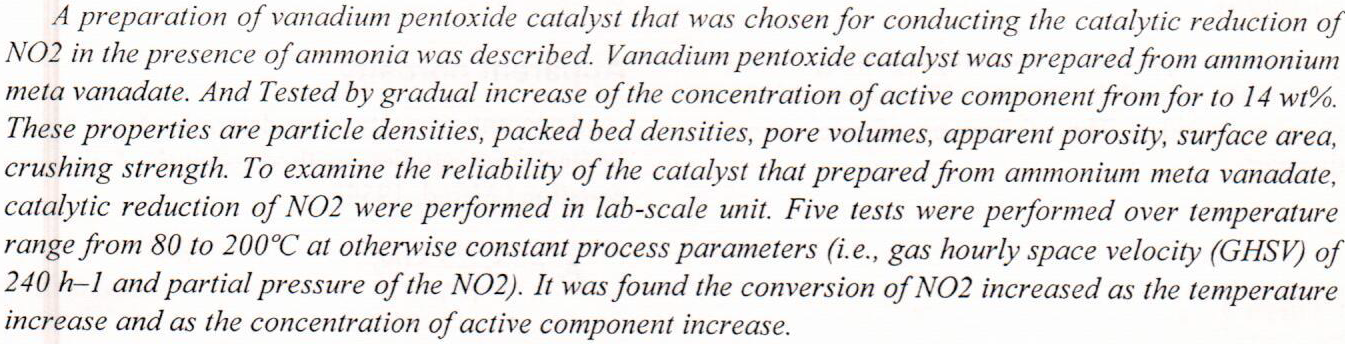
Catalytic Reduction of NOx using Locally Prepared Catalysts with Ammonia

Biosorption is an effective method to remove toxic metals from wastewaters. In this study biosorption of lead and chromium ions from solution was studied using Citrobacter freundii and Citrobacter kosari isolated from industrial wastewater. The experimental results showed that optimum grwoth temperature for both bacteria is 30oC and the optimum pH is 7 &6 for C. freundii and C. kosari respectively. While the optimum incubation period to remove Pb and Cr for C. freundii and C. kosari is 4 days and 3days respectively. Also the biosorption of Pb and Cr in mixed culture of bacteria and mixed culture of Pb and Cr was investigated. Result indicate that uptake of Cr and Pb for C.freundii, C. kosari and in mixes culture of both bacteria is 58%, 53%
... Show MorePhenotypic And genotypic characteristics of Salmonella enterica serotype Typhi have been determined for 29 isolates, from Baghdad in 2007. Conventional typing methods were performed by biochemical tests, and antimicrobial susceptibility test. Molecular typing performed by analysis plasmid DNA beside using the Random Amplified Polymorphic DNA (RAPD-PCR). For the latter, two universal primers that have selected for the high discriminatory power were used for RAPD analysis. All isolates were belong one biotype according to the differention by their ability to decarboxylat lysine, 29(100%) were lysine (+). All the isolates were susceptible to the Antibiotics used. However, all the strains free of plasmids. RAPD was capable of grouping the strai
... Show More
In the recent years the research on the activated carbon preparation from agro-waste and byproducts have been increased due to their potency for agro-waste elimination. This paper presents a literature review on the synthesis of activated carbon from agro-waste using microwave irradiation method for heating. The applicable approach is highlighted, as well as the effects of activation conditions including carbonization temperature, retention period, and impregnation ratio. The review reveals that the agricultural wastes heated using a chemical process and microwave energy can produce activated carbon with a surface area that is significantly higher than that using the conventional heating method.
 (6)
(6)
 (5)
(5)

The paper presents a highly accurate power flow solution, reducing the possibility of ending at local minima, by using Real-Coded Genetic Algorithm (RCGA) with system reduction and restoration. The proposed method (RCGA) is modified to reduce the total computing time by reducing the system in size to that of the generator buses, which, for any realistic system, will be smaller in number, and the load buses are eliminated. Then solving the power flow problem for the generator buses only by real-coded GA to calculate the voltage phase angles, whereas the voltage magnitudes are specified resulted in reduced computation time for the solution. Then the system is restored by calculating the voltages of the load buses in terms
... Show MoreThe effect of different Ti additions on the microstructure of Al-Ti alloy prepared by powder metallurgy was investigated. A certain amount of Ti (10wt%, 15wt%, and 20wt%) were added to aluminium and the tests like microhardness, density, scanning electron microscope (SEM), optical microscope (OM) and X-Ray Diffraction (XRD) were conducted to determine the influence of different Ti additives on the Al-Ti alloy properties and microstructure. The results show that the grains of α-Al changed from large grains to roughly spherical and then to small rounded grains with increasing Ti content, the micro-hardness of the alloy increases with increasing Ti, and XRD results confirm the formation of TiAl3 intermetallic co
... Show More
(3)
Iron oxide (Fe3O4) nanoparticles were synthesized via an eco-friendly green approach by adding Phoenix dactylifera extract to the aqueous solution of ferric chloride. The effect of annealing temperature (Ta) (100-150) °C on particle size was studied. X-ray diffraction (XRD), UV-visible spectroscopy, atomic force microscopy (AFM), and field emission scanning electron microscopy (FESEM) were used to evaluate the produced nanoparticles. According to XRD spectra, the crystallite size of the samples was determined using the Scherrer formula. AFM and FE-SEM were used to determine surface morphology. A UV-Vis optical spectroscopic examination was carried out to determine the band gap energy of the iron oxide nanoparticles. It was found th
... Show More
(3)
(4)
The goal of this article is to construct fibrewise w-compact (resp. locally w-compact) spaces. Some related results and properties of these concepts will be investigated. Furthermore, we investigate various relationships between these concepts and three classes of fibrewise w-separation axioms.
(13)
(9)

The current study was to examine the reliability and effectiveness of using most abundant, inexpensive waste in the form of scrap raw zero valent aluminum ZVAI and zero valent iron ZVI for the capture, retard, and removal of one of the most serious and hazardous heavy metals cadmium dissolved in water. Batch tests were conducted to examine contact time (0-250) min, sorbent dose (0.25-1 g ZVAI/100 mL and 2-8 g ZVI/100 mL), initial pH (3-6), pollutant concentration of 50mg/L initially, and speed of agitation (0-250) rpm . Maximum contaminant removal efficiency corresponding to (90 %) for cadmium at 250 min contact time, 1g ZVAI/ 6g ZVI sorbent mass ratio, pH 5.5, pollutant concentration of 50 mg/L initially, and 250 rpm agitation speed wer
... Show More
(12)