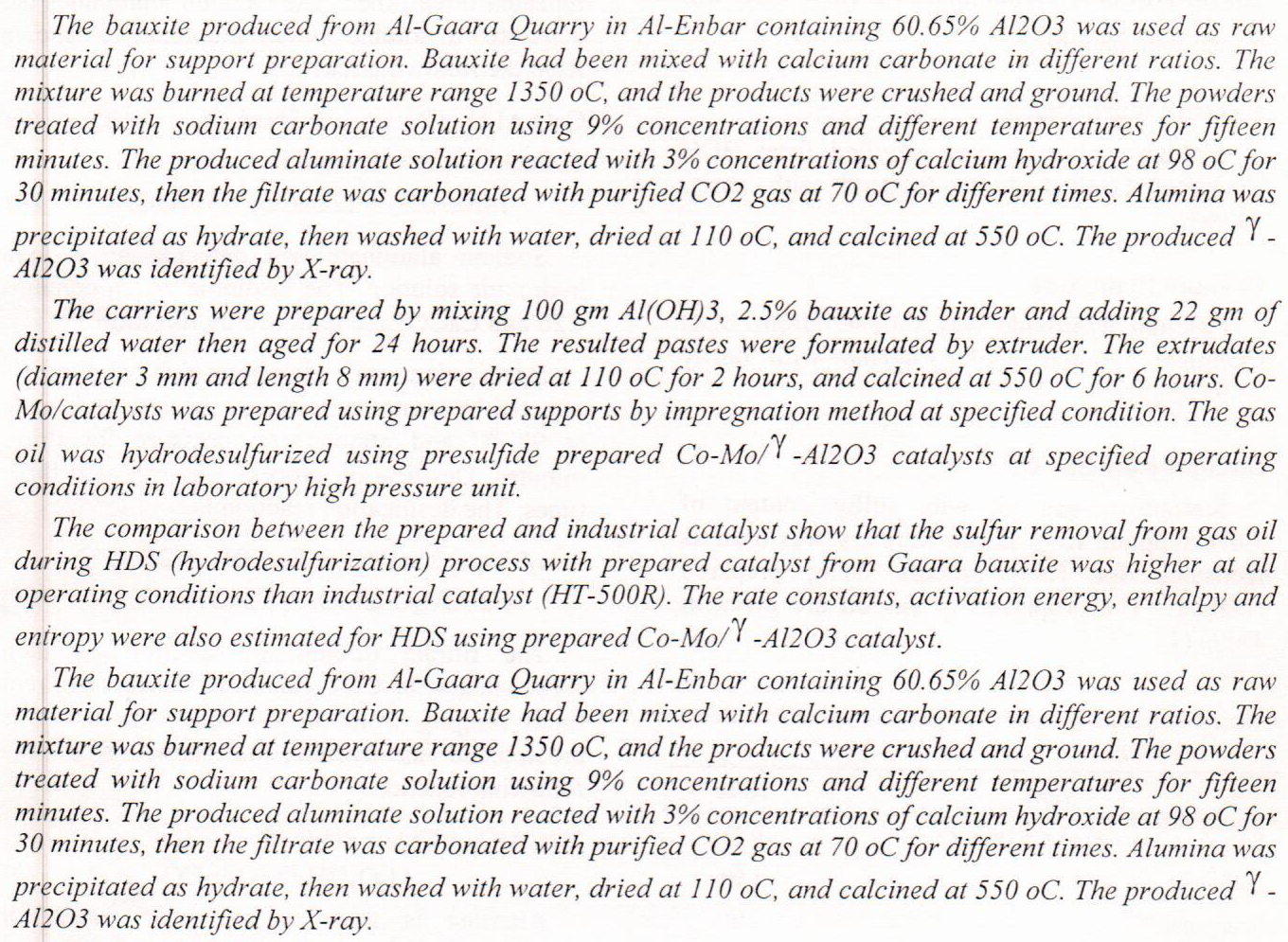
Active Alumina Extraction from Iraqi Bauxite for Catalyst's Support


Background: CYP1A1 gene polymorphisms and tobacco smoking are among several risk factors for various types of cancers, but their influence on breast cancer remains controversial. We analyzed the possible association of CYP1A1 gene polymorphisms and tobacco smoking-related breast cancer in women from Iraq. Materials and methods: In this case-control study, gene polymorphism of CYP1A1 gene (CYP1A1m1, T6235C and CYP1A1m2, A4889G) of 199 histologically verified breast cancer patients' and 160 cancer-free control women's specimens were performed by using PCR-based restriction fragment length polymorphism. Results: Three genotype frequencies (TT, TC, and CC) of CYP1A1m1T/C appeared in 16.1, 29.6, and 54.3% of women with breast cancer, respectiv
... Show More (17)
(17)

In this work, thiadiazole derivatives were prepared by taking advantage of active sites in (2-amino-5-mercapto-1, 3, 4-thiadiazole) as a starting material base. The main heterocyclic compounds (1, 3, 4-thiadiazole, oxazole) etc, 2-amino-5-mercapto-1,3,4-thiadiazole compound (1) was prepared by cyclic closure of thiosemicarbazide compound with anhydrous sodium carbonate and carbon disulfide. Oxidation of (1) via hydrogen peroxide, to have (2) which was treated with chloro acetyl chloride to get (3). Preparation of thiazole ring (4) was from reacting of (3) with thiourea. Synthesis of diazonium salts (5) from compound (4) using sodium nitrite and HCl. Compound (5) reacted with different ester compounds to prepare a new azo compounds (6–8).C
... Show More
(4)
 (3)
(3)

In this work, the adsorption of crystal violet dye from aqueous solution on charcoal and rice husk has been investigated, where the impact of variable factors (contact time; the dosage of adsorbent, pH, temperature, and ionic strength) have been studied. It has been found that charcoal and rice husk have an appropriate adsorption limit with regards to the expulsion of crystal violet dye from fluid arrangements. The harmony adsorption is for all intents and purposes accomplished in 45 min for charcoal and 60 min for rice husk. The amount of crystal violet dye adsorbed (0.4 g of charcoal and 0.5 g of rice husk) increased with an increasing pH and the value of 11 is the best
... Show More
(6)
(2)
Pseudomonas aeruginosa readily binds to different kind of abiotic surfaces and form biofilm. The ability of the bacterial species to form biofilm onto polyvinyl chloride (PVC) is associated with several economic, health and environmental problems. The effect of kind of water on ability of this bacterium to form biofilm is scanty in literature. In present study, the ability of different environmental isolates of P. aeruginosa to form biofilm onto polystyrene microtiter plate was evaluated. Furthermore, the effect of waters that collected from different sources on biofilm formation of this bacterium onto PVC was studied. Spectrophotometric method was used to check the ability of bacteria to form biofilm and evaluated the role of waters onto a
... Show MoreIn this research, the kinetic studies of four isoenzymes of Asprtate aminotransferase, which partially purified from the urine of chronic renal failure patients were carried out .The four isoenzymes were obeyed Michaelis-Menton's equation and the optimum concentration of their substrate (Aspartic acid) was (166.5x10⁻³) mole/liter,and their Km values were determined. Four isoenzymesI,II,III,IV have shown an optimum pH at 7.4.The four isoenzymes obeyed Arrhenius equation up to 37º C and their Ea and Q10 constants were determined .
The quantum chromodynamics theory approach was taken to study the photonic emission from interaction of quark gluon at high at Bremsstrahlung processes. Strength coupling, quark charge 𝑒𝑞 , flavor number 𝑛𝐹 , thermal energy T of system, fugacity of gluon ƛ𝑔, fugacity of quark ƛ𝑞 , critical temperature 𝑇𝐶 and photons energy 𝐸 are taken to calculate photons rate via the quantum system. Photons emission rate studies and calculates via high energy 400MeV to 650 MeV using flavor number 3 and 7 for 𝑢̅𝑔 → 𝑑̅𝑔𝛾 and 𝑐𝑔 → 𝑠𝑔𝛾 systems at bremsstrahlung processes with critical temperature (𝑇𝑐 = 190 and 196) MeV with photons energy (1-10) GeV. The confinement and de-confineme
... Show More
(1)
The study aimed to evaluating the inhibitory activity of apigenin extracted from Salvia officinalis leaves on the growth of L20B cancer cell in vitro, and through two incubation periods; 48 and 72 hours. Accordingly, eight concentrations (1.56, 3.13, 6.25, 12.5, 25.0, 50.0, 100.0 and 200.0 micromol) of apigenin and similar concentrations of vitamin C and carbon tetrachloride (CCl4) were tested. The apigenin revealed its significant inhibitory potentials against the growth of L20B cell line, especially at the low concentrations (1.56, 3.13 and 6.25 micromol) and at 72 incubation period in comparison with vitamin C and CCl4.
(5)
(1)