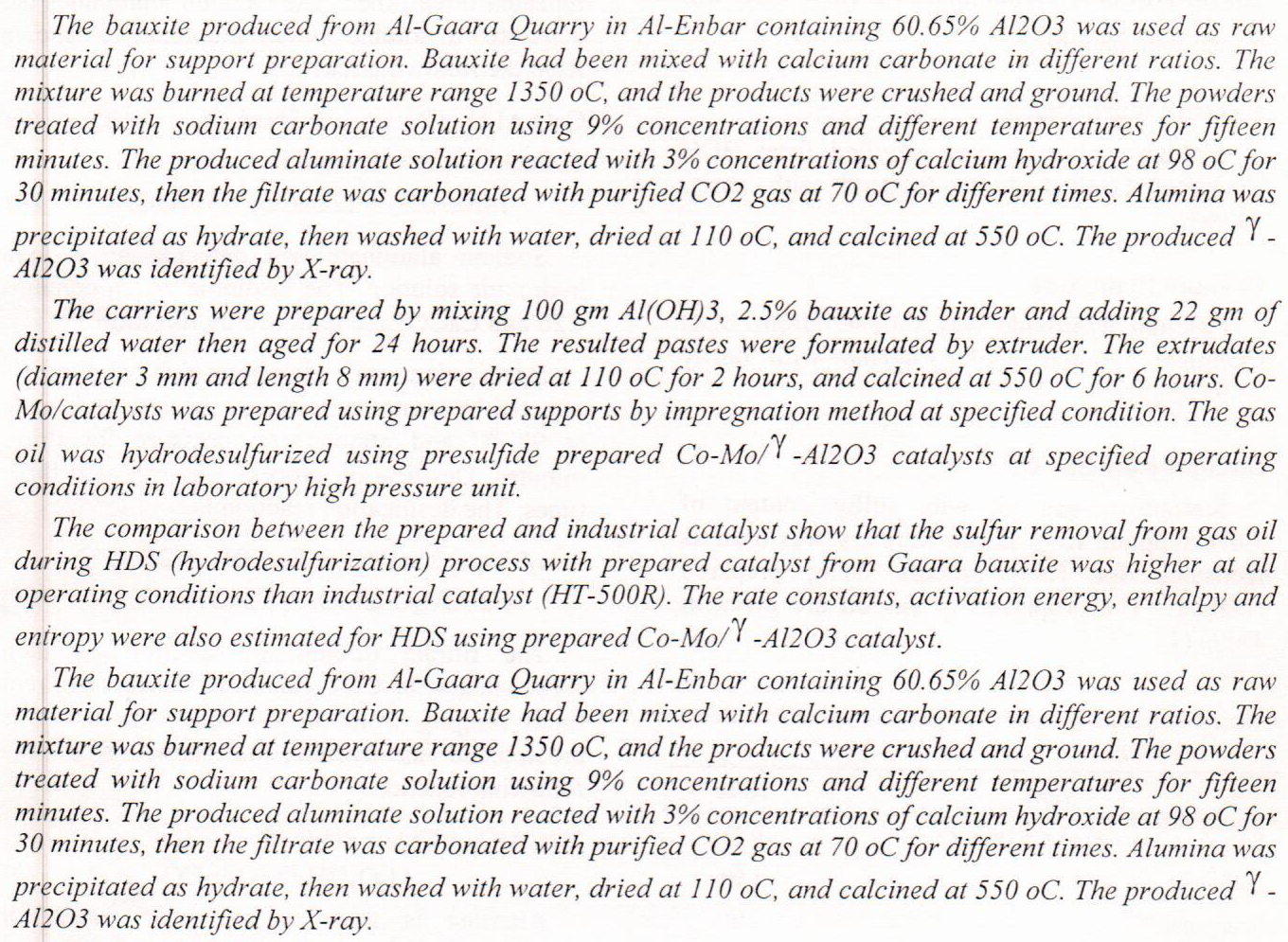
Active Alumina Extraction from Iraqi Bauxite for Catalyst's Support

 (36)
(36)

The performance of a batch undivided electrochemical reactor with a rotating cylinder electrode of woven-wire (60 mesh size), stainless steel 316, is examined for the removal of copper from synthetic solution of o.5 M sodium chloride containing 125 ppm at pH ≈ 3.5. The effect of total applied current, rotation speed on the figures of merit of the reactor is analyzed. For an applied current of 300 mA at 100 rpm, the copper concentration decreased from 125 to mg l-1 after 60 min of electrolysis with a specific energy consumption of 1.75 kWh kg-1 and a normalized space velocity of 1.62 h-1. The change in concentration was higher when the total applied currents were increased because of the turbulence
... Show MoreBiosorption of cadmium ions from simulated wastewater using rice husk was studied with initial concentration of 25 mg/l. Equilibrium isotherm was studied using Langmuir, Freundlich, BET and Timken models. The results show that the Freundlich isotherm is the best fit model to describe this process with high determination coefficient equals to 0.983. There was a good compliance between the experimental and theoretical results. Highest removal efficiency 97% was obtained at 2.5g of adsorbent, pH 6 and contact time 100 min.
The degradation and mineralization of 4-chlorophenol (4-CP) by advanced oxidation processes (AOPs) was investigated in this work, using both of UV/H2O2 and photo-Fenton UV/H2O2/Fe+3 systems.The reaction was influenced by the input concentration of H2O2, the amount of the iron catalyst, the type of iron salt, the pH and the concentration of 4-CP. A colored solution of benzoquinon can be observed through the first 5 minutes of irradiation time for UV/H2O2 system when low concentration (0.01mol/L) of H2O2 was used. The colored solution of benzoquinon could also be observed through the first 5 minutes for the UV/H2O2/Fe+3 system at high
concentration (100ppm) of 4-CP. The results have shown that adding Fe+3 to the UV/H2O2 system enhanced
(1)
Nicotine was separated from eggplant and green pepper seeds (Solanaceous) by High Performance Liquid Chromatography (HPLC).The concentration of nicotine in the eggplant extract (0.871-0.877 μg/ml) was determined by injecting standard material with 0.5 and 1.5 μg/ml, while the concentrations of nicotine in green pepper extract (0.613-0.618 μg/ml) was determined when the standard material was injected with 0.5 and 1.5 μg/ml. The qualitative chemical data was calculated from derivations of the standard material. Nicotine concentration was measured qualitatively in both extracts through the calibration curve and method of the standard addition. This technique has high accuracy and compatibility, bringing the proportion of relati
... Show More (6)
(3)
(6)
(3)

To determine the expression of key epithelial–mesenchymal transition (EMT) markers in gingival tissue samples collected from patients with periodontitis.
Epithelial–mesenchymal transition is a process responsible for shifting epithelial‐phenotype to mesenchymal‐phenotype leading to loss of epithelial‐barrier function. Thus, EMT could be involved as a pathogenic mechanism in periodontitis as both conditions share common promoters and signalling pathways.
Gingival tissue samples were collected fro
(14)
(11)
 (20)
(3)
(20)
(3)
This study aimed to assess the efficiency of Nerium oleander in removing three different metals (Cd, Cu, and Ni) from simulated wastewater using horizontal subsurface flow constructed wetland (HSSF-CW) system. The HSSF-CW pilot scale was operated at two hydraulic retention times (HRTs) of 4 and 7 days, filled with a substrate layer of sand and gravel. The results indicated that the HSSF-CW had high removal efficiency of Cd and Cu. A higher HRT (7 days) resulted in greater removal efficiency reaching up to (99.3% Cd, 99.5% Cu, 86.3% Ni) compared to 4 days. The substrate played a significant role in removal of metals due to adsorption and precipitation. The N. oleander plant also showed a good tolerance to the uptake of Cd, Cu, and Ni ions fr
... Show More
(19)
(14)
(11)
This study aimed to assess the efficiency of Nerium oleander in removing three different metals (Cd, Cu, and Ni) from simulated wastewater using horizontal subsurface flow constructed wetland (HSSF-CW) system. The HSSF-CW pilot scale was operated at two hydraulic retention times (HRTs) of 4 and 7 days, filled with a substrate layer of sand and gravel. The results indicated that the HSSF-CW had high removal efficiency of Cd and Cu. A higher HRT (7 days) resulted in greater removal efficiency reaching up to (99.3% Cd, 99.5% Cu, 86.3% Ni) compared to 4 days. The substrate played a significant role in removal of metals due to adsorption and precipitation. The N. oleander plant also showed a good tolerance to the uptake of Cd, Cu, and Ni ions fr
... Show More
(21)
(19)