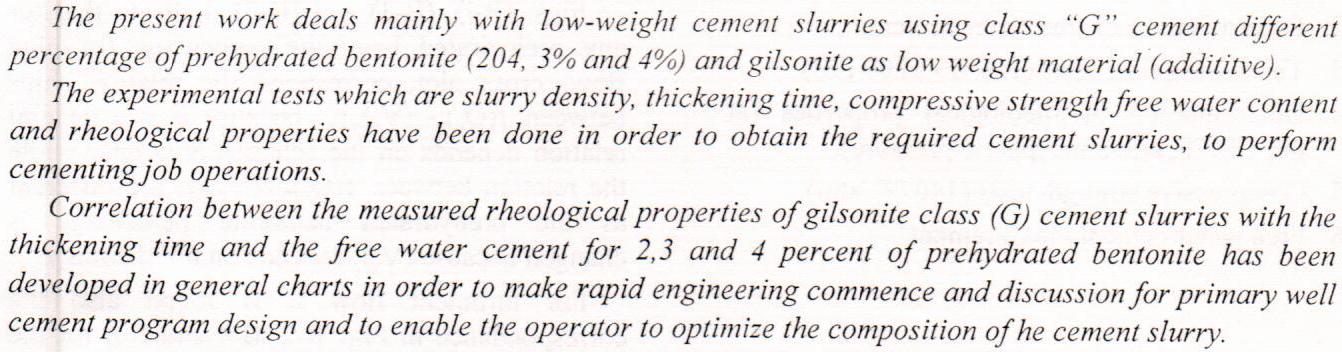
Physical and Rheological Properties of Class "G" Gilsonite Cement Slurries (Experimental Study)

Determining the aerodynamic characteristics of iced airfoil is an important step in aircraft design. The goal of this work is to study experimentally and numerically an iced airfoil to assess the aerodynamic penalties associated with presence of ice on the airfoil surface. Three iced shapes were tested on NACA 0012 straight wing at zero and non-zero angles of attack, at Reynolds No. equal to (3.36*105). The 2-D steady state continuity and momentum equations have been solved utilizing finite volume method to analyze the turbulent flow over a clean and iced airfoil. The results show that the ice shapes affected the aerodynamic characteristics due to the change in airfoil shape. The experimental results show that the horn iced airfoil
... Show More
 (2)
(2)
 (4)
(4)


The present work aims to validate the experimental results of a new test rig built from scratch to evaluate the thermal behavior of the brake system with the numerical results of the transient thermal problem. The work was divided into two parts; in the first part, a three-dimensional finite-element solution of the transient thermal problem using a new developed 3D model of the brake system for the selected vehicle is SAIPA 131, while in the second part, the experimental test rig was built to achieve the necessary tests to find the temperature distribution during the braking process of the brake system. We obtained high agreement between the results of the new test rig with the numerical results based on the developed model of the brake
... Show More
(4)
(2)
Cams are considered as one of the most important mechanical components that depends the contact action to do its job and suffer a lot of with drawbacks to be predicted and overcame in the design process. this work aims to investigate the induced cam contact and the maximum shear stress energy or (von misses) stresses during the course of action analytically using Hertz contact stress equation and the principal stress formulations to find the maximum stress value and its position beneath the contacting surfaces. The experimental investigation adopted two dimensions photoelastic technique to analyze cam stresses under a plane polarized light. The problem has been numerically simulated using Ansys software version 15 as FE
... Show MoreIn this study, generation of elliptical gears with different teeth profiles of crowned involute, double circular arc (DCA), and combined (crowned involute with DCA) has been developed. The resulting mathematical equations have been computerized and feed to CNC end mill machine to manufacture elliptical gear models with different profiles. These models are investigated in plane polariscope to show the resulting stresses under certain load. Comparison of photo-elastic stress results shows that combined elliptical gears with DCA side as a loaded side have a minimum resulting contact stress with a reduction percentage of 40% compare with contact stresses in counterpart elliptical gear of involute profile (which is commonly u
... Show More
In this work a study was made in centrifugal fan blower to investigate the effect of impeller blade design on sound pressure level (SPL). Shroud and unshroud impeller of nine blades are used. The sound generation from flow inside the test rig at different positions was displayed by using spectral analyzer. The experiments were carried out in anechoic chamber with small holes in its walls, under ambient condition about (25-27) C ° to avoid the effect of temperature on the sound pressure level. The results showed that (SPL) decreased with the increase of distance from the source about (3-4)dB when distance varied about (0.8-1.06)m, and the (SPL) decreased with the decrease of velocity about (8-12)dB when velocity varied between (13000-260
... Show More
In this research, an experimental study was conducted to high light the impact of the exterior shape of a cylindrical body on the forced and free convection heat transfer coefficients when the body is hold in the entrance of an air duct. The impact of changing the body location within the air duct and the air speed are also demonstrated. The cylinders were manufactured with circular, triangular and square sections of copper for its high thermal conductivity with appropriate dimensions, while maintaining the surface area of all shapes to be the same. Each cylinder was heated to a certain temperature and put inside the duct at certain locations. The temperature of the cylinder was then monitored. The heat transfer coefficient were then cal
... Show MoreBackground: The finite element method (FEM) is expected to be one of the most effective computational tools for measuring the stress on implant-supported restorations. This study was designed using the 3D-FEM to evaluate the effect of two adhesive luting types of cement on the occlusal stress and deformation of a hybrid crown cemented to a mono-implant. Materials and Method: The mono-screw STL file was imported into the CAD/CAM system library from a database supported by De-Tech Implant Technology. This was to assist in the accurate reproduction of details and design of a simulated implant abutment. Virtually, a digital crown was designed to be cemented on an abutment screw. A minimum occlusal thickness of 1mm and marginal fitting of 1.2
... Show More
(2)
(2)
The utilization of sugarcane molasses (SCM), a byproduct of sugar refining, offers a promising bio-based alternative to conventional chemical admixtures in cementitious systems. This study investigates the effects of SCM at five dosage levels, 0.25%, 0.50%, 0.75%, 1.00%, and 1.25% by weight of cement, on cement mortar performance across fresh, mechanical, thermal, durability, and density criteria. A comprehensive experimental methodology was employed, including flow table testing, compressive strength (7, 14, and 28 days) and flexural strength measurements, embedded thermal sensors for real-time hydration monitoring, water absorption and chloride ion penetration tests, as well as 28-day density determination. Results revealed clear
... Show More
The most important environmental constraints at the present time
is the accumulation of glass waste (transparent glass bottles). A lot of
experiments and research have been made on waste and recycling
glass to get use it as much as possible. This research using recycling
of locally waste colorless glass to turn them into raw materials as
alternative of certain percentages of cement to save the environment
from glass waste and reduce some of the disadvantages of cement
with conserving the mechanical and physical properties of concrete
made. A set of required samples were prepared for mechanical test
with different weight percentage of waste glass (2%, 4%, 5%, 6%,
8%, 10%, 15%, 20% and 25%). American standard