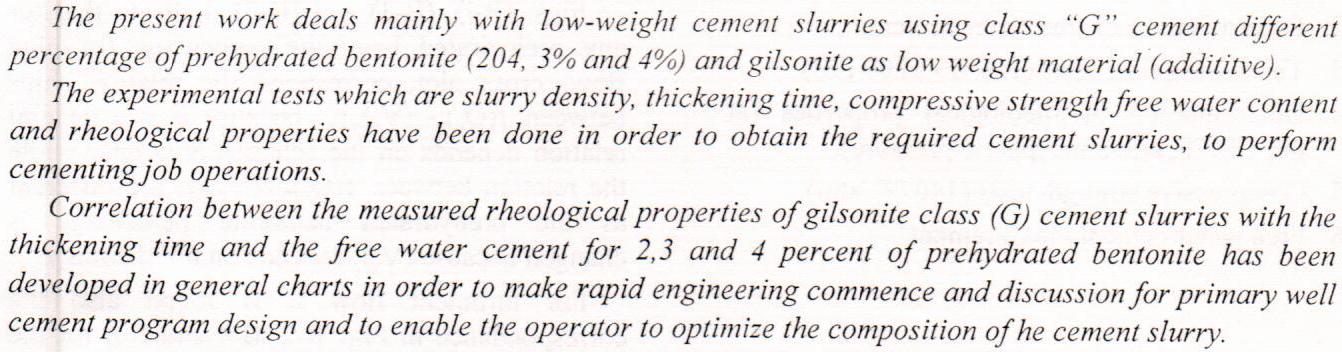
Physical and Rheological Properties of Class "G" Gilsonite Cement Slurries (Experimental Study)

The objective of this study is to determine the efficacy of class V Er:YAG laser (2940 nm) cavity preparation and conventional bur cavity preparation regarding Intrapulpal temperature rise during cavity preparation in extracted human premolar teeth. Twenty non carious premolar teeth extracted for orthodontic purposes were used and class V cavity preparation was applied both buccal and lingual sides for each tooth .Samples were equally grouped into two major groups according to cavity depth (1mm and 2mm). Each major group was further subdivided into two subgroupsof ten teeth for each (twenty cavities for each subgroup). TwinlightEr:YAG laser (2940 nm) with 500mJ pulse energy, P.R.R of 10 Hz and 63.69 J/cm2 energy density was used. The ana
... Show More (9)
(9)
 (4)
(4)


 (1)
(6)
(5)
(1)
(6)
(5)
In this research Bi2S3 thin films have been prepared on glass substrates using chemical spray pyrolysis method at substrate temperature (300oC) and molarity (0.015) mol. Structural and optical properties of the thin films above have been studied; XRD analysis demonstrated that the Bi2S3 films are polycrystalline with (031) orientation and with Orthorhombic structure. The optical properties were studied using the spectral of the absorbance and transmission of films in wavelength ranging (300-1100) nm. The study showed that the films have high transmission within the range of the visible spectrum. Also absorption coefficient, extinction coefficient and the optical energy gap (Eg) was calculated, found that the film have direct ener
... Show More
(45)
(42)
(24)
(17)
In this study, titanium dioxide (TiO2) nanoparticles incorporated with cement were synthesis by a simple casting method as a function concentration of TiO2 (0.2, 0.4, 0.8, 1, and 2 wt%). The prepared samples were characterized using the technique of Field Emission Scanning Electron Microscope (FESEM) and UV-Visible spectrophotometer, which was used to measure the adsorption spectra. The observed photocatalytic efficiency of TiO2 nanoparticles (NP) incorporated with cement was investigated by decomposing the dye methyl blue (MB) solution under sunlight irradiation. According to the slope, the value of the k constant at the best sample is 0.8wt%, k=0.8265 min-1. FESEM image of the TiO2
... Show More