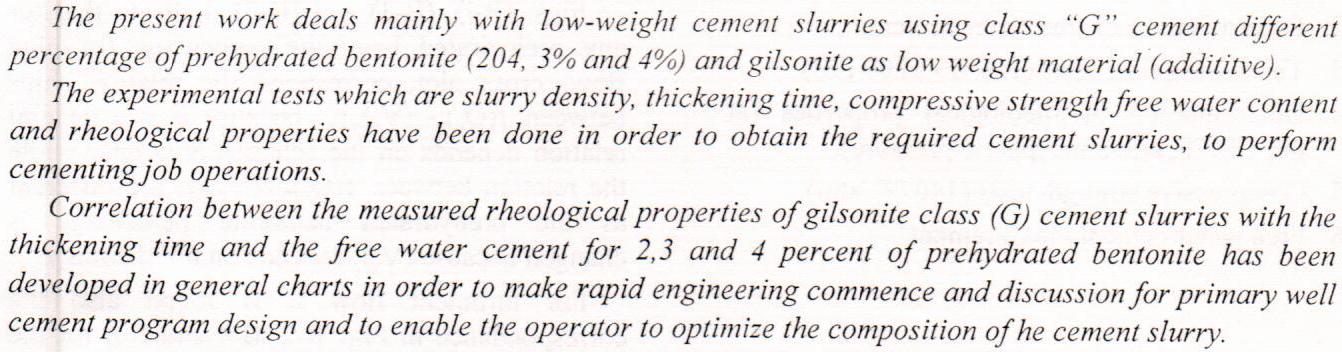
Physical and Rheological Properties of Class "G" Gilsonite Cement Slurries (Experimental Study)

Background: The PMMA polymer denture base materials are low mechanical properties, adaptation of the denture base to underlying tissue is important for retention and stability of denture. The aim of the study was toevaluate the effect of mixtureZrO2-Al2O3 nanoparticles on impact strength, transverse strength, hardness, roughness, denture base adaptation of heat cured acrylic resin denture base material. Materials and methods: One hundred (100) specimens were prepared, the specimens were divided into five groups (20 specimens to each) according to the test type, each group was subdivided in to two subgroups (control and experimental) each subgroup consist of 10 specimens, the experimental group included mixture of 2% (ZrO2-Al2O3ratio2:1) b
... Show More (2)
(2)

The research is dealing with the absorption and fluorescence spectra for the hybrid of an Epoxy Resin doped with organic dye Rhodamine (R6G) of different concentrations (5*10-6, 5*10-5, 1*10-5, 1*10-4, 5*10-4) Mol/ℓ at room temperature. The Quantum efficiency Qfm, the rate of fluorescence emission Kfm (s-1), the non-radiative lifetime τfm (s), fluorescence lifetime τf and the Stokes shift were calculated. Also the energy gap (Eg) for each dye concentration was evaluated. The results showed that the maximum quantum effi
... Show More (4)
(1)
(4)
(1)


Using photo electrochemical etching technique (PEC), porous silicon (PS) layers were produced on n-type silicon (Si) wafers to generate porous silicon for n-type with an orientation of (111) The results of etching time were investigated at: (5,10,15 min). X-ray diffraction experiments revealed differences between the surface of the sample sheet and the synthesized porous silicon. The largest crystal size is (30 nm) and the lowest crystal size is (28.6 nm) The analysis of Atomic Force Microscopy (AFM) and Field Emission Scanning Electron Microscope (FESEM) were used to research the morphology of porous silicon layer. As etching time increased, AFM findings showed that root mean square (RMS) of roughness and po
... Show More
(1)
This study exposed to use the liquid whey (which was produced from of soft cheese processed) partially or completely instead of milk in fatty cake, this whey residue is still not used, instead it is thrown in rivers which effect different environment and economic problems. Different concentrations was used (25% , 50% , 75% , and 100%) of whey in baked cake , Volume , height and other different properties ( panel taste ) was studied too . Sensory evaluation results showed that an improved in all the character of the baked cake was happen by the used of 25% and 50% of the whey in comparison with the control treatment, the 75% replacement showed a decrease in appearance , texture and tenderness , while the degrees of color and fla
... Show More
(1)
(4)
This paper reports on the experimental study, which conducted a series of triaxial tests for the asphalt concrete using hydrated lime as a mineral additive. Three HMA mixes, prepared by the specification for wearing, levelling and base layers, were studied under three different temperatures. The test results have demonstrated that, compared with the control mixes excluding HL, the permanent deformation resistance of the HL modified mixes has significant improvement. The deformation has been reduced at the same load repetition number, meanwhile the flow number has been considerably increased. The degree of improvement in permanent deformation resistance using HL is more pronounced at high stress deviation states and high temperature.
... Show More
Thin films of Mn2O3 doped with Cu have been fabricated using the simplest and cheapest chemical spray pyrolysis technique onto a glass substrate heated up to 250 oC. Transmittance and absorptance spectra were studied in the wavelength range (300 -1100) nm. The average transmittance at low energy was about 60% and decrease with Cu doping, Optical constants like refractive index, extinction coefficient and dielectric constants (εr), (εi) are calculated and correlated with doping process.
The work concerned with studying the effect of (SiO2) addition as a
filler on the adhesive properties of (PVA). Samples were prepared as
sheets by using casting method. The mechanical properties showed
that increase in tensile strength from (34MPa) to (68MPa) when
(SiO2) added to (PVA). The adhesive strength showed that joint
properties depend upon specific adhesive characteristic of material
(PVA) and (SiO2\PVA)composites at different concentrations (1.5%,
2.5%, 3.5%, 4.5wt%), the cohesive strength of the adhesive material,
the joint design, and adherent type (Sponge Rubber(SR), Natural
leather (NL), Vulcanized Rubber(VR), and Cartoon). The results
proved the tensile strength increased with (SiO2) ratio, so
Superconducting thin films of Bi1.6Pb0.4Sr2Ca2Cu2.2Zn0.8O10 system were prepared by depositing the film onto silicon (111) substrate by pulsed laser deposition. Annealing treatment and superconducting properties were investigated by XRD and four probe resistivity measurement. The analysis reveals the evolution of the minor phase of the films 2212 phase to 2223 phase, when the film was annealed at 820 °C. Also the films have superconducting behavior with transition temperature ≥90K.