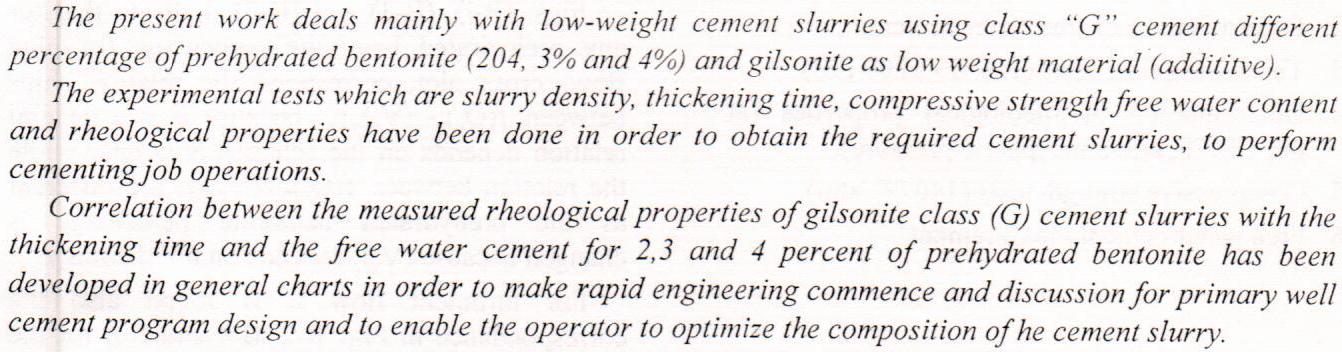
Physical and Rheological Properties of Class "G" Gilsonite Cement Slurries (Experimental Study)

The physical, the thermal and the mechanical properties of Nano-composites, that consisted of Polyprime EP epoxy that reinforced by multi-walled carbon nanotubes (MWCNTs), have been studied. Various loading ratios, 0.1, 0.5, and 1 wt. %of MWCNT shave been infused into epoxy by a magnetic stirrer and then the hardener mixed with the mthat supplied with the epoxy. All sample shave been cutting using CNC machine. Tensile test, three-point bending, hardness tests, lee's disk, differential scanning calorimetry, water absorption and dielectric and electrical conductivity test were utilized on unfilled, MWCNT-filled epoxy to identify the loading effect on the properties of materials. Scanning electron microscopy (SEM) was used to determine the
... Show More
Stone Matrix Asphalt (SMA) is a gap-graded asphalt concrete hot blend combining high-quality coarse aggregate with a rich asphalt cement content. This blend generates a stable paving combination with a powerful stone-on-stone skeleton that offers excellent durability and routing strength. The objectives of this work are: Studying the durability performance of stone matrix asphalt (SMA) mixture in terms of moisture damage and temperature susceptibility and Discovering the effect of stabilized additive (Fly Ash ) on the performance of stone matrix asphalt (SMA) mixture. In this investigation, the durability of stone matrix asphalt concrete was assessed in terms of temperature susceptibility, resistance to moisture damage, and sensitivity t
... Show More (1)
(1)
Samples prepared by using carbon black as a filler material and phenolic resin as a binder. The samples were pressed in a (3) cm diameter cylindrical die to (250)MPa and treated thermally within temperature range of (600-1000)oC for two and three hours. Physical properties tests were performed, like density, porosity, and X-ray tests. Moreover vicker microhardness and electric resistivity tests were done. From the results, it can be concluded that density was increased while porosity was decreased gradually with increasing temperature and treating time. In microhardness test, it found that more temperature and treating time cause more hardness. Finally the resistivity was decreased in steps with temperature and treating time. It can be c
... Show MoreMagneto-rheological (MR) Valve is one of the devices generally used to control the speed of Hydraulic actuator using MR fluid. The performance of valve depends on the magnetic circuit design. Present study deals with a new design of MR valve. The finite element analysis is carried out on this valve to optimize its design. The design of the magnetic circuit is accomplished by magnetic finite element software such as Finite Element Method Magnetic (FEMM). The Model dimensions of MR valve, material properties and the circuit properties of valve coil are taken into account. The results of analysis are presented in terms of magnetic strength and magnetic flux density. The valve can be operated with variable flow rate by varying the current. It i
... Show More (2)
(2)

The study concern with the preparation of three type of mixtures; which are prepared from different percentage of polyvenil Butyral, Di-n-butyl phathalate and paraffin wax pastillated. The solvent used is Xylolzul analyses. After washing, Drying and milling the kaolin Dukhla, as a matrix in this study, and by using sieving Tech. The range of particle size used is less than and less than as a mesh batch. The added percentage from prepared mixture were 5% and 10% to 95% and 90% of the matrix respectively. Then disk samples were prepared by using a compaction pressure with heating. After cooling and drying the samples were undergo heat treatment in the range of (1250 – 1350) oC. The measurement of shrinkage and Dielectric properties sho
... Show More
ZnIn2(Se1-xTex)4 (ZIST) chalcopyrite semiconductor thin films at various contents (x = 0.0, 0.2, and 0.4) are deposited on glass and p type silicon (111) substrate to produce heterojunction solar cell by using the thermal evaporation technique at RT where the thickness of 500 nm with a vacuum of 1×10⁻⁵ mbar and a deposited rates of 5.1 nm/s. This study focuses on how differing x content effect on the factors affecting the solar cell characteristics of ZIST thin film and n-ZIST/p-Si heterojunction. X-ray diffraction XRD investigation shows that this structure of ZIST film is polycrystalline and tetragonal, with (112) preferred orientation at 2θ ≈ 27.01. Moreover, atomic force microscopy AFM is studying the external morphology of
... Show More

A new class of generalized open sets in a topological space, called G-open sets, is introduced and studied. This class contains all semi-open, preopen, b-open and semi-preopen sets. It is proved that the topology generated by G-open sets contains the topology generated by preopen,b-open and semi-preopen sets respectively.
In this research study Hardness (shore D), Water absorption,
Flexural, Impact Test, and Fracture Toughness of polymer nano
composites. The polymer nano composites based on unsaturated
polyester resin reinforced with Kevlar fibers (K.F). The samples are
attended by hand lay – up method according to (Rule mixture) for
various volume fractions of unsaturated polyester resin, fiber and
carbon nanotube. The polyester resin was matrix strengthened with
3% volume fraction from Kevlar fiber and (0.5%, 1%, 1.5%, 2%)
volume fractions of carbon nanotube. The water absorption, hardness
(shore D), flexural test, impact test and toughness fracture properties
were studied. Results showed that the water absorption increas
(1)