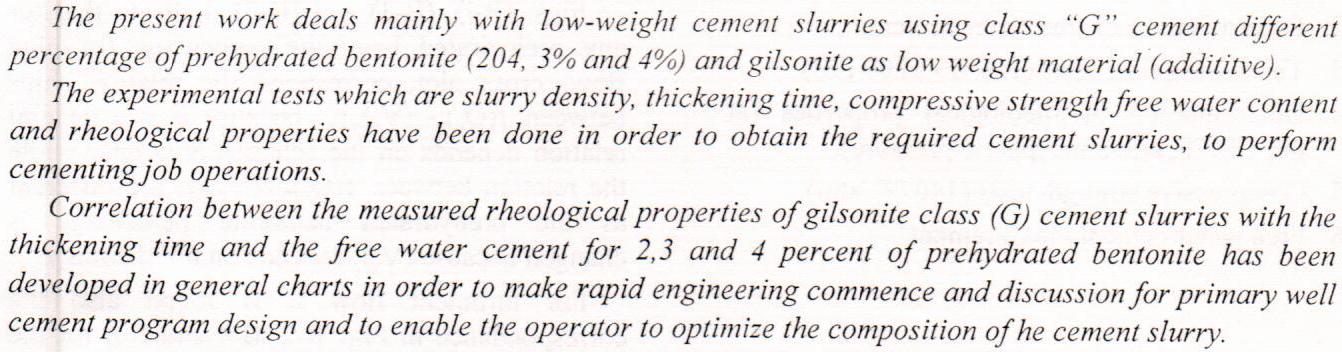
Physical and Rheological Properties of Class "G" Gilsonite Cement Slurries (Experimental Study)

Test results of eight reinforced concrete one way slab with lacing reinforcement are reported. The tests were designed to study the effect of the lacing reinforcement on the flexural behavior of one way slabs. The test parameters were the lacing steel ratio, flexural steel ratio and span to the effective depth ratio. One specimen had no lacing reinforcement and the remaining seven had various percentages of lacing and flexural steel ratios. All specimens were cast with normal density concrete of approximately 30 MPa compressive strength. The specimens were tested under two equal line loads applied statically at a thirds part (four point bending test) up to failure. Three percentage of lacing and flexural steel ratios wer
... Show MoreAn experimental analysis was included to study and investigate the mass transport behavior of cupric ions reduction as the main reaction in the presence of 0.5M H2SO4 by weight difference technique (WDT). The experiments were carried out by electrochemical cell with a rotating cylinder electrode as cathode. The impacts of different operating conditions on mass transfer coefficient were analyzed such as rotation speeds 100-500 rpm, electrolyte temperatures 30-60 , and cupric ions concentration 250-750 ppm. The order of copper reduction reaction was investigated and it shows a first order reaction behavior. The mass transfer coefficient for the described system was correlated with the aid of dimensionless groups as fo
... Show Morelar water heating systems with heat pipes of three diameter groups of 16, 22 and 28.5 mm. The first and third groups had evaporator lengths of 1150, 1300 and 1550 mm. The second group had an additional length of 1800 mm. all heat pipes were of fixed condenser length of 200 mm. Ethanol at 50% fill charge ratio of the evaporator volume was used as the heat pipes working fluid. Each heat pipe condenser section was inserted in a storage tank and the evaporator section inserted into an evacuated glass tube of the Owens- Illinois type. The combined heat pipe and evacuated glass tube form an active solar collector of a unique design.
The resulting ten solar water heating systems were tested outdoors under the meteorological conditions of Bag
 (1)
(1)

: In this study, a linear synchronous machine is compared with a linear transverse flux machine. Both machines have been designed and built with the intention of being used as the power take off in a free piston engine. As both topologies are cylindrical, it is not possible to construct either using just flat laminations and so alternative methods are described and demonstrated. Despite the difference in topology and specification, the machines are compared on a common base in terms of rated force and suitability for use as a generator. Experience gained during the manufacture of two prototypes is described.
(9)

In this study, the behavior of screw piles models with continuous helix was studied by conducting laboratory experimental tests on a single screw pile that has several aspect ratios (L/D) under the influence of static axial compression loads. The screw piles were inserted in a soft soil that has a unit weight of 18.72 kN/m3 and moisture content of 30.19%. Also, the soil has a liquid limit of 55% and a plasticity index of 32%. A physical laboratory model was designed to investigate the ultimate compression capacity of the screw pile and measure the generated porewater pressure during the loading process. The bedding soil was prepared according to the field unit weight and moisture content and the failure load was assumed correspondin
... Show More (8)
(6)
(8)
(6)

In the recent decade, injection of nanoparticles (NPs) into underground formation as liquid nanodispersions has been suggested as a smart alternative for conventional methods in tertiary oil recovery projects from mature oil reservoirs. Such reservoirs, however, are strong candidates for carbon geo-sequestration (CGS) projects, and the presence of nanoparticles (NPs) after nanofluid-flooding can add more complexity to carbon geo-storage projects. Despite studies investigating CO2 injection and nanofluid-flooding for EOR projects, no information was reported about the potential synergistic effects of CO2 and NPs on enhanced oil recovery (EOR) and CGS concerning the interfacial tension (γ) of CO2-oil system. This study thus extensively inves
... Show MoreThis study experimentally investigated Free-Fall Gravity Drainage (FFGD) under combination-drive conditions in a two-dimensional Hele-Shaw model representing a water-drive reservoir. An initially high gravity potential from the oil column enabled early oil drainage before aquifer support became dominant. Three water-drive strengths were tested, demonstrating that a stronger aquifer (1.15 psig) accelerated oil recovery to approximately 75% of the original oil in place (OOIP) within 60 minutes, resulting in a final recovery of 79.5%. However, this was accompanied by rapid water breakthrough after 2.5 minutes and high-water cuts exceeding 90%. In contrast, a weaker aquifer (0.725 psig) stabilized the oil–water contact, delaying w
... Show More
(4)
(3)
The efforts embedded in this paper have been devoted to designing, preparing, and testing warm mix asphalt (WMA) mixtures and comparing their behavior against traditional hot mix asphalt mixtures. For WMA preparation, the Sasobit wax additive has been added to a 40/50 asphalt binder with a concentration of 3%. An experimental evaluation has been performed by conducting the Marshall together with volumetric properties, indirect tensile strength, and wheel tracking tests to acquire the tensile strength ratio (TSR), retained stability index (RSI), and rut depth. It was found that the gained benefit of reduction in mixing and compaction temperatures was reversely associated with a noticeable decline in Marshall properties and moisture s
... Show More
(1)
(1)