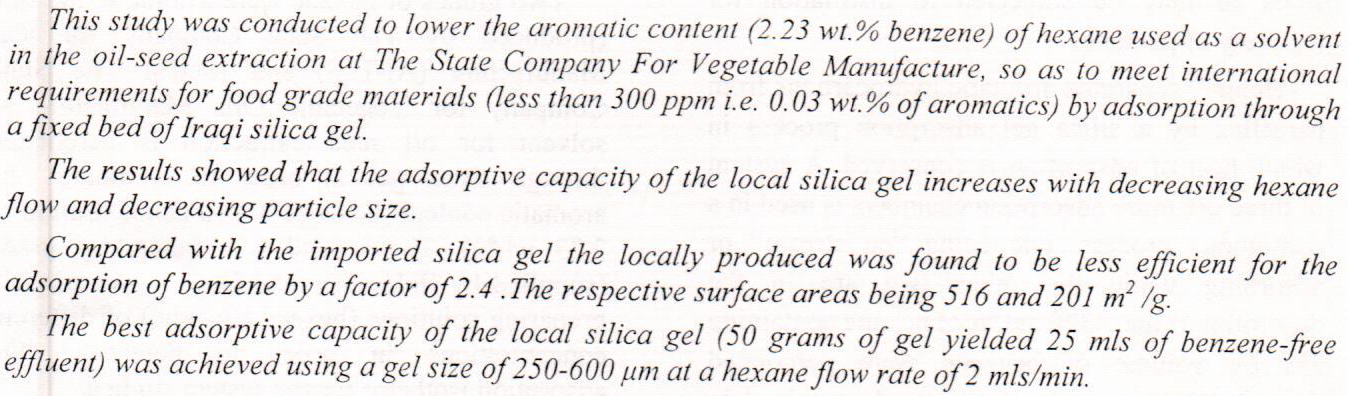
Reduction of Aromatic Content from Hexane by Silica Gel

 (12)
(12)
 (11)
(11)



Anthropogenic activities cause soil pollution with different serious pollutants, such as polycyclic aromatic hydrocarbon (PAHs) compounds. This study assessed the contamination of PAHs in soil samples collected from 30 sites divided into eight groups (residential areas, oil areas, agricultural areas, roads, petrol stations, power plants, public parks and electrical generators) in Basrah city-Iraq during 2019-2020. The soil characteristics including (moisture, pH, EC and TOC) were measured. Results showed the following ranges (soil moisture (0.03-0.18%),pH (6.90-8.16), EC (2.48-104.80) mS/cm and TOC (9.90-20.50%)). Gas Chromatography (GC) was used to measure PAHs in extracted soil samples. The total PAH range (499.96 - 5864.86) ng/g dr
... Show More
(6)
(4)
Carbon dioxide (CO2) capture and storage is a critical issue for mitigating climate change. Porous aromatic Schiff base complexes have emerged as a promising class of materials for CO2 capture due to their high surface area, porosity, and stability. In this study, we investigate the potential of Schiff base complexes as an effective media for CO2 storage. We review the synthesis and characterization of porous aromatic Schiff bases materials complexes and examine their CO2 sorption properties. We find that Schiff base complexes exhibit high CO2 adsorption capacity and selectivity, making them a promising candidate for use in carbon capture applications. Moreover, we investigate the effect of various parameters such as temperature, and pressu
... Show MoreNanofluids (dispersion of nanoparticles in a base fluid) have been suggested as promising agents in subsurface industries including enhanced oil recovery. Nanoparticles can easily pass through small pore throats in reservoirs formations; however, physicochemical interactions between nanoparticles and between nanoparticles and rocks can cause a significant retention of nanoparticles. This study investigated the transport, attach, and retention of silica nanoparticles in core plugs. The hydrophilic silica nanoparticles were injected into limestone core as nanofluid of different nanoparticles size (5 nm, and 20 nm), concentration (0.005 – 0.1 wt% SiO2), and base fluid salinity (0 – 3 wt% NaCl) at different temperatures (23, and 50 °C). D
... Show More
(44)
(24)
Stevia rebaudiana Bertoni contains diterpenoid steviol glycosides that have no adverse impact on blood sugar levels despite being 300 times sweeter than sugar. This study aimed to investigate the rate of callus induction from stevia leaves and the content of glycosides when changing the sucrose percentage in the culture medium.. Murashige and Skoog (MS) culture medium supported by 4.0 mg/l naphthalene acetic acid (NAA) and 1.0 mg/l benzyl adenine (BA) was used, and different concentrations of sucrose (2, 3, 4, 5 and 6%) were tested .The extraction of glycosides from leaf and callus tissues was performed by using methanol. Extracted glycosides were analyzed by high-performance liquid chromatography (HPLC). The results showed signific
... Show MoreIn this work, the linear properties of Vitamin D3-5000IU soft gel were investigated by measuring its absorption and fluorescence spectra. It was observed that there was a shift towards longer wavelength within limits (75 nm), with quantitative efficiency equal to (33.58%). The values of absorbance were used to calculate the extinction coefficient, optical refractive index, optical conductivity and optical dielectric constant values.
The non-linear properties of Vitamin D3-5000IU soft gel was also studied using the Z-Scan technique by using Neodymium-doped Yttrium Garnet (Nd: YAG) continuous laser (CW) emitting in &n
... Show More
(1)
(1)
Titanium dioxide nanorods have been prepared by sol-gel template
method. The structural and surface morphology of the TiO2 nanorods was
investigated by X-ray diffraction (XRD) and atomic force microscopy
(AFM), it was found that the nanorods produced were anatase TiO2 phase.
The photocatalytic activity of the TiO2 nanorods was evaluated by the
photo degradation of methyl orange (MO). The relatively higher
degradation efficiency for MO (D%=78.2) was obtained after 6h of exposed
to UV irradiation.
(1)
Background : The dermatophytesare taxonomically related fungi causing different skin infections referred to as tineas in man or ringworm in man and animals . Objective:This study was established to investigate theof effect of yellow sap and gel of Aloe vera on skin of the rabbits which infected with T.verrucosum. Methods : Twelveskin biopsy were taken from rabbits for histopathological study to know the the effects of the T.verrucosumand treated with yellow sap and gel. Results : the results of histopathological study of effect of yellow sap and gel of Aloe vera on skin of the rabbits which infected with T.verrucosum showed the concentration of the gel of aloe vera at 75% was more effected to treat the infective area of skin with T.verrucos
... Show More