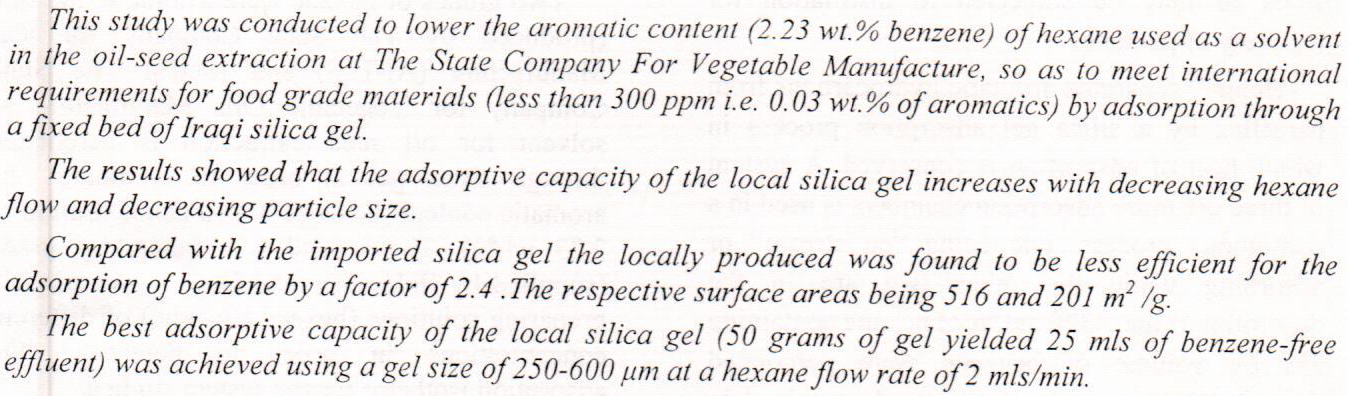
Reduction of Aromatic Content from Hexane by Silica Gel

This research aims to find out the phonemic, dialect and semantic ailments that were interrogated by the book of the parsing of thirty surahs of the Noble Qur’an by Ibn Khalawiyeh, by examining some phonemic phenomena of Qur’anic expressions and their explanatory relationships that resulted in their occurrence, such as substitution and compression, as the sounds in a word are affected by one another, especially during performance and composition. This influence and influence is the tendency of the human being to the law of ease, facilitation, and the reduction of muscular effort in speech often, all for the purpose of obtaining phonemic harmony for the compound letters; To facilitate pronunciation; And get rid of the muscular effort
... Show MoreA survey of chrysidid wasps and an identification key to the genera from different localities in Iraq are provided. The genus Pseudomalus Ashmead, 1902 with Pseudomalus auratus (Linnaeus) and Omalus timidus (Nurse), are new records from Iraq. As well, a preliminary checklist of Iraq’s Chrysididae is suggested. Twenty species within nine genera in two subfamilies have been included in the current list. Historical information is provided together with remarks on the current taxonomic status and the particular validity for some species.


 (126)
(126)
 (117)
(117)

Understanding, promoting, and teaching media literacy is an important societal challenge. STEM educators are increasingly looking to incorporate 21st century skills such as media literacy into core subject education. In this paper we investigate how undergraduate Computer Science (CS) students can learn media literacy as a by-product of collaborative video tutorial production. The paper presents a study of 34 third-year CS undergraduates who, as part of their learning, were each asked to produce three video tutorials on Raspberry Pi programming, using a collaborative video production tool for mobile phones (Bootlegger). We provide results of both quantitative and qualitative analysis of the production process and resulting video tutorials,
... Show More
(22)
(17)
It is no secret to anyone that studying and investigating books of jurisprudence, despite their suffering, is a pleasure that cannot be compared to pleasure, and it has benefits and importance that cannot be limited and summed up, and it has great fruits that researchers and students of knowledge reap, as well as enriching libraries with jurisprudential material, after dusting them and taking them out to the light of libraries to be seen. Researchers and scholars, generation after generation, so that this nation can benefit from this pioneering intellectual and scientific product that was written for us by our first ancestors of working scholars who enriched human civilization with this scientific material, which has become a beacon guid
... Show MoreHuge efforts are being made to control the spread and impacts of the coronavirus pandemic using vaccines. However, willingness to be vaccinated depends on factors beyond the availability of vaccines. The aim of this study was three-folded: to assess children’s rates of COVID-19 Vaccination as reported by parents, to explore parents’ attitudes towards children’s COVID-19 vaccination, and to examine the factors associated with parents’ hesitancy towards children’s vaccination in several countries in the Eastern Mediterranean Region (EMR).
(59)
(46)
The aim of the present study was to isolated the Enterococcus spp. from milk samples of cow and vaginal swabs from aborted women and patient women in Baghdad during September 2016 to april 2017. All 100 milk sample collecting was carried out on California Mastitis Test (CMT) and the positive Percentage of CMT reactions was 5% and the percentage of Enterococcus isolates from mastitic milk was 60% and 30% from nonmasitic milk. The prevalence of Enterococcus spp was 31% of milk samples and the prevalence of Enterococcus spp. Isolates were 67.74% of the isolates of cow milk samples were Enterococcus faecalis, 25.80% was Group D and 6.45% was non groupable while Enterococcus spp. isolates from aborted women samples were 20% and all isolated was
... Show MoreA many risk challenge in (settings hospital) are multi- bacteria are antibiotic-resistant. Some type strains that ability adhesion surface-attached bio-film census. Fifteen MRSA isolates were considered as high biofilm producers Moreover all MRSA isolates; M3, M5, M7 and M11 produced biofilms but the thickest biofilm seen M7strain. The MIC values of N. sativa oil against clinical isolates of MRSA were between (0.25, 0.5, 0.75, 1.0) μg/ml While MRSAcin (50, 75, 100, 125) µg\ ml. All biofilms treated with MRSAcin and Nigella sativa developed a presence of live cells after cultured on plate agar with inhibition zone between MIC (18 – 15) and (14- 11)mm respectively.Yet, results showed that MRSA supernatant developed a inhibitory ef
... Show More
(7)
(7)
It is often noted that disordered materials have different chemical properties to their more “ordered” cousins. Quantifying these effects in terms of thermodynamics is challenging in part because disordered materials can be difficult to characterize and are frequently relatively unstable. During the course of our experiments to understand the effects of disorder in catalysts for water oxidation we observed that many disordered manganese and cobalt oxide water oxidation catalysts directly oxidized peroxide in contrast to their more ordered analogues which catalyzed its disproportionation, that is, MnO2+2H+ +H2O2! Mn2+ +2H2O+O2(oxidation) versus H2O2!H2O+1=2 O2(disproportionation). By measuring the efficiency for one reaction over the oth
... Show More
(6)
(5)