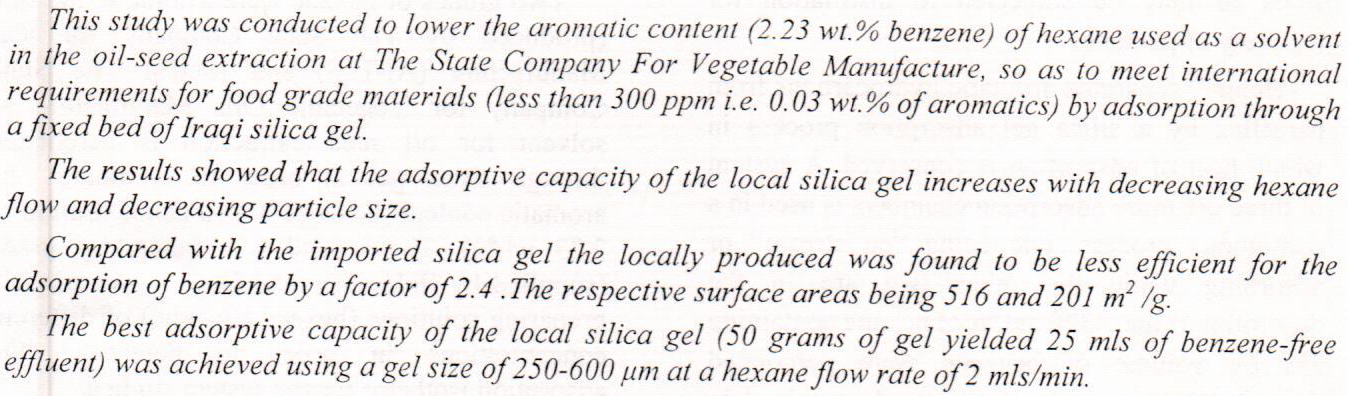
Reduction of Aromatic Content from Hexane by Silica Gel

The objective of the research is to shed light on the nature of the impact of the activities of the national strategy for poverty alleviation in achieving the goals of sustainable development, and the research problem was represented by Is there an effect of the activities of the national strategy for poverty reduction in achieving the goals of sustainable development? and represents the field of research in the Ministry of Labor and Social Affairs For the years (2012-2016) and the results of the sustainable development goals indicators for the years (2012-2016), the ready-made statistical program (SPSS ver.10) was used to calculate the percentages, multiple linear regression equation, the F test and the R2 coefficient, and the research
... Show MoreA field experiment was carried out during two winter season 2013, 2014 at the field of the Department of Field Crops, College of Agriculture, University of Baghdad, to study the effect of seeds soaking with Gibberellic acid and foliar with Abscisic Acid on the growth, yield, and content of Anise oil seeds using factorial experiment within RCBD design with three replicates. The seeds was treated within GA3 were soaked with two concentrations of 30, and 60 mg. litter-1 in addition to without soaking and the code has been B0 , B1 , B2 overlapped these transactions with two concentrations of Abscisic Acid 3, and 6 mg. litter-1 in addition to without foliar A0 , A1 , A2The seeds to be treated with GA3 are soaked for 24 hours prior
... Show More (2)
(2)

The current research aims to determine the requirements of Trends of International Mathematics and Science Study (TIMSS 2019) and to find out the extent to which the content of science textbooks for grades (1-4) in the Sultanate of Oman includes the requirements of (TIMSS 2019). Only the Cognitive Process dimension has been considered when conducting the analysis. The study population includes all science books from the first to the fourth grade for the academic year 2021-2022. The study identified and organized the requirements in the study tool, which is a list of requirements of (TIMSS 2019). After confirming its validity and reliability, the analysis was performed, and data were collected and analyzed statistically using frequencies
... Show More (37)
(37)
(37)
(37)


This study is designed to highlight some of the physiological disorders taken place in the renal function, immunological response as well as the ability of the redox system represented by total antioxidant capacity and malondialdehyde levels to combat the toxic exposure of mercuric chloride (HgCl2) with or without collaboration of resveratrol (RES) supplement. Forty-five adult Sprague Dawley, 8-10 weeks old female rats weighing 170-220 g were randomly grouped as following; control group (C) kept without any medication. Dimethyl sulfoxide (DMSO) used as vehicle to prepare RES treatment was given to D-group. RES administered to R-group. Challenge group of rats (HD) was administered HgCl2. The last group of rats (HR) was given HgCl2 with RES i
... Show More
(8)
(4)
As a result of industrial development, many types of waste are generated, some of which are discharged into water, causing water pollution and having a negative impact on life. The electro-Fenton process (EF) has verified high efficiency in treating pollutants with low cost, ease of handling and operation, and this technology is one of the more efficient advanced oxidation technologies. The main objective of this present work is to explore the efficiency of a three-dimensional Electro-Fenton system (3DEF) in removing eosin, methylene blue, and methylene violet from simulated wastewater using graphite as anode, nickel foam as the cathode, and alum sludge as the third particle and as the source of catalyst. The study investigated the effect o
... Show More
(32)
(30)
(3)
The removal of heavy metal ions from wastewater by ion exchange resins ( zeolite and purolite C105), was investigated. The adsorption process, which is pH dependent, shows maximum removal of metal ions at pH 6 and 7 for zeolite and purolite C105 for initial metal ion
concentrations of 50-250 mg/l, with resin dose of 0.25-3 g. The maximum ion exchange capacity was found to be 9.74, 9.23 and 9.71 mg/g for Cu2+, Pb2+, and Ni2+ on zeolite respectively, while on purolite C105 the maximum ion exchange capacity was found to be 9.64 ,8.73 and 9.39 for Cu2+, Pb2+, and Ni2+ respectively. The maximum removal was 97-98% for Cu2+ and Ni2+ and 92- 93% for Pb2+ on zeolite, while it was 93-94% for Cu2+, 96-97% for Ni2+, and 87-88% for Pb2+ on puroli
(12)
(1)