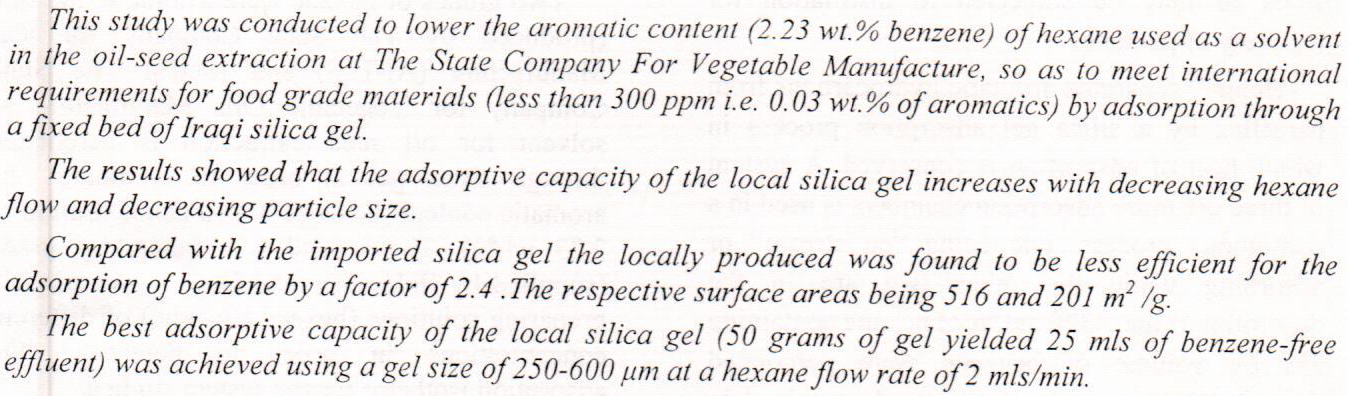
Reduction of Aromatic Content from Hexane by Silica Gel

Pharmaceuticals have been widely remaining contaminants in wastewater, and diclofenac is the most common pharmaceutical pollutant. Therefore, the removal of diclofenac from aqueous solutions using activated carbon produced by pyrocarbonic acid and microwaves was investigated in this research. Apricot seed powder and pyrophosphoric acid (45 wt%) were selected as raw material and activator respectively, and microwave irradiation technique was used to prepare the activated carbon. The raw material was impregnated in pyrophosphoric acid at 80◦C with an impregnation ratio of 1: 3 (apricot seeds to phosphoric acid), the impregnation time was 4 h, whereas the power of the microwave was 700 watts with a radiation time of 20 min. A series o
... Show More (19)
(19)
 (5)
(5)
 (3)
(2)
(3)
(2)

The adsorption of copper ions onto produced activated carbon from banana peels (with particle size 250 µm) in a single component system with applying magnetic field has been studied using fixed bed adsorber. The fixed bed breakthrough curves for the copper ions were investigated. The adsorption capacity for Cu (II) was investigated. It was found that 1) the exposure distance (E.D) and strength of magnetic field (B), affected the degree of adsorption; and 2) experiments showed that removal of Cu ions and accumulative adsorption capacity of adsorbent increase as the exposure distance and strength of magnetic field increase.
The geometric morphometric technique was used to study the variables in the shape and size wings of different populations of mosquitoes Culex quinquefasciatus from different Iraqi provinces Babylon, Baghdad and Wasit. The results showed that the average of centroid size were 366, 387.5 and 407.4 Micron in Babylon, Baghdad and Kut, respectively. The statistical analysis showed that there were no significant differences in the average of centroid size of all specimens and they belong to the same species.
(2)
Background: Dolutegravir sodium (DTG), used to treat HIV, faces challenges in delivering effective therapeutic concentrations to the brain due to the blood-brain barrier (BBB). Nanostructured lipid carriers (NLCs) combined with in situ gels present a promising strategy for enhancing brain drug delivery via the intranasal route. Objective: To compare brain pharmacokinetics of DTGs delivered via NLC-loaded in situ gel intranasal administration with the conventional intravenous (IV) drug solution. Methods: 80 Wistar rats, which were divided into three groups: two groups consisting of 39 animals each and a control group with 2 animals. Rats were administered with a dose of 1.0 mg/kg of DTGs IV, and DTGs NLC-loaded in situ gel were admin
... Show More
(5)
(3)
Lasmiditan (LAS) is a recently developed antimigraine drug and was approved in October, 2019 for the treatment of acute migraines; however, it suffers from low oral bioavailability, which is around 40%.
This study aimed to improve the LAS bioavailability via formulation as nanoemulsionbased in situ gel (NEIG) given intranasally and then compare the traditional aqueous-LASsuspension (AQS) with the two successful intranasal prepared formulations (NEIG 2 and NEIG 5) in order to determine its relative bioavailability (F-relative) via using rabbits.
(9)
(8)
(40)
(45)

This research was dealing with the aesthetic impact of encryption in form and content and aesthetic implications in the design of contemporary fabrics. That's where the design of the cloth is linked to the continuous development and continuous innovation and the pursuit of the all-new innovative designs and at the same time an unmarked Cryptographic with semantics and symbols reflect reality aesthetically pleasing and contains four chapters on the research :The first chapter discusses the research problem and its significance is the current quest ( encryption in form and content in contemporary designs fabrics and aesthetic implications ) in that it shows the importance of encryption in the design of fabrics and foundation design configu
... Show More