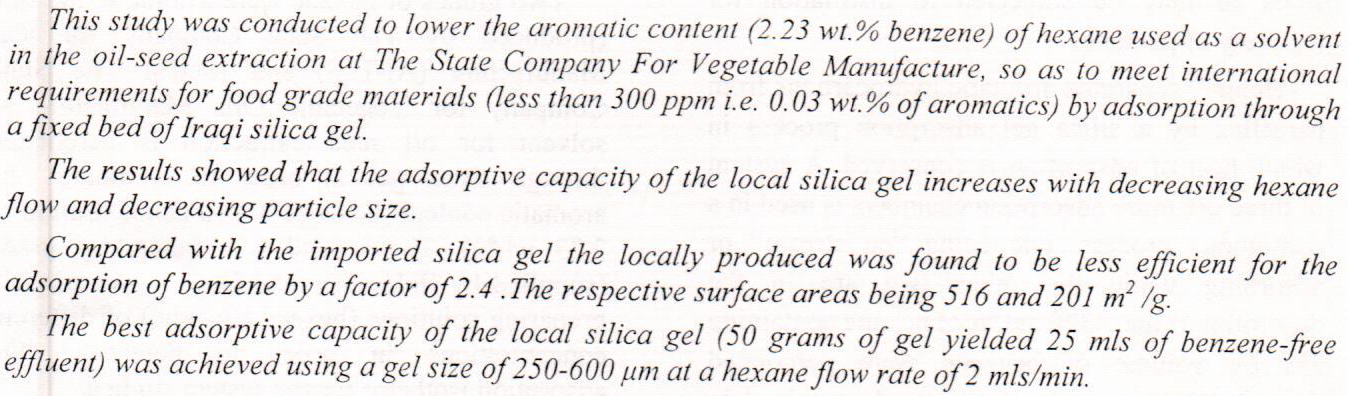
Reduction of Aromatic Content from Hexane by Silica Gel

The nanostructured MnO2 /carbon fiber (CF) composite electrode was prepared using the anodic electrodeposition process. The crystal structure and morphology of MnO2 particles were determined with X-ray diffraction and field-emission scanning electron microscopy. The electrosorptive properties of the prepared electrode were investigated in the removal of cadmium ions from aqueous solution, and the effect of pH, cell voltage, and ionic strength was optimized and modeled using the response surface methodology combined with Box–Behnken design. The results confirm that the optimum conditions to remove Cd(II) ions were: pH of 6.03, a voltage of 2.77 V, and NaCl concentration of 3 g/L. The experimental results showed a good fit for the Freundli
... Show More (3)
(3)
 (2)
(2)



Mastitis is an udder tissue inflammation which has infected various species of animals. It happens through several types of pathogenic bacteria, particularly Streptococcus agalactiae. GBS is a leading cause of cow mastitis. In our sample, 9.52% of Streptococcus agalactiae were isolated which were collected from bovine mastic milk and identified by biochemical tests such as catalase, oxidase, Production of indole, fermentation of sugar, an examination of antibiotic sensitivity, CAMP test and group kits of Lancefield. The results showed that all Streptococcus agalactiae isolate was diagnosed by CAMP test by the appearance of the arrowhead in blood agar and by the appearance of visible agglutination on a card in the serological grouping kit of
... Show More
Acinetobacter baumannii received attention for its multi-drug resistant associated with many severe infections and outbreaks in clinical environment. The aims of the study are to investigate the antibiotic susceptibility profile of clinically isolated A. baumannii, biofilm production, and the efficiency of Low Frequency Ultrasound (LFU) and honey to attenuate biofilm production. A total of 100 samples were taken from different sources from Baghdad hospitals. The susceptibility patterns revealed the percentage of pan drug resistant (PDR) isolates were 1.5 %, 72.7 % were extended drug resistant (XDR), 16.7 % were multidrug resistant (MDR), and 9.1 % were non MDR and sensitive to most antibiotics used. The ability to form
... Show More
(7)
(2)
Iraqi crude Atmospheric residual fraction supplied from al-Dura refinery was treated to remove metals contaminants by solvent extraction method, with various hydrocarbon solvents and concentrations. The extraction method using three different type solvent (n-hexane, n-heptane, and light naphtha) were found to be effective for removal of oil-soluble metals from heavy atmospheric residual fraction. Different solvents with using three different hydrocarbon solvents (n-hexane, n-heptane, and light naphtha) .different variables were studied solvent/oil ratios (4/1, 8/1, 10/1, 12/1, and 15/1), different intervals of perceptual (15, 30-60, 90 and 120 min) and different temperature (30, 45, 60 and 90 °C) were used. The metals removal perce
... Show More
(1)
A comparative study was done on the adsorption of methyl orange dye (MO) using non-activated and activated corn leaves with hydrochloric acid as an adsorbent material. Scanning electron microscopy (SEM) and Fourier Transform Infrared spectroscopy (FTIR) were utilized to specify the properties of adsorbent material. The effect of several variables (pH, initial dye concentration, temperature, amount of adsorbent and contact time) on the removal efficiency was studied and the results indicated that the adsorption efficiency increases with the increase in the concentration of dye, adsorbent dosage and contact time, while inversely proportional to the increase in pH and temperature for both the treated and untreated corn leav
... Show More
(25)
A comparative study was done on the adsorption of methyl orange dye (MO) using non-activated and activated corn leaves with hydrochloric acid as an adsorbent material. Scanning electron microscopy (SEM) and Fourier Transform Infrared spectroscopy (FTIR) were utilized to specify the properties of adsorbent material. The effect of several variables (pH, initial dye concentration, temperature, amount of adsorbent and contact time) on the removal efficiency was studied and the results indicated that the adsorption efficiency increases with the increase in the concentration of dye, adsorbent dosage and contact time, while inversely proportional to the increase in pH and temperature for both the treated and untreated corn leaves. The equi
... Show More
(25)
The efficient removal of dissolved organic compounds (DOC) from wastewater has become a major environmental concern because of its high toxicity even at low concentrations. Therefore, a technique was needed to reduce these pollutants. Ion exchange technology (IE) was used with AmberliteTM IR120 Na, AmberliteTM IR96RF, and AmberliteTM IR402, firstly by using anion and mixed bed system, where the following variables are investigated for the process of adsorption: The height of the bed in column (8,10 and 14 cm), different concentrations of (DOC) content at constant flow rate. The use of an ion exchanger unit (continuous system) with three columns (cation, anion, and mixed bed) was studied.
... Show More
(2)
(6)
(5)
(4)
(5)
(7)
(5)