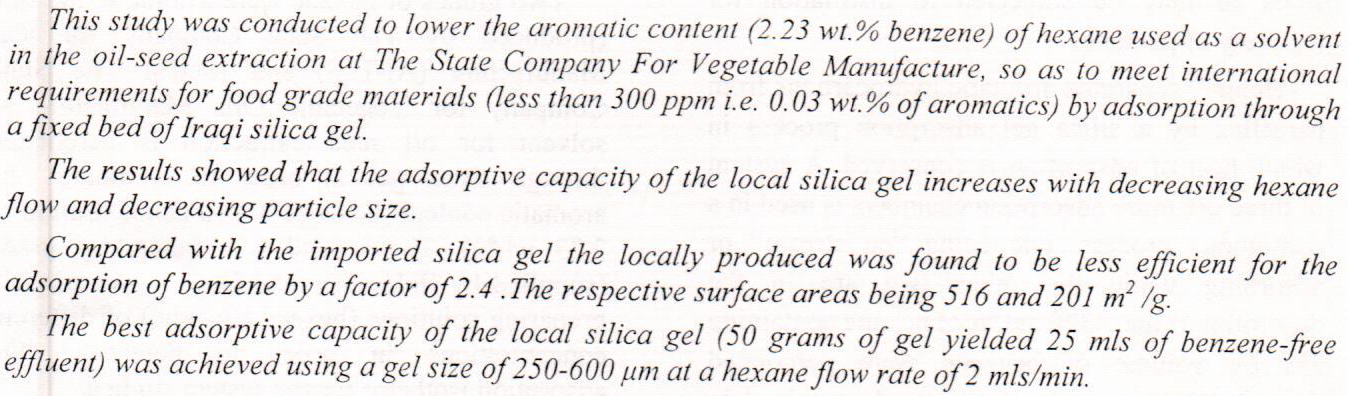
Reduction of Aromatic Content from Hexane by Silica Gel

The aim of the study was to know the factors analysis of scale Bar-On & Parker, post analysis is found fourteen factors for the first degree of the scale. Also we extracted five factors from the second degree.
The scale consists of (60) items , applied on sample of (200) students (Male &Female ) age (15-18) years randomly chosen from preparatory schools . The scale unveiled satis factors validity and reliability. An others aims is to low the emotional Intelligence level and know the difference of statistical in sex , age variable and the specialization variable .The result was no difference of statistical in sex and specialization variable , but the difference appear
... Show MoreThe possibility of using activated carbon developed from date palm seeds wastes as a permeable reactive barrier (PRB) to remove copper from polluted shallow groundwater was investigated. The activated carbon has been developed from date palm seeds by dehydrating methods using concentrated sulfuric acid. Batch tests were performed to characterize the equilibrium sorption properties of new activated carbon in copper-containing aqueous solutions, while the sandy soil (aquifer) was assumed to be inert. Under the studied conditions, the Langmuir isotherm model gives a better fit for the sorption data of copper by activated carbon than other models. At a pilot scale, One-dimensional column experiments were performed, and an integrated model ba
... Show MoreBackground: Candida albicans is a prevalent commensal that can cause severe health problems in humans. One such condition that frequently returns after treatment is oral candidiasis. Aim: the goal of this research is to evaluate the efficiency of 940 nm as a fungicidal on the growth of Candida albicans in vitro. Material and Methods: In vitro samples (fungal swabs) were taken from the oral cavity of 75 patients suffering from oral thrush. Following the process of isolating and identifying Albicans. The samples are divided into four groups:(Group 1): Suspension of C. albicans was put in a solution of saline as a control group. (Group 2): Suspension of C. albicans that had been treated wit
... Show More (2)
(2)

Background: Candida albicans is a prevalent commensal that can cause severe health problems in humans. One such condition that frequently returns after treatment is oral candidiasis. Aim: the goal of this research is to evaluate the efficiency of 940 nm as a fungicidal on the growth of Candida albicans in vitro. Material and Methods: In vitro samples (fungal swabs) were taken from the oral cavity of 75 patients suffering from oral thrush. Following the process of isolating and identifying Albicans. The samples are divided into four groups:(Group 1): Suspension of C. albicans was put in a solution of saline as a control group. (Group 2): Suspension of C. albicans that had been treated with nystatin. (Group 3): Suspension of C. albica
... Show More
(2)
 (153)
(129)
(153)
(129)

 (1)
(1)
(1)
(1)
The current study sheds light on the measurement and estimation of the radioactivity of radionuclides (238U, 226Ra, 232Th, and 40k) in natural waters of different regions of Nineveh Governorate in Iraq.15 samples were collected from different sources of natural waters, where gamma-ray spectroscopy was used using NaI)TI) sodium iodide detector to determine the concentration of radioactivity in the samples. According to the results, the radioactivity concentration in the tested water sample were ranged from 0.36 ± 0.04-1.57 ± 0.09with an average value of 0.69 ± 0.06 Bq/l for 238U, and 2.9 ± 0.02-0.88 ± 0.03 with an average value of 0.65 ± 0.03 Bq/l for 226Ra Bq/l
... Show More
(1)
(1)
A phytoremediation experiment was carried out with kerosene as a model for total petroleum hydrocarbons. A constructed wetland of barley was exposed to kerosene pollutants at varying concentrations (1, 2, and 3% v/v) in a subsurface flow (SSF) system. After a period of 42 days of exposure, it was found that the average ability to eliminate kerosene ranged from 56.5% to 61.2%, with the highest removal obtained at a kerosene concentration of 1% v/v. The analysis of kerosene at varying initial concentrations allowed the kinetics of kerosene to be fitted with the Grau model, which was closer than that with the zero order, first order, or second order kinetic models. The experimental study showed that the barley plant designed in a subsu
... Show More
(10)