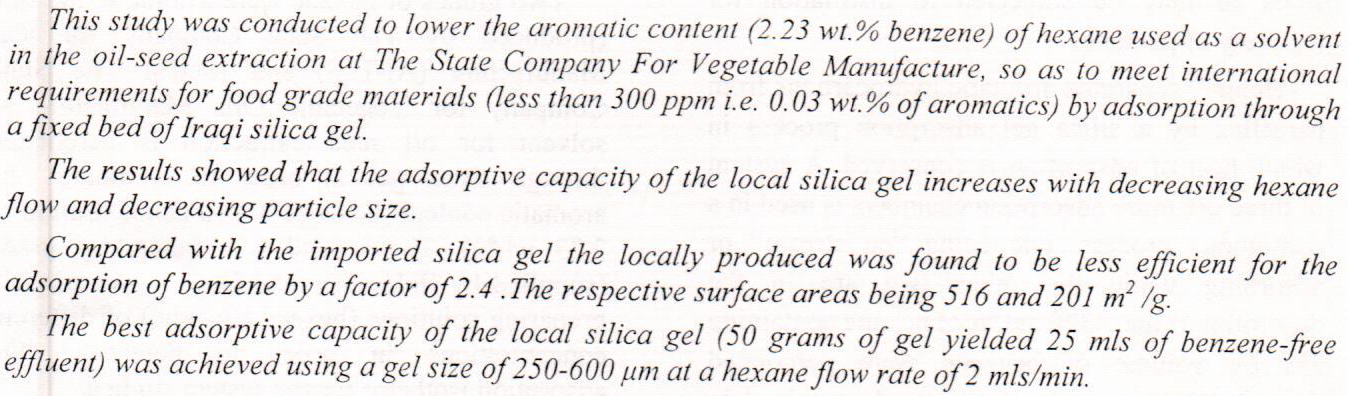
Reduction of Aromatic Content from Hexane by Silica Gel

The preparation of activated carbon (AC) from date stones by using microwave assisted K2CO3 activation was investigated in this paper. The influence of radiation time, radiation power, and impregnation ratio on the yield and methylene blue (MB) uptake of such carbon were studied. Based on Box-Wilson central composite design, two second order polynomial models were developed to correlate the process variables to the two responses. From the analysis of variance the significant variables on each response were identified. Optimum coditions of 8 min radiation time, 660 W radiation power and 1.5 g/g impregnation ratio gave 460.123 mg/g MB uptake and 19.99 % yield. The characteristics of the AC were examined by pore structure analysis, and scan
... Show MoreThe process of discharging the quantities of dyes resulting from industrial processes with wastewater leads to the occurrence of a serious environmental problem that threatens the environmental health security of humans. Therefore, a number of studies have been addressed that include presenting many physical and chemical treatment methods to get rid or reduce the proportion of pigments such as biological decomposition, ion exchange, and sedimentation. Chemotherapy, reverse osmosis, coagulation, Toxic sludge generation, flocculation. In addition to the above, this review deals with a number of studies that present activated carbon of plant origin, methods of obtaining it, types and advantages of it being cheap and environmentally friendly. A
... Show MoreAdsorption techniques are widely used to remove organics pollutants from waste water particularly, when using low cost adsorbent available in Iraq. Al-Khriet powder which was found in legs of Typha Domingensis is used as bio sorbent for removing phenolic compounds from aqueous solution. The influence of adsorbent dosage and contact time on removal percentage and adsorb ate amount of phenol and 4- nitro phenol onto Al-Khriet were studied. The highest adsorption capacity was for 4-nitrophenol 91.5% than for phenol 82% with 50 mg/L concentration, 0.5 gm. dosage of adsorbent and pH 6 under a batch condition. The experimental data were tested using different isotherm models. The results show that Freundlich model resulted in the best fit also
... Show MoreThis studies deals with investigated the potential of a Iraqi bentonite clay for the adsorption of bromo phenol red dye from contaminated water. Impulse adsorption experiments were performed. The contact time influence of initial dye concentration, temperature, pH, ionic strength, partical size adsorbent and adsorbent dosage on bromo phenol red adsorption are investigated in a series of batch adsorption experiments. Adsorption equilibrium data were analyzed and described by the Freundlich, Langmuir and temkin isotherms equations. Thermodynamic parameters inclusive the Gibbs free energy (∆G• ), enthalpy (∆H• ), and entropy (∆S• ), were also calculated. These parameters specified that adsorption of bromo phenol red onto bentonite
... Show MoreIn this study involves removing of Brilliant Dyes, were which (Brilliant Green {BG} and Brilliant Cresyl Blue {BCB}) by using Iraqi Siliceous Rocks Powder (SRP). Adsorption isotherms were studied and the factors which prefer it, like temperature and salt effect, Adsorption isotherms of dyes, Brilliant Cresyl Blue {BCB} was found to be comparable to Langmuir equation according to Giles classification, isotherms dye Brilliant Green {BG} was found to be comparable to Freundlich equation more than dye Brilliant Blue {BCB} according to Giles classification. The adsorption process on this surface (SRP) studied at different temperatures, the results showed that the adsorption of dyes (BCB, BG) on the surface increased with increased temperature (E
... Show More (22)
(22)
 (24)
(24)



A liquid membrane process of Alkaloids extraction from Datura Innoxia solution was studied applying pertraction process in rotating discs contactor (RDC). Decane as a liquid membrane and dilute sulphuric acid as stripping solution were used. The effect of the fundamental parameters influencing the transport process, eg type of solvent used, effect of disks speed, amount of liquid membrane and effect of pH for feed and strip solution. The transport of alkaloids was analysed on the basis of kinetic laws of two consecutive irreversible first order reactions. Thus, the kinetic parameters (k1, k1,, tmax, and) for the transport of alkaloids were determined. The effect of organic membrane type on percentage of Alkaloids transport was found to be i
... Show MoreA liquid membrane process of Alkaloids extraction from Datura Innoxia solution was studied applying pertraction process in rotating discs contactor (RDC). Decane as a liquid membrane and dilute sulphuric acid as stripping solution were used. The effect of the fundamental parameters influencing the transport process, e.g. type of solvent used, effect of disks speed, amount of liquid membrane and effect of pH for feed and strip solution. The transport of alkaloids was analysed on the basis of kinetic laws of two consecutive irreversible first order reactions. Thus, the kinetic parameters (k1, k1, , tmax, and ) for the transport of alkaloids were determined. The effect of organic membrane type on percentage of Alkaloids transport was found
... Show MoreThe extraction of Eucalyptus oil from Iraqi Eucalyptus Camadulensis leaves was studded using water distillation methods. The amount of Eucalyptus oil has been determined in a variety of extraction temperature and agitation speed. The effect of water to Eucalyptus leaves (solvent to solid) ratio and particle size of Eucalyptus leaves has been studied in order to evaluate the amount of Eucalyptus oil. The optimum experimental condition for the Eucalyptus oil extraction was established as follows: 100 C extraction temperature, 200 rpm agitation speed; 0.5 cm leave particle size and 6: 1 ml: g amount of water to eucalyptus leaves Ratio.
Biosorption is an effective method to remove toxic metals from wastewaters. In this study biosorption of lead and chromium ions from solution was studied using Citrobacter freundii and Citrobacter kosari isolated from industrial wastewater. The experimental results showed that optimum grwoth temperature for both bacteria is 30oC and the optimum pH is 7 &6 for C. freundii and C. kosari respectively. While the optimum incubation period to remove Pb and Cr for C. freundii and C. kosari is 4 days and 3days respectively. Also the biosorption of Pb and Cr in mixed culture of bacteria and mixed culture of Pb and Cr was investigated. Result indicate that uptake of Cr and Pb for C.freundii, C. kosari and in mixes culture of both bacteria is 58%, 53%
... Show More