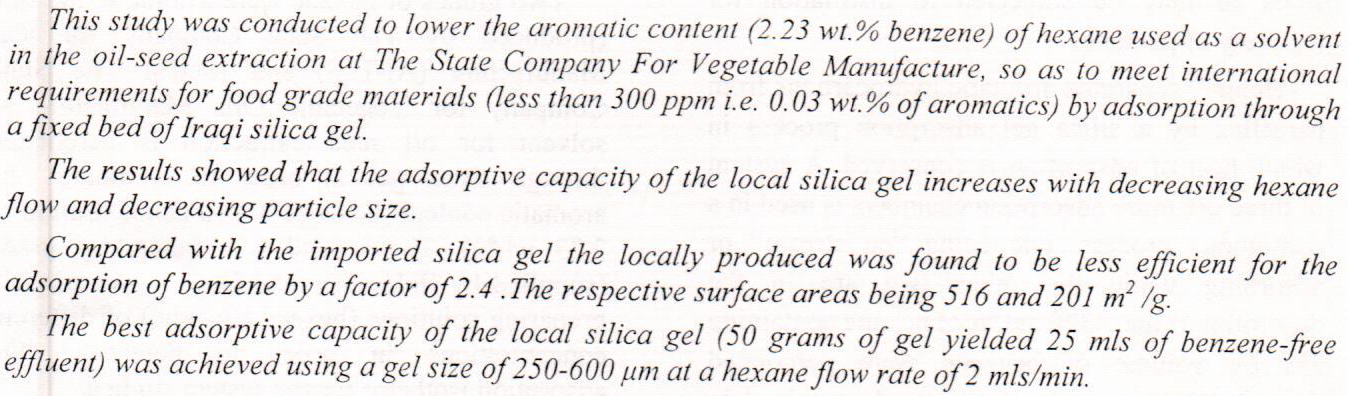
Reduction of Aromatic Content from Hexane by Silica Gel

 (7)
(7)
 (6)
(6)



The aim of this study is to propose reliable equations to estimate the in-situ concrete compressive strength from the non-destructive test. Three equations were proposed: the first equation considers the number of rebound hummer only, the second equation consider the ultrasonic pulse velocity only, and the third equation combines the number of rebound hummer and the ultrasonic pulse velocity. The proposed equations were derived from non-linear regression analysis and they were calibrated with the test results of 372 concrete specimens compiled from the literature. The performance of the proposed equations was tested by comparing their strength estimations with those of related existing equations from literature. Comparis
... Show More
(6)
The availability of low- cost adsorbent namely Al-Khriet ( a substance found in the legs of Typha Domingensis) as an agricultural waste material, for the removal of lead and cadmium from aqueous solution was investigated. In the batch tests experimental parameters were studied, including adsorbent dosage between (0.2-1) g, initial metal ions concentration between (50-200) ppm (single and binary) and contact time (1/2-6) h. The removal percentage of each ion onto Al-Khriet reached equilibrium in about 4 hours. The highest adsorption capacity was for lead (96%) while for cadmium it was (90%) with 50 ppm ions concentration, 1 g dosage of adsorbent and pH 5.5. Adsorption capacity in the binary mixture were reduce at about 8% for lead a
... Show More
(4)
(1)
The risk of significant concern is resistance to antibiotics for public health. The alternative treatment of metallic nanoparticles (NPs), such as heavy metals, effects on antibiotic resistance bacteria with different types of antibiotics of - impossible to treat using noval eco-friendly synthesis technique nanoparticles copper oxide (CuO NPs) preparation from S. epidermidis showed remarkable antimicrobial activity against S.aureus Minimum inhibitory concentra range (16,32,64,256,512) µg/ml via well diffusion method in vitro, discover those concentrations effected in those bacteria and the best concentration is 64 µg/ml, characterization CuO NPs to prove this included atomic force microscope, UV, X-ray Diffraction and TEM, and ant
... Show More
(13)
(8)
(5)
(4)
The apricot plant was washed, dried, and powdered after harvesting to produce a fine powder that was used in water treatment. created an alcoholic extract from the apricot plant using ethanol, which was then analysed using GC-MS, Fourier transform infrared spectroscopy, and ultraviolet-visible spectroscopy to identify the active components. Zinc nanoparticles were created using an alcoholic extract. FTIR, UV-Vis, SEM, EDX, and TEM are used to characterize zinc nanoparticles. Using a continuous processing procedure, zinc nanoparticles with apricot extract and powder were employed to clean polluted water. Firstly, 2 g of zinc nanoparticles were used with 20 ml of polluted water, and the results were Tetra 44% and Levo 32%; after
... Show More
(3)
(4)
In the recent years the research on the activated carbon preparation from agro-waste and byproducts have been increased due to their potency for agro-waste elimination. This paper presents a literature review on the synthesis of activated carbon from agro-waste using microwave irradiation method for heating. The applicable approach is highlighted, as well as the effects of activation conditions including carbonization temperature, retention period, and impregnation ratio. The review reveals that the agricultural wastes heated using a chemical process and microwave energy can produce activated carbon with a surface area that is significantly higher than that using the conventional heating method.
(6)
(4)
We studied the effect of certain environmental conditions for removing heavy metal elements from contaminated aqueous solutions (Cd, Cu, Pb, Fe, Zn, Ni, Cr) using the bacterium Bacillus subtilis to appoint the optimal conditions for removal ,The best optimum temperature range for two isolate was 30-35○C while the hydrogen number for the maximum mineral removal range was 6-7. The best primary mineral removal was 100 mg/L, while the maximum removal for all minerals was obtained after 6 hrs of Cu element time and the maximum removal efficiency was obtained after 24 hrs of Cu element. The results have proved that the best aeration for maximum removal was obtained at rotation speed of 150 rpm/minute. Inoculums of 5ml/100ml which contained 1
... Show MoreThe plant licorice is considered important plants as nutritionally and medically and economically, as a rich in phytochemical, vitamins and minerals, and being widely available, Research indicated the presence of many nutrients such as (proteins, Carbohydrates, vitamins and minerals) as well as presence of Glycyrrhizin which responsible of sweet taste, that allowing the possibility to use it as natural intensity sweetener with few calories in Sweetening of many food. This research is aimed to study the Stability of Glycyrrhizin toward the various manufacturing conditions such as (thermal treatment, pH of foods and microwaves), so three factorial experiments was implemented to find out the Stability as following: 100C° - 121C° - Microwa
... Show More