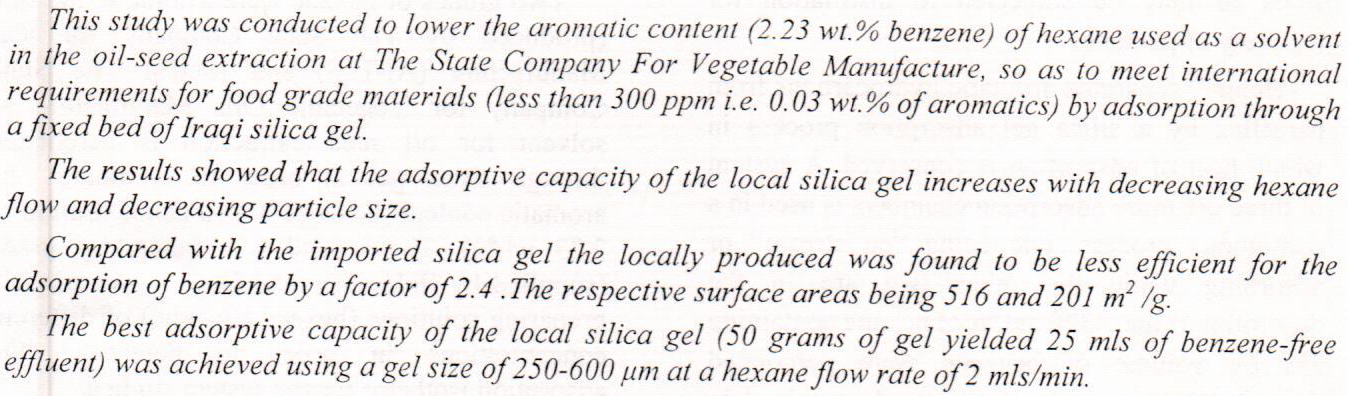
Reduction of Aromatic Content from Hexane by Silica Gel

n this work, the adsorption of crystal violet dye from aqueous solution on charcoal and rice husk has been investigated, where the impact of variable factors (contact time; the dosage of adsorbent, pH, temperature, and ionic strength) have been studied. It has been found that charcoal and rice husk have an appropriate adsorption limit with regards to the expulsion of crystal violet dye from fluid arrangements. The harmony adsorption is for all intents and purposes accomplished in 45 min for charcoal and 60 min for rice husk. The amount of crystal violet dye adsorbed (0.4 g of charcoal and 0.5 g of rice husk) increased with an increasing pH and the value of 11 is the best. The effect of temperature on the adsorption process was studied
... Show More (6)
(6)
 (2)
(2)



Sixty urine samples were collected from women with urinary tract infection in different ages. The aims of this study were determined the dominancy of pathogens isolated from urine of women with UTI and evaluating the antibacterial activity of Rosmarinus officinalis L. essential oil against these pathogenic isolates. Identification of bacteria was done on Chromogenic orientation agar while disc diffusion method was used for determination the sensitivity of bacterial isolates to antibiotics and Agar well diffusion method was used for evaluation the antibacterial effect of Rosemary essential oil on these isolates. The results showed that 50% of women infected with Escherichia coli, it was dominants in ages above 15 years old while Staphylococc
... Show MoreThe quantum chromodynamics theory approach was taken to study the photonic emission from interaction of quark gluon at high at Bremsstrahlung processes. Strength coupling, quark charge 𝑒𝑞 , flavor number 𝑛𝐹 , thermal energy T of system, fugacity of gluon ƛ𝑔, fugacity of quark ƛ𝑞 , critical temperature 𝑇𝐶 and photons energy 𝐸 are taken to calculate photons rate via the quantum system. Photons emission rate studies and calculates via high energy 400MeV to 650 MeV using flavor number 3 and 7 for 𝑢̅𝑔 → 𝑑̅𝑔𝛾 and 𝑐𝑔 → 𝑠𝑔𝛾 systems at bremsstrahlung processes with critical temperature (𝑇𝑐 = 190 and 196) MeV with photons energy (1-10) GeV. The confinement and de-confineme
... Show More
(1)
A total of 200 samples (180 fecal materials and 20 organ samples) were collected from (5 different poultry farms, 10 local poultry shops, 5 houses poultry, 5 Eggs stores shops and 5hand slaughters centers) in Ibb city, Yemen, 2014. According to morphological, cultural, as well as biochemical characterization and serological tests, 59(29.5%) isolates were identified as Salmonella spp. and all Salmonella isolates were categorized by serotype, which comprised of, 37(62.71%) Salmonella Typhimurium serovar, 21(35.59%). Salmonella Enteritidis serovar and 1(1.69%) Salmonella Heidlberg serovar. Antibiotic sensitivity test was done for bacterial isolates and the results showed there were clear differences in antibiotic resistant. Antimicrobial
... Show MoreIn Present study, 25 clinical isolates of Proteus spp. of clinical samples, urine, wounds and burns collected from different hospitals in Baghdad city, all isolates were identified as Proteus mirabilis using different bacteriological media, biochemical assays and Vitek-2 system. It was found that 15 (60%) isolates were identifying as P. mirabilis. The susceptibility of P. mirabilis isolates to cefotaxime was 66.6 %, while to ceftazidime was 20%. Extended spectrum β-lactamses producing Proteus was 30.7 %. DNA of 5 isolates of P. mirabilis was extracted and detection for blaVEB-1 gene by using multiplex polymerase chain reaction (PCR). Results showed that the presence of this gene in all tested isolates, as an important indicator for increas
... Show MoreIn this work, the adsorption of crystal violet dye from aqueous solution on charcoal and rice husk has been investigated, where the impact of variable factors (contact time; the dosage of adsorbent, pH, temperature, and ionic strength) have been studied. It has been found that charcoal and rice husk have an appropriate adsorption limit with regards to the expulsion of crystal violet dye from fluid arrangements. The harmony adsorption is for all intents and purposes accomplished in 45 min for charcoal and 60 min for rice husk. The amount of crystal violet dye adsorbed (0.4 g of charcoal and 0.5 g of rice husk) increased with an increasing pH and the value of 11 is the best
... Show More
(6)
(2)
The quantum chromodynamics theory approach was taken to study the photonic emission from interaction of quark gluon at high at Bremsstrahlung processes. Strength coupling, quark charge 𝑒𝑞 , flavor number 𝑛𝐹 , thermal energy T of system, fugacity of gluon ƛ𝑔, fugacity of quark ƛ𝑞 , critical temperature 𝑇𝐶 and photons energy 𝐸 are taken to calculate photons rate via the quantum system. Photons emission rate studies and calculates via high energy 400MeV to 650 MeV using flavor number 3 and 7 for 𝑢̅𝑔 → 𝑑̅𝑔𝛾 and 𝑐𝑔 → 𝑠𝑔𝛾 systems at bremsstrahlung processes with critical temperature (𝑇𝑐 = 190 and 196) MeV with photons energy (1-10) GeV. The confinement and de-confineme
... Show More
(1)
Cyprinidae species are the most abundant and widely distributed fish species in the inland waters of Iraq. Cyprinids are complex species, and it is difficult to identify them on the basis of morphology. Thus, the morphological characteristics must be achieved and confirmed by molecular analysis. Twenty specimens of Cyprinion kais Heckel, 1843 (Piscies, Cypriniformes, Cyprinidae) were collected from two localities at Tigris River in the middle of Iraq: five specimens from Al-Tharthar Lake, Saladin Province, and 15 specimens from Al- Zubaydiyah sub-district, Wasit Province. The DNA sequences of C. kais were done using the mitochondrial DNA cytochrome b (cytb) gene. After analysis, the sequences were compared with sequences of ot
... Show More
(3)
Background: Medicinal plants that possess antimicrobial and antioxidant properties have garnered significant attention for their role in maintaining food quality, improving safety, and impeding spoilage. They also can aid in controlling food contamination risks and augmenting the nutritional value of foods. Objective: The study aimed to obtain botanical extracts possessing antimicrobial capabilities and use them to inhibit the growth of molds and yeasts. Additionally, these extracts are aimed at prolonging product shelf life by harnessing their antioxidant attributes. Methods: Several microorganisms, including E. coli and Pseudomonas, were subjected to testing. Ethanolic alcohol, chloroform, and essential oil extracts were prepared;
... Show More
(10)
(2)