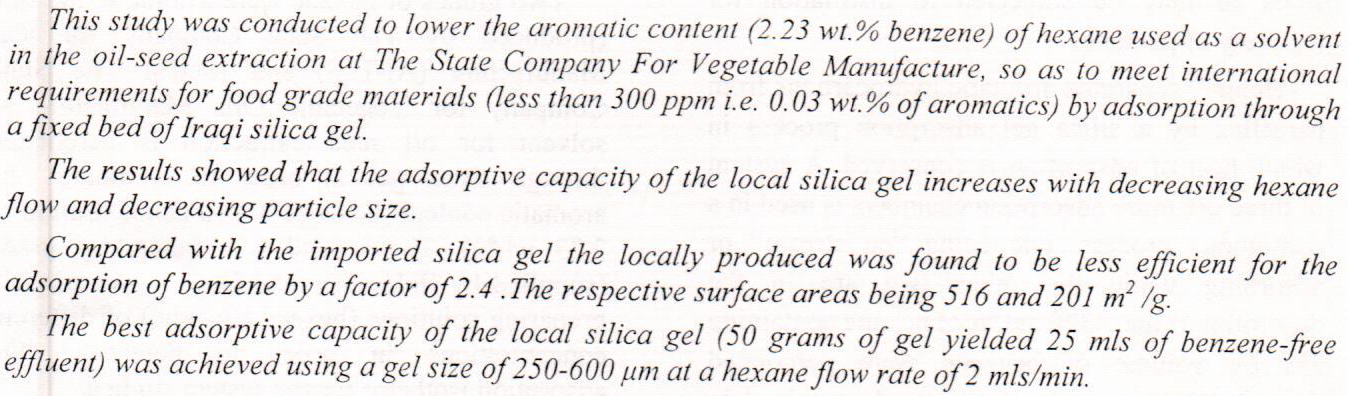
Reduction of Aromatic Content from Hexane by Silica Gel


The present study is to investigate the possibility of using wastes in the form of scrap iron (ZVI) and/ or aluminum ZVAI for the detention and immobilization of the chromium ions in simulated wastewater. Different batch equilibrium parameters such as contact time (0-250) min, sorbent dose (2-8 g ZVI/100 mL and 0.2-1 g ZVAI/100 mL), initial pH (3-6), initial pollutant concentration of 50 mg/L, and speed of agitation (0-250) rpm were investigated. Maximum contaminant removal efficiency corresponding to (96 %) at 250 min contact time, 1g ZVAI/ 6g ZVI sorbent mass ratio, pH 5.5, pollutant concentration of 50 mg/L initially, and 250 rpm agitation speed were obtained.
The best isotherm model for the batch single Cr(III) uptake by ZVI
... Show More (12)
(12)
Background: Pumpkin seeds are a valuable source of high-quality protein and can be utilized as functional food ingredients due to their properties, such as solubility, foam formation, and stability. This study aims to produce protein isolate and its enzymatic hydrolysates from local pumpkin seeds to study their properties. Methodology: Preparing defatted pumpkin seeds for protein extraction, followed by the enzymes’ hydrolysis using Trypsin and Pepsin enzymes separately and together in two methods. The determination of amino acids and the degree of hydrolysis was conducted; moreover, protein properties were studied, including solubility, emulsifying activity, stability index, foaming capacity, and stability. Results: A protein sample was
... Show MoreBacterial strains were isolated from oil-contaminated soil, in 2018, these isolates were identified, and with the aim of finding out the ability of these isolates to degrede the oil compounds, the color change of medium which added to it isolates was read by the method of Pacto Bushnell Hans. Then the change in the petroleum compounds was read by gas chromatography, for the most effective isolates.
The nine isolated bacterial showed different degrees of color change, and the isolates (Pseudomonas, Bacillus, Micrococcus) outperformed the color change amount (78, 78, 77) %, respectively, compared to the control, and the three isolates together showed the best color change of 90.7. % Compared to the control, and the
... Show More (6)
(2)
(6)
(2)


The - M ultiple mixing ratios of -transitions from levels of 56Fe populated in 56 56 Fe n n Fe ( , ) reactions are calculated by using const. S.T.M. This method has been used in other works [3,7] but with pure transition or with transitions that can be considered as pure transitions، in our work we used This method for mixed - transitions in addition to pure - transitions. The experimental angular distribution coefficients a2 was used from previous works [1] in order to calculet - values. It is clear from the results that the - values are in good agreement or consistent, within associated errors, with those reported previously [1]. The discrepancies that occur are due to inaccuracies existing in the expe
... Show More
(6)
(2)
(1)
n this study new derivatives of Schiff bases (5-10) were synthesized from the new starting material 1 . Which has been synthesized by the reaction of (1 mol.) of dichloroacetic acid with two moles of morpholine, in the presence of potassium hydroxide, Ester derivatives 2 and 3 were synthesized by the reaction of 1 with methanol or ethanol respectively in the presence of sulphuric acid as catalyst . Compound 2 was also prepared from dimethylsulphate with high yield , 2 and 3 was used to synthesized 2,2-dimorpholinylacetohydrazide 4 via reaction with NH2NH2.H2O 80% .Imines (5-10) were synthesized via the reaction of 4 with appropriate aromatic aldehydes in the presence of G.A.A as a catalyst . Derivatives compounds (1-10) were identifie
... Show More
(2)
(3)
(1)
Oryza sativa japonica (ofada rice) is largely grown in Aramoko, Abakaliki and Ofada are communities and consumed by both the poor and rich in Nigeria. A total of twenty ofada rice farmlands were identified in each study area and rice samples were randomly collected, thoroughly mixed to make a representative sample from each farmland. Soil samples were collected in each farm to a depth of 5-15cm from at least eight different points and thoroughly mixed together to form a representative sample. The samples were thereafter taken to the laboratory for preparation and spectroscopic analysis. A well-calibrated NaI(Tl) gamma-ray detector was used in spectrometric analysis of the samples and descriptive statistics was used to analyze th
... Show More
(10)
(6)