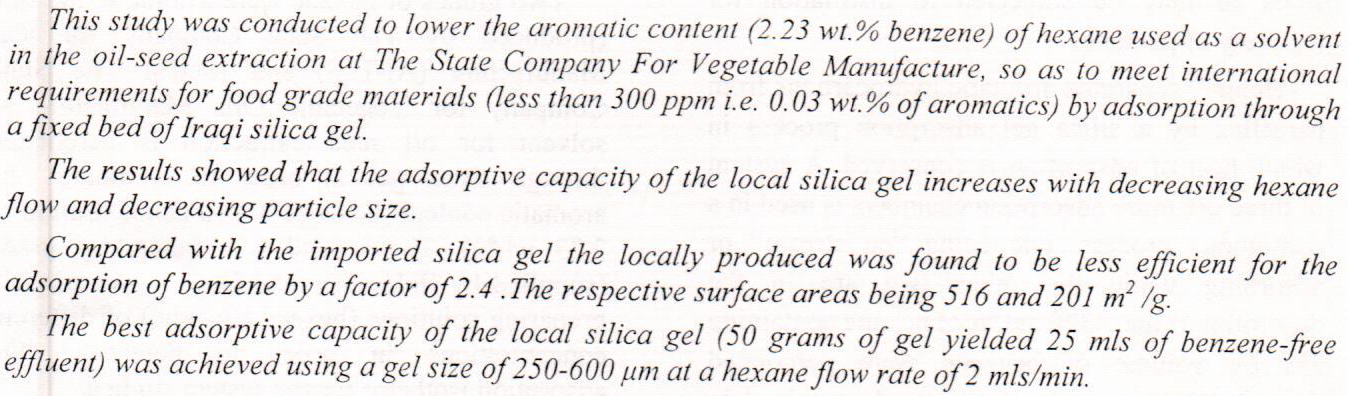
Reduction of Aromatic Content from Hexane by Silica Gel

Aeromonas salmonicida is a fish pathogen and recognized to cause a variety of diseases in humans. There are a few information about A.salmonicida in Iraq and there is no any previous molecular study on it. During the period of December 2017 to May 2018; Sixteen isolates of the A. salmonicida were isolated and identified from 300 common carp (Cyprinus carpio) fishes stomach in aquarium of Erbil city/ Iraq by using manual, automated Vitek 2 compact system, and confirmed by PCR using gene TonB-dependent siderophore (364bp). Antimicrobial susceptibility was determined by disk diffusion method and the results found that all isolates 100% susceptible to imipenem, 100% resistant to nalidixic acid and variable resistan
... Show More


Modified bentonite has been used as effective sorbent material for the removal of acidic dye (methyl orange) from aqueous solution in batch system. The natural bentonite has been modified using cationic surfactant (cetyltrimethyl ammonium bromide) in order to obtain an efficient sorbent through converting the properties of bentonite from hydrophilic to organophilic. The characteristics of the natural and modified bentonite were examined through several analyses such as Scanning electron microscopy (SEM), Fourier transform infrared spectroscopy (FTIR), and Surface area. The batch study was provided the maximum dye removal efficiency of 88.75 % with a sorption capacity of 555.56 mg/g at specified conditions (150 min, pH= 2, 250 rpm, and 0.
... Show More (4)
(4)
Synthesis of 2-mercaptobenzothiazole (A1) is performed from the reaction of o-aminothiophenol and carbon disulfide CS2 in ethanol under basic condition. Compound (A1) is reacted with chloro acetyl chloride to give compound (A2). Hydrazide acid compound (A3) is obtained from the reaction of compound (A2) with hydrazine hydrate in ethanol under reflux in the presence of glacial acetic acid .The reaction of hydrazide acid compound (A3) with ethyl acetoacetate gives pyrazole compound (A4). The new hydrazone compound (A5) was prepared from the reaction of compound (A3) with benzaldehyde. Reaction of compound
... Show More (12)
(2)
(12)
(2)
In this work, a local sunflower husk (SFH) was used as a natural surface for removing Basic Green-4 (BG4) dye, as a watersoluble pollutant. The effect of initial concentration, contact time, the mass of surface of the dye with the SFH as well as the medium temperature was studied. The application of Langmuir, Freundlich isotherms on the collected data of the adsorption process found to harmonize to Freundlich equation more than that of Langmuir. However, the adsorbed mass of BG4 dye showed a direct increase with the increase of SFH mass and equilibrium was achieved within a 60min window. The interaction of BG4 with SFH surface was spontaneous and exothermic. The empirical kinetic outcomes at ambient temperatures were applied to pseudo 1st a
... Show More
(3)
In this paper, the species of the genus of Chlaenius Bonelli, 1810 (Coleoptera, Carabidae) were reviewed, and it was revealed that there are 21 confirmed species in Iraq; among them, the species of Chlaenius hamifer Chaudoir, 1856 was recorded for the first time in Iraq.
Diagnostic characters, a redescription of some of the morphological features, photographs and illustrations are provided for the new record species in this investigation.
In this study, the photodegradation of Congo red dye (CR) in aqueous solution was investigated using Au-Pd/TiO2 as photocatalyst. The concentration of dye, dosage of photocatalyst, amount of H2O2, pH of the medium and temperature were examined to find the optimum values of these parameters. It has been found that 28 ppm was the best dye concentration. The optimum amount of photocatalyst was 0.09 g/75 mL of dye solution when the degradation percent was ~ 96 % after irradiation time of 12 hours, while the best amount of hydrogen peroxide was 7μl/75 mL of dye solution at degradation percent ~97 % after irradiation time of 10 hours, whereas pH 5 was the best value to carry out the reaction at the highest deg
... Show More
(20)
(13)
Since its first description as a cytotoxic agent, Olea europaea leaves extract gained significant popularity against human breast cancer, ethyl acetate extract of Olea europaea leaves obtained by acid hydrolysis method was evaluated in vitro as cytotoxic agent against new human breast cancer (AMJ13) cell line, using the MTT assay. One main pentacyclic triterpenoid; oleanolic acid, was isolated from leaves of Olea europaea by well-known two different methods, but not used for this compound before, the acidic hydrolysis method and basic acidic method. The presence of oleanolic acid was proved in both methods with qualitative and quantitative d
... Show More
(7)
(1)
(24)