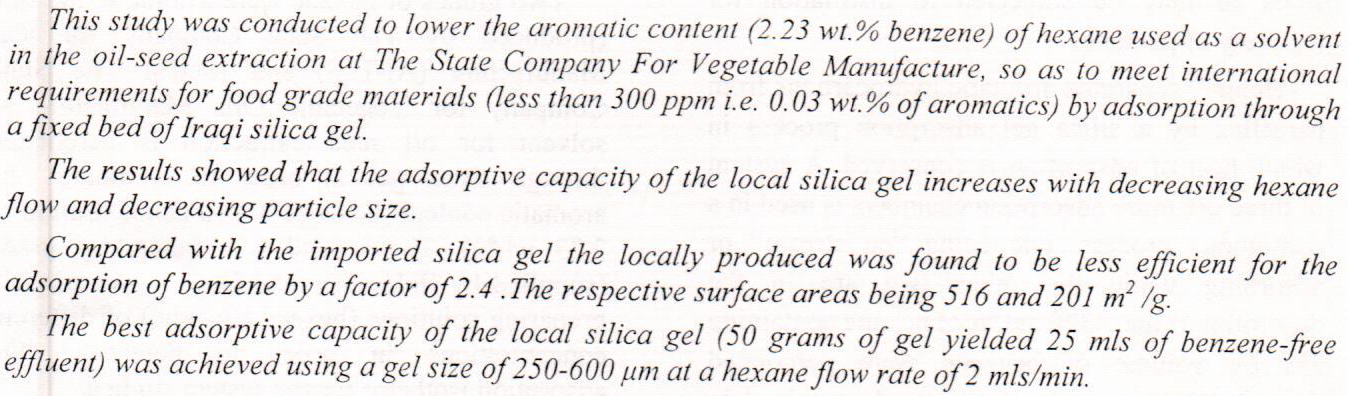
Reduction of Aromatic Content from Hexane by Silica Gel

Abstract Background: Multidrug-resistant bacteria (MDR) often contaminate hospital environment and cause serious illnesses. Quorum Sensing (QS) regulates a variety of downstream cellular processes, including antibiotics resistance mechanisms and biofilm formation, and causes harm to the host. This study investigates antibacterial susceptibility and biofilm formation of pathogenic bacteria in hospital environment. Methods: Hundred bacterial isolates were collected from various environments in the Medical City hospital. The antimicrobial susceptibility technique was evaluated through disk diffusion method. Next, biofilms formation was detected by the microliter plate assay. Finally, PCR was used to analyze the frequency of QS system gene
... Show More (2)
(2)

Many stone tools were found on a hill south of the Hor Al-Dalmaj which is located in the central part of the alluvial plain of Mesopotamia, between the Tigris and Euphrates Rivers. The types of rocks from which the studied stone tools were made are not found in the alluvial plain, because it consists of friable sand, silt, and clay. All existing sediments were precipitated in riverine environments such as point bar, over bank, and floodplain sediments. The collected stone tools were described with a magnifying glass (10 x) and a polarized microscope after they were thin sectioned. Microscopic analysis showed that these stone tools are made of sedimentary, volcanic igneous and metamorphic rocks, such as: sandstones, limestones, chert, con
... Show More
(1)

This study aimed at isolating uropathogenic Escherichia coli from urinary tract infections (UTIs) of human and cattle to examine the molecular diversity and phylogenetic relationship of the isolates. A total of 100 urine samples were collected from UTIs of human and cattle. The isolates identification was done using routine diagnostic methods and confirmed by Vitek2. Antimicrobial susceptibility was tested against 10 antimicrobials. Random amplified polymorphic DNA (RAPD)-polymerase chain reaction (PCR) was applied to identify the genetic diversity among E. coli isolates from human and animal origin by using five different octamer primers. The gelJ software for the phylogenetic analysis created Dendrograms. Out of 50 human urine samples, E.
... Show More
(7)
The foreguts of a total of 515 fish of Chondrostoma regium (Heckel, 1843) (locally: Bala’aot Malloky) were studied. These fish were collected from Tigris River at Salah Al-Deen Province (between Al-Hagag & Yathrib) for 20 months between March and October of the next year. Detritus, plant in origin materials (19.6%, 23.0% & 24.9%); green and blue green algae, mostly Cladophora, Cosmarium and Merismpedia sp. (17.1%, 12.9% & 12.2%) and diatoms, mostly Diatoma, Chanathes, Amphora and Cyulbella sp. (16.9%, 8.8% & 8.2%) were the main food categories taken by these fishes according to occurrence (O%), volumetric methods (V%) and ranking index (R%). Debris (not part of the diet) took 45.3% of the studied fish foreguts by volume. Detritus was also
... Show More
A qualitative chemical test was performed on functional groups extracted from fenugreek plant and its extracts (aqueous, alcoholic and volatile oil). Results revealed that fenugreek seeds contain the main functional groups, while extracts are varied accorodihg to their content of functional groups qualitatively and quantitively. Moreover, inhibition activity was tested for extracts of fenugreek seeds (aqueous, alcoholic and volatile oil). against gram negative (Salmonella typhimurium, Escherichia coli and Pseudomonas aeruginosa) and gram positive (Staphylococcus aureus) by the ager well diffusion method. Data have revealed that inhibition activity was different in accoradance with extract solvent and the tested microorgan. Oil extract (15)%
... Show MoreThe purpose of this study to synthesize and characterize silver nanoparticles using phenolic compounds obtained from Camellia sinensis, to test the antibacterial properties of biosynthesized nanoparticles on the formation of biofilms in multidrug-resistant Pseudomonas aeruginosa. Ten isolates of P. aeruginosa were obtained from the Genetic Engineering and Biotechnology Institute laboratories of the University of Baghdad. By using the VITEK-2 system and culturing the isolates on cetrimide agar, the diagnosis was confirmed. Camellia sinensis silver nanoparticles (CAgNPs) were created using an extract of the plant's aqueous and methanolic leaves. Based on the results of the nanoparticle synthesis, spherical nanoparticles that may be single or
... Show More (5)
(5)
Coagulation - flocculation are basic chemical engineering method in the treatment of metal-bearing industrial wastewater because it removes colloidal particles, some soluble compounds and very fine solid suspensions initially present in the wastewater by destabilization and formation of flocs. This research was conducted to study the feasibility of using natural coagulant such as okra and mallow and chemical coagulant such as alum for removing Cu and increase the removal efficiency and reduce the turbidity of treated water. Fourier transform Infrared (FTIR) was carried out for okra and mallow before and after coagulant to determine their type of functional groups. Carbonyl and hydroxyl functional groups on the surface of
... Show More
(61)
(44)

For this research, the utilisation of electrocoagulation (EC) toremove theciprofloxacin (CIP) and levofloxacin (LVX) from aqueous solutions was examined. The effective removal efficiencies are 93.47% for CIP and 88.00% for LVX, under optimum conditions. The adsorption isotherm models with suitable mechanisms were applied to determine the elimination of CIP and LVX utilizingtheEC method. Thefindingsshowed the adsorption of CIP and LVX on iron hydroxide flocs followed the Sips isotherm, with correlation coefficient values (R2) of 0.939 and 0.937. Threekinetic models were reviewed to determine the accurate CIP and LVX elimination methods using the EC method. The results showed that itfittedfor the second-order model, which indicated that the c
... Show More
(38)