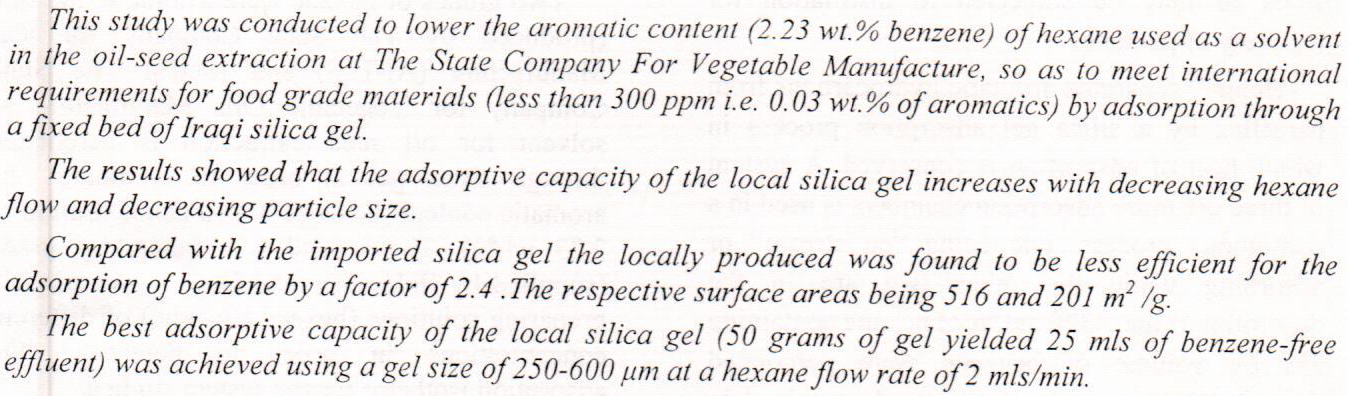
Reduction of Aromatic Content from Hexane by Silica Gel

The present work aims to study the possibility of utilization a forward osmosis desalination process as an alternative method to extract water from brine solution rejected from reverse osmosis process.
Experiments conducted in a laboratory–scale forward osmosis (FO) unit in cross flow flat sheet membrane cell yielded water flux ranging from (0.0315 to 0.56 L/m2 .min) when using CTA membrane,and ranging from (0.419 to 2.785 L/m2 .min) for PA membrane under 0.4 bar. Two possible membrane orientations were tested. Sodium chloride with high concentrations was used as draw solution solute. The effect of membrane orientation on internal concentration polarization (ICP) was studied. Two regimes of ICP; dilutive and concentrative were desc
 (5)
(5)

This paper describes the synthesis of ?- Fe2O3 nanoparticles by sol-gel route using carboxylic acid(2-hydroxy benzoic acid) as gelatin media and its photo activity for degradation of cibacron red dye . Hematite samples are synthesized at different temperatures: 400, 500, 600, 700, 800 and 900 ?C at 700 ?C the ?-Fe2O3 nanoparticles are formed with particle size 71.93 nm. The nanoparticles are characterized by XRD , SEM, AFM and FTIR . The 0.046 g /l of the catalyst sample shows high photo activity at 3x10⁻⁵M dye concentration in acidic medium at pH 3.
 (2)
(3)
(2)
(3)

Background: Meclizine hydrochloride (MCZ) is an antihistamine that is used as an antiemetic to prevent and cure nausea and vomiting. Because of its limited water solubility and first-pass metabolism, it exhibits variable absorption. Objective: To formulate and evaluate MCZ as an intranasal in situ gel with increased residence time and permeability. Methods: We made an inclusion complex of MCZ using various cyclodextrins as a complexing agent to help the drug dissolve better. The complexes were studied, and the ones that were better at dissolving were chosen to be used in the creation of an in situ gel with poloxamer 407 (17–20% w/v) and hyaluronic acid (0.25–0.75% w/v). Prepared formulas were subjected to various evaluation tes
... Show More
(9)
(8)
(36)
(36)

Molasse medium containing different concentrations of (NH4)2 SO4, (NH4)3 PO4, urea, KCI, and P2O5 were compared with the medium used for commercial production of C. utilis in a factory south of Iraq. An efficient medium, which produced 19. 16% dry wt. and 5. 78% protein, was developed. The effect of adding various concentrations of micronutrients (FeSO4, 7T20, MnSO4. 7H20, ZnSO4. 7E20) was also studied. Results showed that FeSo4. 7H20 caused a noticeable increase in both dry wt. and protein content of the yeast.
This work was conducted to study the extraction of eucalyptus oil from natural plants (Eucalyptus camadulensis leaves) by organic solvents. the effects of the main operating parameters were studied; type of solvent (n-hexane and ethanol), time to reach equilibrium, the temperature (45°C to 65°C) for n-hexane and (45°C to 75°C) for ethanol, solvent to solid ratio (5:1 to 8:1 (v/w)), agitation speed (0 to 900 rpm) and the particle size (0.5 to 2.5 cm) of fresh leaves to find the best processing conditions for the achieving maximum oil yield. The concentration of eucalyptus oil in solvent was measured by using UV-spectrophotometer. The results (for n-hexane) showed that the agitation speed of 900 rpm, temperature 65°C with solvent to soli
... Show MoreThe presence of hydrocarbons in the soil is considered one of the main problems of pollution. In our current study, eight samples isolated from soil saturated with hydrocarbons were taken from different areas of Baghdad, Iraq. In this study, 5 isolates belonging to Pseudomonas aeruginosa by 99%, 4 isolates to Klebsiella pneumoniae by 98%, and 3 isolates to Enterobacter hormaechei by 97% were diagnosed in different ways. A molecular examination was also conducted by 16sRNA. We recorded P. aeruginosa, K. Pneumoniae and E. hormaechei as new local isolates in NCBI. In addition, a comparison was made between our isolates and the global isolates to determine the degree of convergence in the evolutionary line. The genes alkB and nahAc7 were diagno
... Show More
(4)
This research aimed to examine the effect of concentration of dyes stuff, contact time, temperature and ratio of adsorbent weight in (gm) to volume of solution in (ml) on the percentage removal. Two dyes were used; direct blue 6 and direct yellow and the adsorbent was the maize cob. Batch experiments were performed by contacting different weights of adsorbent with 50 ml of solution of desired concentration with continuous stirring at various temperatures. The percentage of removal was calculated and the maximum percentage of removal was 80%. And as the concentration of solution, contact time, temperature and the ratio of adsorbent to volume of solution increase the percentage of removal increase.
In this work, a novel biocatalytic process for the production of 7-methylxanthines from theobromine, an economic feedstock has been developed. Bench scale production of 7-methlxanthine has been demonstrated. The biocatalytic process used in this work operates at 30 OC and atmospheric pressure, and is environmentally friendly. The biocatalyst was E. coli BL21(DE3) engineered with ndmB/D genes combinations. These modifications enabled specific N7- demethylation of theobromine to 7-methylxanthine. This production process consists of uniform fermentation conditions with a specific metabolically engineered strain, uniform induction of specific enzymes for 7-methylxanthine production, uniform recovery an
... Show More
(9)
Industrial wastewater containing nickel, lead, and copper can be produced by many industries. The reverse osmosis (RO) membrane technologies are very efficient for the treatment of industrial wastewater containing nickel, lead, and copper ions to reduce water consumption and preserving the environment. Synthetic industrial wastewater samples containing Ni(II), Pb(II), and Cu(II) ions at various concentrations (50 to 200 ppm), pressures (1 to 4 bar), temperatures (10 to 40 oC), pH (2 to 5.5), and flow rates (10 to 40 L/hr), were prepared and subjected to treatment by RO system in the laboratory. The results showed that high removal efficiency of the heavy metals could be achieved by RO process (98.5%, 97.5% and 96% for Ni(II),
... Show More