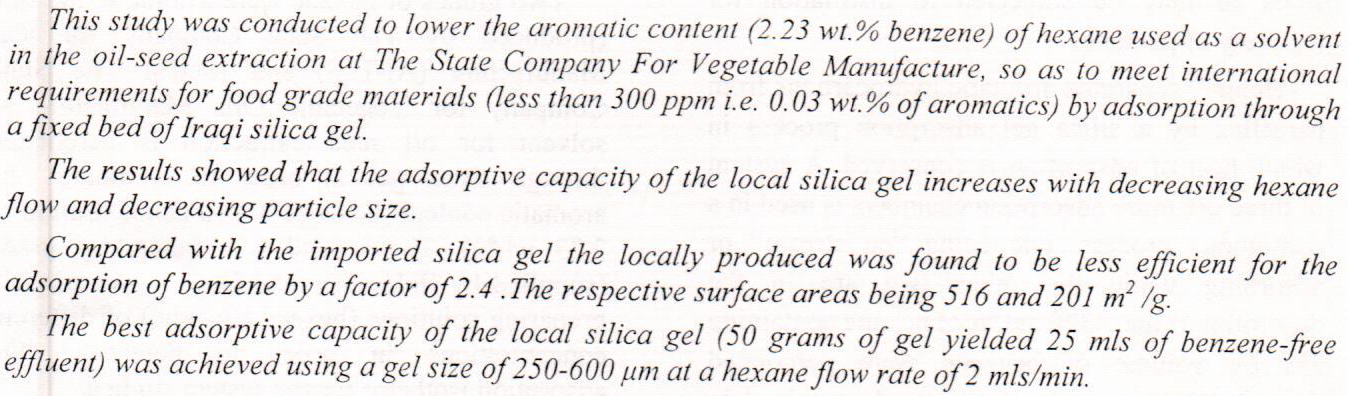
Reduction of Aromatic Content from Hexane by Silica Gel

The aim of this work is to enhance the mechanical properties of the glass ionomer cement GIC (dental materials) by adding Zirconium Oxide ZrO2 in both micro and nano particles. GIC were mixed with (3, 5 and 7) wt% of both ZrO2 micro and nanoparticles separately. Compressive strength (CS), biaxial flexural strength (BFS), Vickers Microhardness (VH) and wear rate losses (WR) were investigated. The maximum compression strength was 122.31 MPa with 5 wt. % ZrO2 micro particle, while 3wt% nanoparticles give highest Microhardness and biaxial flexural strength of 88.8 VHN and 35.79 MPa respectively. The minimum wear rate losses were 3.776µg/m with 7 wt. % ZrO2 nanoparticle. GIC-contai
... Show More (16)
(16)

TiO2 thin films have been deposited at different concentration of
CdO of (x= 0.0, 0.05, 0.1, 0.15 and 0.2) Wt. % onto glass substrates
by pulsed laser deposition technique (PLD) using Nd-YAG laser
with λ=1064nm, energy=800mJ and number of shots=500. The
thickness of the film was 200nm. The films were annealed to
different annealing (423 and 523) k. The effect of annealing
temperatures and concentration of CdO on the structural and
photoluminescence (PL) properties were investigated. X-ray
diffraction (XRD) results reveals that the deposited TiO2(1-x)CdOx
thin films were polycrystalline with tetragonal structure and many
peaks were appeared at (110), (101), (111) and (211) planes with
preferred orientatio
The properties of structural and optical of pure and doped nano titanium dioxide (TiO2) films, prepared using chemical spray pyrolysis (CPS) technique, with different nanosize nickel oxide (NiO) concentrations in the range (3-9)wt% have been studied. X-Ray diffraction (XRD) technique where using to analysis the structure properties of the prepared thin films. The results revealed that the structure properties of TiO2 have polycrystalline structure with anatase phase. The parameters, energy gap, extinction coefficient, refractive index, real and imaginary parts were studied using absorbance and transmittance measurements from a computerized ultraviolet visible spectrophotometer (Shimadzu UV-1601 PC) in the wavelength
... Show More
(3)
In this work, silicon nitride (Si3N4) thin films were deposited on metallic substrates (aluminium and titanium sheets) by the DC reactive sputtering technique using two different silicon targets (n-type and p-type Si wafers) as well as two Ar:N2 gas mixing ratios (50:50 and 70:30). The electrical conductivity of the metallic (aluminium and titanium) substrates was measured before and after the deposition of silicon nitride thin films on both surfaces of the substrates. The results obtained from this work showed that the deposited films, in general, reduced the electrical conductivity of the substrates, and the thin films prepared from n-type silicon targets using a 50:50 mixing ratio and deposited on both
... Show More
Cu X Zn1-XO films with different x content have been prepared by
pulse laser deposition technique at room temperatures (RT) and
different annealing temperatures (373 and 473) K. The effect of x
content of Cu (0, 0.2, 0.4, 0.6, 0.8) wt.% on morphology and
electrical properties of CuXZn1-XO thin films have been studied.
AFM measurements showed that the average grain size values for
CuXZn1-xO thin films at RT and different annealing temperatures
(373, 473) K decreases, while the average Roughness values increase
with increasing x content. The D.C conductivity for all films
increases as the x content increase and decreases with increasing the
annealing temperatures. Hall measurements showed that there are
two
 (49)
(42)
(49)
(42)


|
Copper oxide thin films were synthesized by using spray pyrolysis deposition technique, in the temperature around 400°C in atmosphere from alcoholic solutions. Copper (II) chloride as precursor and glass as a substrate. The textural and structural properties of the films were characterized by atomic force microscopy (AFM), X-ray diffraction (XRD). The average particle size determined from the AFM images ranged from 30 to 90 nm and the roughness average was equal to 9.3 nm. The XRD patterns revealed the formation of a polycrystalline hexagonal CuO. The absorption and transmission spectrum, band gap, film thickness was investigated. The films were tested as an |
(1)
Two simple methods spectrophotometric were suggested for the determination of Cefixime (CFX) in pure form and pharmaceutical preparation. The first method is based without cloud point (CPE) on diazotization of the Cefixime drug by sodium nitrite at 5Cº followed by coupling with ortho nitro phenol in basic medium to form orange colour. The product was stabilized and measured 400 nm. Beer’s law was obeyed in the concentration range of (10-160) μg∙mL-1 Sandell’s sensitivity was 0.0888μg∙cm-1, the detection limit was 0.07896μg∙mL-1, and the limit of Quantitation was 0.085389μg∙mL-1.The second method was cloud point extraction (CPE) with using Trtion X-114 as surfactant. Beer
... Show More
(3)
(1)
Polyaromatic hydrocarbons (PAHs) are a group of aromatic compounds that contain at least two rings. These compounds are found naturally in petroleum products and are considered the most prevalent pollutants in the environment. The lack of microorganism capable of degrading some PAHs led to their accumulation in the environment which usually causes major health problems as many of these compounds are known carcinogens. Xanthene is one of the small PAHs which has three rings. Many xanthene derivatives are useful dyes that are used for dyeing wood and cosmetic articles. However, several studies have illustrated that these compounds have toxic and carcinogenic effects. The first step of the bacterial degradation of xanthene is conducted by d
... Show More
(6)
(5)
In this study, successive electrocoagulation (EC) and electro-oxidation (EO) processes were used to minimize some of the major pollutants in real wastewater, such as organics (detected by chemical oxygen demand (COD)), and turbidity. The wastewater utilized in the present study was collected from the Midland Refinery Company in Baghdad-Iraq. The performance of the successive batch EC-EO processes was studied by utilizing Graphite and Aluminum (Al) as monopolar anode electrodes and stainless steel (st.st.) as the cathode. The Taguchi experimental design approach was used to attain the best experimental conditions for COD reduction as a major response. Starting from chemical oxygen demand COD of (600 ppm), the effects of current densi
... Show More
(22)