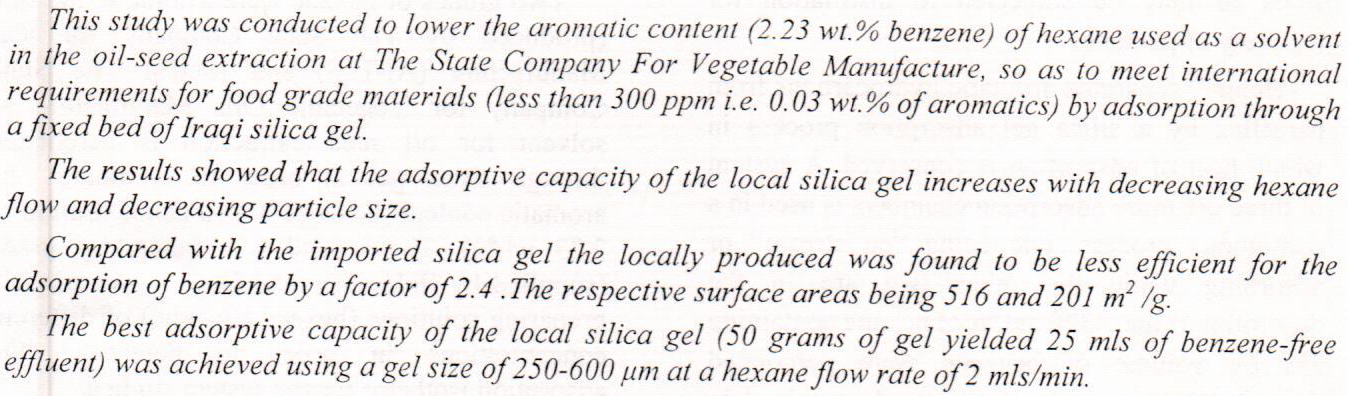
Reduction of Aromatic Content from Hexane by Silica Gel

Specialized hardware implementations of Artificial Neural Networks (ANNs) can offer faster execution than general-purpose microprocessors by taking advantage of reusable modules, parallel processes and specialized computational components. Modern high-density Field Programmable Gate Arrays (FPGAs) offer the required flexibility and fast design-to-implementation time with the possibility of exploiting highly parallel computations like those required by ANNs in hardware. The bounded width of the data in FPGA ANNs will add an additional error to the result of the output. This paper derives the equations of the additional error value that generate from bounded width of the data and proposed a method to reduce the effect of the error to give
... Show MoreThe development of human resources training programs has an applied and important role in the preparation of human cadresin terms of capacity to absorb technical sciences and skills and scientific and practical practices at faster rates in order to bealighed with continous development. Hence the recognition of the significant role that human resources play in the economy of any country,which has stressed the interest towards the economic unity of the qualified staff that it needsin atimely manner through the ongoing training process in the era of high technology day by day In this regard ,the current research deal with accounting of human resources and its impact on reducing costs in the military establishment and the
... Show More
The Reversed Phase High Performance Liquid Chromatography (RP-HPLC) has been used for the separation of Poly aromatic hydrocarbons(PAHs) by using column Reprosil 100 C 18 which was found to be a suitable one for this purpose. The result showed that using mobile phase of (Acetonitrile-water) Reversed Phase HPLC , flow rate of (1.2 ml/min) , column temperature (30CËš) and wave length of (254nm), give a complete separation with a good resolution . The total separation time was less than 20 min. The result of the study showed that the vegetables of Baghdad city were polluted by poly aromatic hydrocarbons(PAHs) in different places where samples taken because of drainage of the heavy water ,industrial trash and trash of oil colanders. -
... Show MoreBackground: Large amounts of oily wastewater and its derivatives are discharged annually from several industries to the environment. Objective: The present study aims to investigate the ability to remove oil content and turbidity from real oily wastewater discharged from the wet oil's unit (West Qurna 1-Crude Oil Location/ Basra-Iraq) by using an innovated electrocoagulation reactor containing concentric aluminum tubes in a monopolar mode. Methods: The influences of the operational variables (current density (1.77-7.07 mA/cm2) and electrolysis time (10-40 min)) were studied using response surface methodology (RSM) and Minitab-17 statistical program. The agitation speed was taken as 200 rpm. Energy and electrodes consumption had been studi
... Show More (22)
(22)
The sol-gel preparation technique of transparent silica monoliths containing up to 0.5 M of samarium have been described. The sol-gel processing parameters are: acid catalyzed hydrolysis and controlled drying. The prepared monoliths are analyzed by X-ray diffraction, pycnometer measurements, Fourier transformation infrared spectroscopy and optical spectroscopy. The oscillator strengths of the Sm3+ ions in the silica monoliths are calculated. The results show a linear concentration dependence of some Sm3+ transitions in UV/Vis absorption spectra and formation of Sm3+ clusters inside the pores structure of silica monoliths at high Sm3+ concentration
The ceramic composite with different proportions of clay and silica was prepared with a grain size of 70 μm and the weight percentage was selected for four groups (clayx silica100-x) were x q15, 25, 30 and 50. In this manuscript, for each pressured sample, a sintering procedure was carried out for 3 hours under static air and at various sintering temperatures (1000, 1100, 1200, 1400)°C. After sintering, the density, porosity, water absorption, compression strength and thermal conductivity were measured. The best results were obtained using a mixture of 15% clay and 85% silica which were sintering at 1400°C for three hours under air.
 (14)
(12)
(14)
(12)


SiO2 nanostructure is synthesized by the Sol-Gel method and thin films are prepared using dip coating technique. The effect of laser densification is studied. X-ray Diffraction (XRD), Fourier Transformation Infrared Spectrometer (FTIR), and Field Emission Scanning Electron Microscopy (FESEM) are used to analyze the samples. The results show that the silica nanoparticles are successfully synthesized by the sol-gel method after laser densification. XRD patterns show that cristobalite structure is observed from diode laser (410 nm) rather than diode laser (532 nm). FESEM images showed that the shape of nano silica is spherical and the particles size is in nano range (? 100 nm). It is concluded that the spherical nanocrystal structure of silica
... Show More
(3)
(1)
Audio classification is the process to classify different audio types according to contents. It is implemented in a large variety of real world problems, all classification applications allowed the target subjects to be viewed as a specific type of audio and hence, there is a variety in the audio types and every type has to be treatedcarefully according to its significant properties.Feature extraction is an important process for audio classification. This workintroduces several sets of features according to the type, two types of audio (datasets) were studied. Two different features sets are proposed: (i) firstorder gradient feature vector, and (ii) Local roughness feature vector, the experimentsshowed that the results are competitive to
... Show More