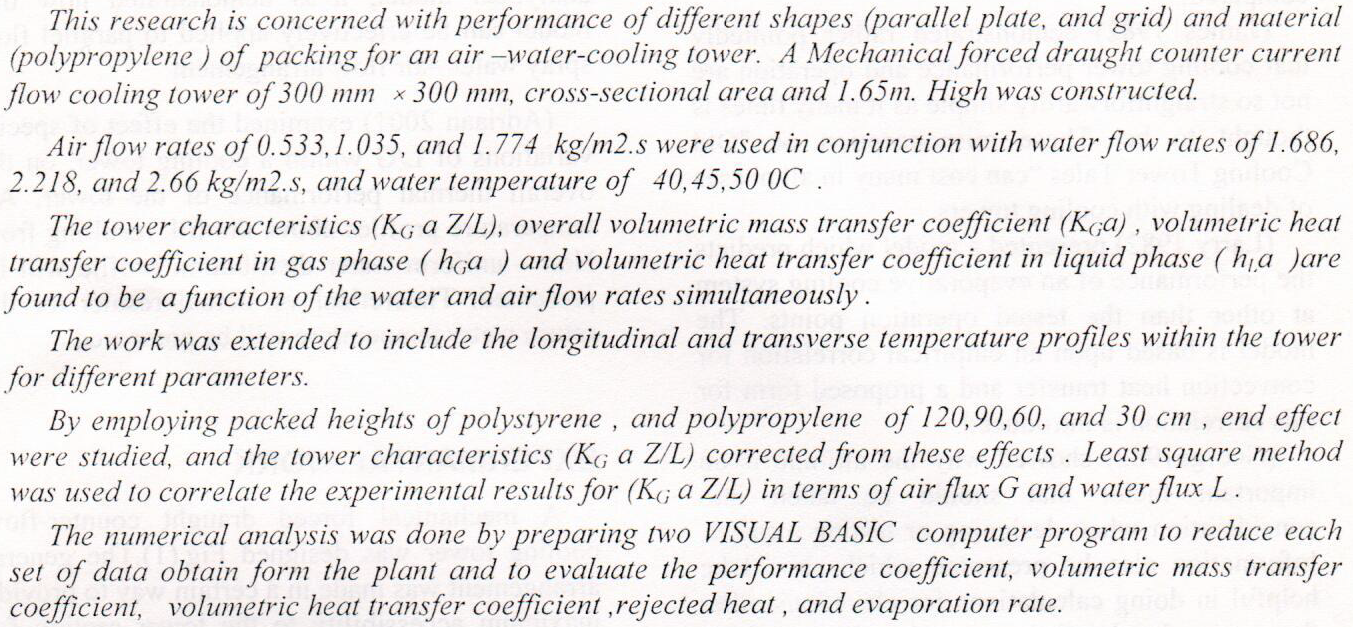
Performance of Countercurrent Flow Cooling Towers

The most important recommendations of this research are:-
1.The benefit of the other countries experiences about the transparency of the government performance, without depending on the transparency that imitating the other experiences; that may not fit with the Iraqi government units.
2.The Ministry of Finance has to prepare the citizen guidebook about the government performance which is considered an essential document, it should be simple and available for all the parties of relation; and for not specialized citizen for the purpose of simplifying the understanding of government performance details.
3.The benefit of the government units websites of inte
... Show More
The luxury of the grace and the extension of the vioa of the subjects that attract two teams of opinion,
Addame
QF Faba believes that
Meet
.
And poverty is the best in human life, and others see it
And Joe titling
Grace, and not for man to suffer as long as stigmatized and
Try not to have money.
And in recent years
G
F
S
A lot of people bypassing
.
I see who says austerity in
Thou shalt not see grace
Color of and
Luxury has been promoted to the religious life of
M
A lounge
And others, and a team of worshipers to distance themselves from the mantle of turquoise,
Faleh me
I was looking at this part because I did not
.
See my opinion
Insurance Companies perform a prominent role in providing services and bolstering national economy, and they contribute in achieving the aims of the economic development plans in addition to many other social and economic benefits. So it is necessary to evaluate the activity of these companies continuously to define performance level and its nature. Financial analysis is one of the important instruments that helps in analyzing and explanation of data in such a way that enable administration to define performance level and diagnosing strength and weakness points. This study tackles the state of affairs of the Iraqi Insurance Company which is considered as one of the active national institutions, due to its distinguished role in collecting
... Show MoreBatch reactive distillation was studied in packed bed column. Esterification of methanol with acetic acid to produce methyl acetate and water with homogenous sulfuric acid as a catalyst was considered. This system was chosen because the reaction is reversible and the boiling point of reactant and products are different.
The reaction was carried out with and without distillation column and shows that the reactive distillation is more efficient from the conventional process (reactor and then separation). The conversion of acetic acid and concentration of methyl acetate increase by (30.43% and 75.14%) respectively at the best condition (reflux ratio 2, feed mole ratio 2 and batch time 90 minute).
The influence of various parameters, s
 (10)
(10)
 (7)
(7)


Existing leachate models over–or underestimates leachate generation by up to three orders of magnitude. Practical experiments show that channeled flow in waste leads to rapid discharge of large leachate volumes and heterogeneous moisture distribution. In order to more accurately predict leachate generation, leachate models must be improved. To predict moisture movement through waste, the two–domain PREFLO, are tested. Experimental waste and leachate flow values are compared with model predictions. When calibrated with experimental parameters, the PREFLO provides estimates of breakthrough time. In the short term, field capacity has to be reduced to 0.12 and effective storage and hydraulic conductivity of the waste must be increased to
... Show More
(23)
(19)
(9)
(9)
