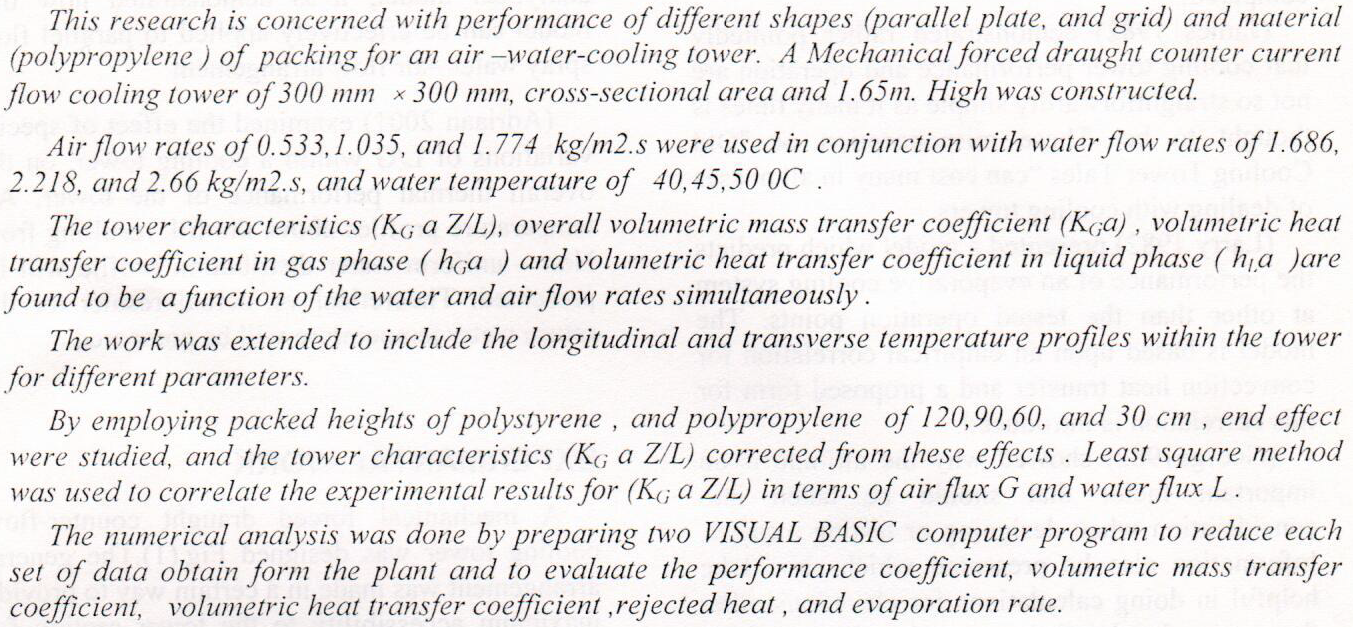
Performance of Countercurrent Flow Cooling Towers

Experimental and numerical studies have been conducted on the effects of bed roughness elements such as cubic and T-section elements that are regularly half-channel arrayed on one side of the river on turbulent flow characteristics and bed erosion downstream of the roughness elements. The experimental study has been done for two types of bed roughness elements (cubic and T-section shape) to study the effect of these elements on the velocity profile downstream the elements with respect to different water flow discharges and water depths. A comparison between the cubic and T-section artificial bed roughness showed that the velocity profile downstream the T-section increased in smooth side from the river and decrease in the rough side
... Show More (2)
(2)

 (5)
(5)
 (4)
(4)
High performance work systems and general industrial enterprise performance
(1)
(20)
This paper deals with an up to date problem for oil and gas industry- separation of the gas -fluid fogs. Here is described the worked out physical model of the gas movement process in the sections of the inertial filtering (IF) gas separators. One can find the mathematical model for research of the fields of velocities and pressures in the inertial curvilinear channel. The main simplifications and assumptions are explained. This mathematical model has been made using mathematical program Maple and it is received the 3-d graphic of the distribution componential speed parts in the channel and also 2-d graphics at the channel sectional view when the flow is flat. The new method for gas - fluid systems separation is suggested.
An overall mathematical model for copper pipe corrosion in flowing water was derived based on mass transfer fundamentals where we introduced the effects of boundary layer velocity, bulk flow velocity and the surface oxide protective film on the corrosion rate. A set of experiments were conducted in a straight 10mm diameter copper pipe, flow of water include six velocities of maximum value 7.33m/sec at 200C and 350C. The good agreement between the calculated and experimental corrosion rate values were achieved , the agreement reached 92% .
Human interaction technology based on motion capture (MoCap) systems is a vital tool for human kinematics analysis, with applications in clinical settings, animations, and video games. We introduce a new method for analyzing and estimating dorsal spine movement using a MoCap system. The captured data by the MoCap system are processed and analyzed to estimate the motion kinematics of three primary regions; the shoulders, spine, and hips. This work contributes a non-invasive and anatomically guided framework that enables region-specific analysis of spinal motion which could be used as a clinical alternative to invasive measurement techniques. The hierarchy of our model consists of five main levels; motion capture system settings, marker data
... Show More

In this paper it is required to enhance the performance of a mechanical system (here: a Hoisting System) where it is preferred to lift a different payloads with approximately the same speed of lifting and keeping at the same time the good performance, and this of course needs some intelligence of the system which will be responsible on measuring the present load and taking into account the speed and performance desired in order to achieve the requirements or the criteria. The process therefore is a Mechatronics System design which includes a measuring system, a control or automation technique, and an actuating system. The criteria built here in this research using a given Hoist system's characteristics and parameters and changing one of
... Show More