The Optimal Corrosion Inhibition of Aluminum in 0.1M NaCl Solution
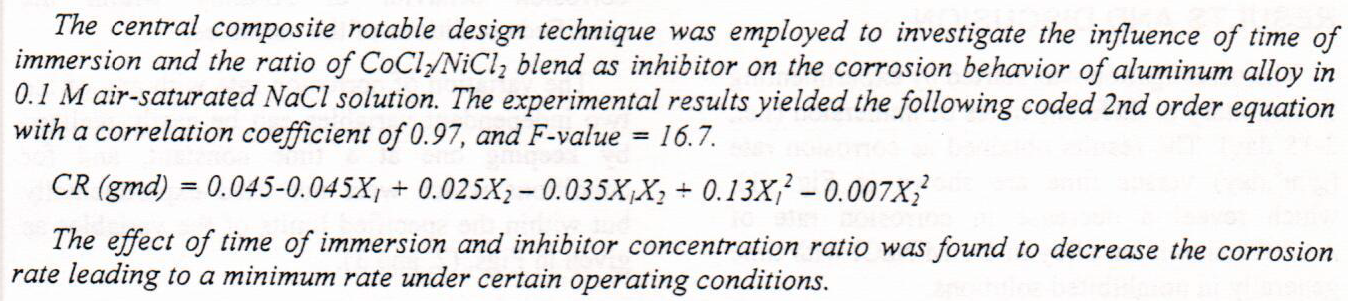

 (37)
(37)
 (38)
(38)



The present researchers are trying to enhance the properties of paper sheet that used widely in many fields such as printing and packaging. The enhancement of paper quality is also possible to preserve paper documents of all kinds, as they are the true record, full of the history, achievements of the human being and the intellectual and cultural of the country. It is possible to improve its physical and mechanical properties and preserve them from damage through the use of some solutions of polymeric adhesives, which act as protective barriers against water and moisture penetration. The paper also has the advantage of porosity, which has been overcome by using three types of polymeric adhesives (Nitro Cellulose, Polyvinyl alcohol acetate, a
... Show More
(2)
Modeling forward kinematics with neural networks allows for efficient handling of nonlinear relationships and realistic error correction in time-critical applications by relying on accurate training data. This paper presents a Multi-Layer Feed-Forward Neural Network (MLFFNN) to solve the forward kinematics of a 3-DOF robot. The proposed MLFFNN consists of 50 hidden neurons and was trained using 628319 samples to find only the position (x, y, z) of the end-effector. Data were generated by MATLAB, assuming an incremental motion of joints. The joint variables ( , , and ) are the inputs of the NN, which outputs the positions of the end effector (x, y, z) calculated using the Denavit-Hartenberg (DH) method. The results demonstrate that t
... Show More
In the cuurent article, the photophysical properties of 3,6-bis(5-bromothiophen-2-yl)-2,5-bis(2-ethylhexyl)-2,5-dihydropyrrolo[3,4-c]pyrrole-1,4-dione were investigated. The visible absorption bands at 527, 558 and 362 nm in propylene carbonate and the compound was found to be fluorescent in solution and in the plastic film with emission wavelengths between 550- 750 nm. The Stokes Shift of P.C., acetonitrile, diethyl ether, Tetrahydrofuran THF, cyclohexane, dibutyl ether, and dichloromethane DCM are 734, 836, 668, 601, 601, 719, and 804 cm-1 in respectively. The Stokes Shift Δ was less in THF and cyclohexane, than the solvents, which indicates that the energy loss is less between the excitation and fluorescence states. The
... Show More
(30)
(22)
The present work utilizes polyacrylic acid beads (PAA) to remove Alizarin yellow R (AYR)] and Alizarin Red S (ARS) from its solution. The isotherms of adsorption were investigated and the factors that impact them, such as temperature, ionic strength effect, shaking effect, and wet PAA. The isotherms of adsorption of (ARS) were found obeys the Freundlich equation. The isotherms of adsorption of (AYR) were found obeys the Langmuir equation. At various temperatures, the adsorption process on (PAA) was investigated. According to our data, there is a positive correlation between the (ARS and AYR) adsorption on the PAA and temperature (Endothermic process). The computation of the thermodynamic functions (ΔH, ΔG, and ΔS) is based on the foregoi
... Show More
(1)
In the theoretical part, removal of direct yellow 8 (DY8) from water solution was accomplished using Bentonite Clay as an adsorbent. Under batch adsorption, the adsorption was observed as a function of contact time, adsorbent dosage, pH, and temperature. The equilibrium data were fitted with the Langmuir and Freundlich adsorption models, and the linear regression coefficient R2 was used to determine the best fitting isotherm model. thermodynamic parameters of the ongoing adsorption mechanism, such as Gibb's free energy, enthalpy, and entropy, have also been measured. The batch method was also used for the kinetic calculations, and the day's adsorption assumes first-order rate kinetics. The kinetic studies also show that the intrapar
... Show More
The Boltzmann transport equation is solved by using two- terms approximation for pure gases . This method of solution is used to calculate the electron energy distribution function and electric transport parameters were evaluated in the range of E/N varying from . 172152110./510.VcmENVcm
From the results we can conclude that the electron energy distribution function of CF4 gas is nearly Maxwellian at (1,2)Td, and when E/N increase the distribution function is non Maxwellian. Behavior of electrons transport parameters is nearly from the experimental results in references. The drift velocity of electron in carbon tetraflouride is large compared with other gases
The Boltzmann transport equation is solved by using two- terms approximation for pure gases and mixtures. This method of solution is used to calculate the electron energy distribution function and electric transport parameters were evaluated in the range of E/N varying from . 172152110./510.VcmENVcm
The electron energy distribution function of CF4 gas is nearly Maxwellian at (1,2)Td, and when E/N increase the distribution function is non Maxwellian. Also, the mixtures are have different energy values depending on transport energy between electron and molecule through the collisions. Behavior of electrons transport parameters is nearly from the experimental results in references. The drift velocity of electron in carbon tetraflouride i