The Optimal Corrosion Inhibition of Aluminum in 0.1M NaCl Solution
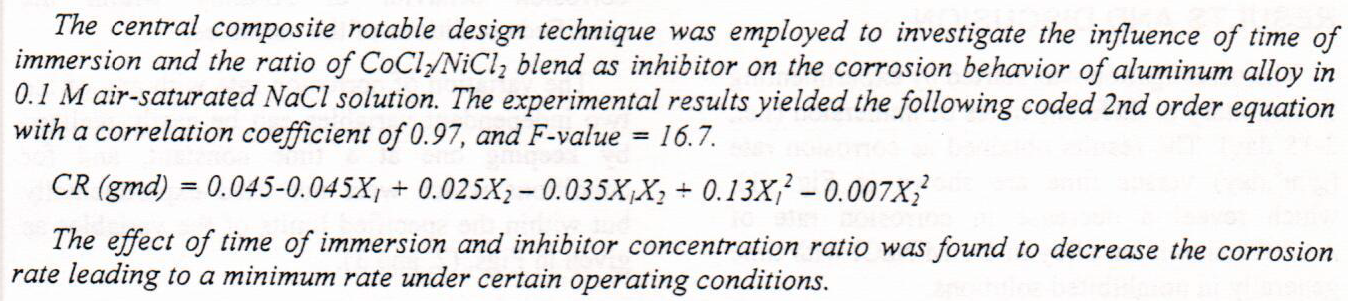

 (7)
(7)
 (5)
(5)



The current study introduces a novel technique to handle electrochemical localized corrosion in certain limited regions rather than applying comprehensive cathodic protection (CP) treatment. An impressed current cathodic protection cell (ICCPC) was fabricated and firmly installed on the middle of a steel structure surface to deter localized corrosion in fixed or mobile steel structures. The designed ICCPC comprises three essential parts: an anode, a cathode, and an artificial electrolyte. The latter was developed to mimic the function of the natural electrolyte in CP. A proportional-integrated-derivative (PID) controller was designed to stabilize this potential below the ICCPC at a cathodic potential of −850 mV, which is crucial for prote
... Show More
(7)
(5)
(2)
(2)
Abstract The surface of kaolin was diagnosed by an AFM and the results were shown The height of the highest peak reached by a quantity of Kaolin surface is 2.5 µm, the granules, and their diameter with an average diameter of 666.1nm. Using Kaolin's adsorption properties, erythrosine was removed of its aqueous solution. It was determined that the maximal dye adsorption ranged 36.53–40.61%. The results of using the Freundlich, Langmuir, and Temkin adsorption isotherms revealed that at temperatures of (298,308,318) K, the Freundlich model was followed, the Langmuir model did not match, and the Temkin model could only be partially applied. There is also physical adsorption. One of the three kinetic models of the
... Show More
The aim of this paper is to present the numerical method for solving linear system of Fredholm integral equations, based on the Haar wavelet approach. Many test problems, for which the exact solution is known, are considered. Compare the results of suggested method with the results of another method (Trapezoidal method). Algorithm and program is written by Matlab vergion 7.
To obtain the approximate solution to Riccati matrix differential equations, a new variational iteration approach was proposed, which is suggested to improve the accuracy and increase the convergence rate of the approximate solutons to the exact solution. This technique was found to give very accurate results in a few number of iterations. In this paper, the modified approaches were derived to give modified solutions of proposed and used and the convergence analysis to the exact solution of the derived sequence of approximate solutions is also stated and proved. Two examples were also solved, which shows the reliability and applicability of the proposed approach.
The petroleum industry, which is one of the pillars of the national economy, has the potential to generate vast wealth and employment possibilities. The transportation of petroleum products is complicated and changeable because of the hazards caused by the corrosion consequences. Hazardous chemical leaks caused by natural disasters may harm the environment, resulting in significant economic losses. It significantly threatens the aim for sustainable development. When a result, determining the likelihood of leakage and the potential for environmental harm, it becomes a top priority for decision-makers as they develop maintenance plans. This study aims to provide an in-depth understanding of the risks associated with oil and gas pipeli
... Show More
(4)
Attention has recently been given to finding alternative and sustainable raw material sources for wood and metal adhesives, such as polyvinyl alcohol (PVA), corn starch (CS), arabic gum (AG), and dextrins (D). Modifying polymer dispersion using unique substances, such as modifying reactive elastomer liquid (EL) using PVA, CS, AG, or D results in sufficiently moisture-resistant adhesive joins. In the present study, the physical characteristics of EL/blended with the natural polymers PVA, CS, AG, and D, based on high-density fiberboard (HDF) wood and aluminum (Al) adhesives and coatings, were investigated and compared to those of pure EL. The EL was blended with PVA, CS, AG, or D at a ratio of 60/40 (w/w) to form EL/blends. The che
... Show More
(1)
This paper presents a hybrid approach for solving null values problem; it hybridizes rough set theory with intelligent swarm algorithm. The proposed approach is a supervised learning model. A large set of complete data called learning data is used to find the decision rule sets that then have been used in solving the incomplete data problem. The intelligent swarm algorithm is used for feature selection which represents bees algorithm as heuristic search algorithm combined with rough set theory as evaluation function. Also another feature selection algorithm called ID3 is presented, it works as statistical algorithm instead of intelligent algorithm. A comparison between those two approaches is made in their performance for null values estima
... Show More
(7)
(3)