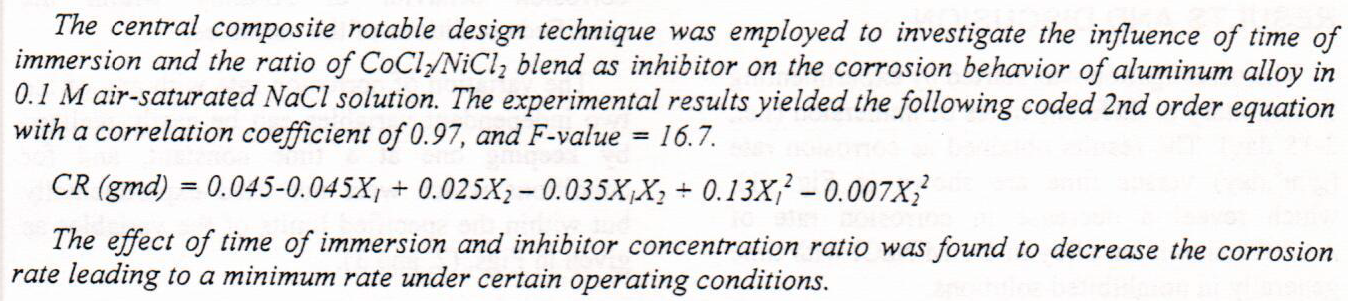
The Optimal Corrosion Inhibition of Aluminum in 0.1M NaCl Solution

This study is aimed to Green-synthesize and characterize Al NPs from Clove (Syzygium aromaticum
L.) buds plant extract and to investigate their effect on isolated and characterized Salmonella enterica growth.
S. aromaticum buds aqueous extract was prepared from local market clove, then mixed with Aluminum nitrate
Al(NO3)3. 9 H2O, 99.9% in ¼ ratio for green-synthesizing of Al NPs. Color change was a primary confirmation
of Al NPs biosynthesis. The biosynthesized nanoparticles were identified and characterized by AFM, SEM,
EDX and UV–Visible spectrophotometer. AFM data recorded 122nm particles size and the surface roughness
RMs) of the pure S. aromaticum buds aqueous extract recorded 17.5nm particles s
 (4)
(4)
 (2)
(2)


Nanostructured Al2O3has been applied as a protective coating against corrosion of the carbon steel (C.S) in seawater environment (3.5% NaCl) at temperatures range (298-328)K. Aluminananoparticles were deposited on carbon steel substrates by cathodic electrophoretic deposition (EPD) with ethanol as suspension medium and poly(acrylic acid) (PAA) as polymeric charging agent. Meanwhile, thesurface morphology was examined using Atomic-force microscopy (AFM). The cross-section AFM showed that the particles sizes for the Al2O3 NPs is around 60-80 nm. The anticorrosion behaviour of coated C.S was investigated in 3.5% NaCl at temperature range 298-328 K by potentiodynamic polarization measurements. Results show that using PAA in suspension coat incr
... Show More
(12)
Background: Esthetic treatment is the options of patient seeking orthodontic treatment. Therefore this study was conducted to measure the concentration of Aluminum, Nickel, Chromium and Iron ions released from combination of monocrysralline brackets with different arch wires immersed in artificial saliva at different duration, to evaluate the corrosion point on different parts of the orthodontic appliances before and after immersion in artificial saliva, and to evaluate the corrosion potential of each group of the orthodontic appliances. Material and methods: Eighty orthodontic sets prepared. Each set represents half fixed orthodontic appliance, from the central incisor to the first molar, for the maxillary arch, each set consisted of molar
... Show MoreThe contemporary development applications on scientific areas of acyclic and cyclic Schiff bases and their complexes.
(66)
(54)

In this paper, two types of iron oxide nanomaterial (Fe3O4) and nanocomposite (T-Fe3O4) were created from the bio-waste mass of tangerine peel. These two materials were utilized for adsorption tests to remove cefixime (CFX) from an aqueous solution. Before the adsorption application, both adsorbents have been characterized by various characterizations such as XRD, FTIR, VSM, TEM, and FESEM. The mesoporous nano-crystalline structure of Fe3O4 and T-Fe3O4 nanocomposite with less than 100-nm diameter is confirmed. The adsorption of the obtained adsorbents was evaluated for CFX removal by adjusting several operation parameters to optimize the removal. The optimal conditions for CFX removal were found to be an initial concentration of 40 and 50 m
... Show More
(17)
The ability of four local fungal isolates for extracellular laccase production has been tested with five grams 1:1(w/v) humidified sawdust as substrate in mineral salt medium. After 21 day of incubation at 25±1 ? C and using one mycelial plug (5mm), higher level of laccase activity (0.15U/ml) and specific activity (15U/mg) were observed by Pleurotus ostreatus in comparison with other fungal isolates. The results of optimum conditions for laccase production from selected isolate showed that, the maximum laccase activity (0.55U/ml) and specific activity (55U/mg) were obtained at moisture ratio 1:3 (w/v), using 3 mycelial plugs (5 mm), after 15 days incubation period at 25±1 ? C. The results of phenol degradation by crud laccase revealed th
... Show More
(2)
This work was conducted to study the treatment of industrial waste water, and more particularly those in the General Company of Electrical Industries.This waste water, has zinc ion with maximum concentration in solution of 90 ppm.
The reuse of such effluent can be made possible via appropriate treatments, such as chemical coagulation, Na2S is used as coagulant.
The parameters that influenced the waste water treatment are: temperature, pH, dose of coagulant and settling time.
It was found that the best condition for zinc removal, within the range of operation used ,were a temperature of 20C a pH value of 13 , a coagulant dose of 15 g Na2S /400ml solution and a settling time of 7 days. Under these conditions the zinc concentrat
In the present study, chalcone derivatives were synthesized via the Claisen-Schmidt condensation of 2-methyl acetanilide or 4-nitro acetanilide with p-dimethyl amino benzaldehyde in an ethanolic sodium hydroxide solution. The resulting chalcone reacted with urea or thiourea to produce several novel pyrimidine derivatives. All the synthesized compounds were characterized by FTIR, 1HNMR and 13CNMR spectroscopy. Before the synthesis process, molecular docking studies were performed to evaluate the potential of the synthesized molecules as drug candidates. Thus, molecular docking studies were performed using the CCDC GOLD suite (version 2025). The molecular docking results showed that the synthesized molecules had a noticeable affinity towards
... Show More
