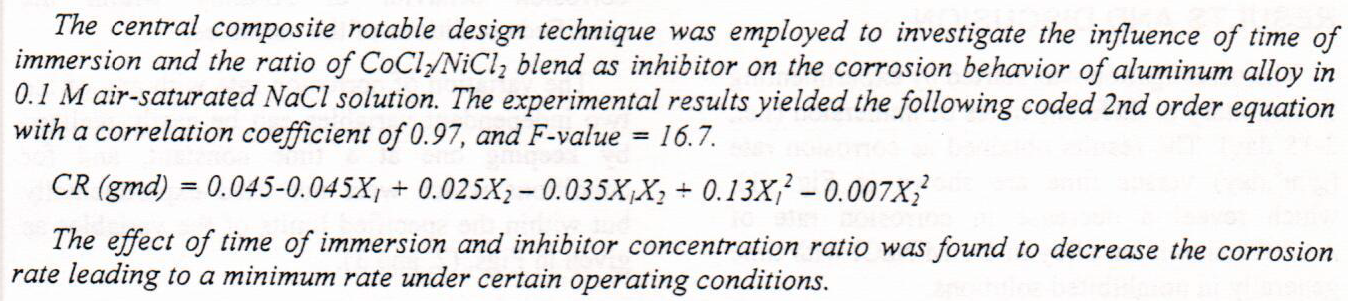
The Optimal Corrosion Inhibition of Aluminum in 0.1M NaCl Solution

Internal curing is a method that has been advised to decrease the primary age cracking, mainly of concrete mixes using low (water to cementitious materials - w/cm) ratios corresponding to the self-compacting concrete-(SCC). This research aims to study the effect of the internal curing using saturated lightweight aggregate- (LWA) on the steel reinforcing corrosion in SCC. In this research, crushed bricks or thermostone were partially replaced by (20%) by the weight of sand and volumetrically measured. The results showed that the steel reinforcement of internally cured concrete showed a slight increase in corrosion up to 300 days of exposure to the saline solution (containing 3.5% NaCl). The ability of using the crushed bricks or thermostone
... Show MoreInternal curing is a method that has been advised to decrease the primary age cracking, mainly of concrete mixes using low (water to cementitious materials - w/cm) ratios corresponding to the self-compacting concrete-(SCC). This research aims to study the effect of the internal curing using saturated lightweight aggregate- (LWA) on the steel reinforcing corrosion in SCC. In this research, crushed bricks or thermostone were partially replaced by (20%) by the weight of sand and volumetrically measured. The results showed that the steel reinforcement of internally cured concrete showed a slight increase in corrosion up to 300 days of exposure to the saline solution (containing 3.5% NaCl). The ability of using the crushed bricks or thermostone
... Show More (3)
(3)

Electrochemical corrosion of hydroxyapatite (HAP) coated performance depends on various parameters like applied potential, time, thickness and sintering temperature. Thus, the optimum parameters required for the development of stable HAP coatings was found by using electrophoretic deposition (EPD) technique. This study discusses the results obtained from open circuit potential-time measurements (OCP-time), potentiodynamic polarisation and immersion tests for all alloy samples done under varying experimental conditions, so that the optimum coating parameters can be established. The ageing studies of the coated samples were carried out by immersing them in Ringer’s solution for a period of 30 days indicates the importance of stable HAP c
... Show More (2)
(2)
 (2)
(2)
The experimental and theoretical methods were studied for inhibition of the corrosion titanium in HCl by using neomycin sulfate drug. The results of neomycin sulfate drug had good corrosion protection for titanium in hydrochloric acid and the inhibition efficiency (%IE) increasing with increasing concentration of drug because the neomycin sulfate drug had adsorption from acid solution on surface of titanium metal. The program of hyperchem-8.07 was used for theoretical study of the drug by molecular mechanics and semi-empirical calculations. Quantum chemical was studied drug absorption and electron transferred from the drug to the Titanium metal, also inhibition potentials of drug attachment with the (LUMO-HOMO) energy gap,
... Show More
(5)

The polymer was used to inhibit the corrosion of copper metal in salt media in different concentrations at room temperature using potentiometric polarization measurement. The polymer was prepared by mixing (0.1 M) 4-Hydroxy aniline (C6H7NO) with (0.25M) of ammonium persulfate as the initiator using the electro-deposition technique. The polymer’s results showed that copper in (3.5%) NaCl had good corrosion resistance. The findings demonstrate that the %IE for polymer-induced copper corrosion is 89.32% at 10 ppm concentration as a result of the 4-hydroxy aniline polymer’s adsorption from salt solution on the surface of copper metal. The numbers from the polarization method and the acquired standard data agree well. The coated copper by po
... Show More
Abstract
This work involves the manufacturing of MAX phase materials include V2AlC and Cr2AlC using powder metallurgy as a new class of materials which characterized by regular crystals in lattice. Corrosion behavior of these materials was investigated by Potentiostat to estimate corrosion resistance and compared with the most resistant material represented by SS 316L. The experiments were carried out in 0.01N of NaOH solution at four temperatures in the range of 30–60oC. Polarization resistance values which calculated by Stern-Geary equation indicated that the MAX phase materials more resistant than SS 316L. Also cyclic polarization tests confirme
... Show MoreThe polymer was used to inhibit the corrosion of copper metal in salt media in di erent concentrations at room temperature using potentiometric polarization measurement. The polymer was prepared by mixing (0.1 M) 4-Hydroxy aniline (C6H7NO) with (0.25M) of ammonium persulfate as the initiator using the electro-deposition technique. The polymer’s results showed that copper in (3.5%) NaCl had good corrosion resistance. The ndings demonstrate that the %IE for polymer-induced copper corrosion is 89.32% at 10 ppm concentration as a result of the 4-hydroxy aniline polymer’s adsorption from salt solution on the surface of copper metal. The numbers from the polarization method and the acquired standard data agree well. The coated copper by poly
... Show More
This research presents a study for precipitating phosphorus (as phosphate ion) from simulated wastewater (5ppm initial concentration of phosphorus) using calcium hydroxide Ca(OH)2 solution. The removal of phosphorus by Ca (OH)2 solution is expected to be very effective since the chemical reaction is of acid-base type but Ca(OH)2 forms complex compound with phosphate ions called. Hydroxyapatite Ca5 (PO4)3OH. hydroxyapatite is slightly soluble in water. This research was directed towards sustainable elements as phosphorus. Kinetics of the dissolution reaction of hydroxyapatite was investigated to find the best factors to recover phosphorus. The effect of con
... Show More