The Optimal Corrosion Inhibition of Aluminum in 0.1M NaCl Solution
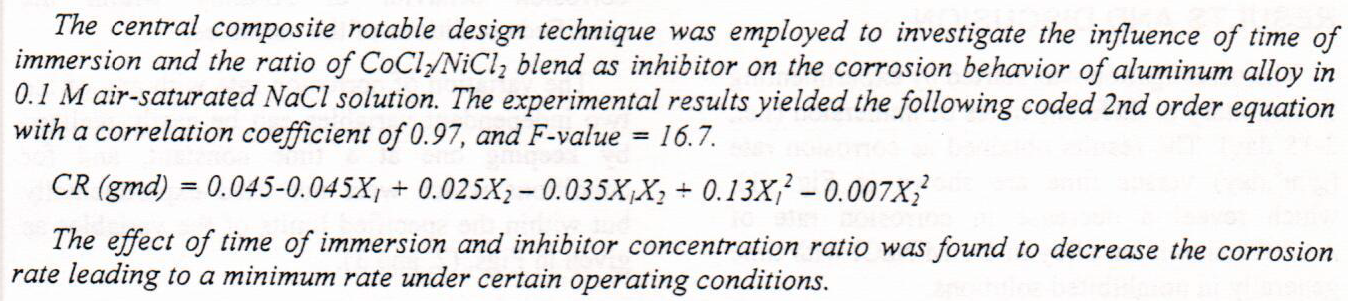

 (9)
(9)
 (9)
(9)



The ligand 4-amino-N-(5-methylisoxazole-3-yl)-benzene-sulfonamide(L1) (as a chelating ligand) was treated with Pd(II),Pt (IV) and Au(III) ions in alcoholic medium in order to prepare a series of new metal complexes. Mixed ligand complexes of this primary ligand were prepared in alcoholic medium in presence of the co-ligand 4,4'-dimethyl-2,2'-bipyridyl(L2) with Cu(II) ,Pd(II) and Au(III) ions. The complexes were characterized in solid state using flame atomic absorption, elemental analysis C.H.N.S, FT-IR, UV-Vis Spectroscopy, conductivity and magnetic susceptibility measurements. The nature of some complexes formed in ethanolic solution has been studied following the molar ratio method, also stability constant was studied and the complexes f
... Show More
(2)
A new ligand complexes have been synthesis from reaction of metal ions of Mn(II), Co(II), Ni(II), Cu(II), Zn(II), Cd(II), Hg(II), Pd(II) and Pt(II) with schiff base LH. 5-[(2-Hydroxy-naphthalen-1-ylmethylene)-amino]-2-phenyl-2,4-dihydro-pyrazol-3-one, this ligand was characterized by Fourier transform infrared (FTIR), UV-vis, 1H, 13CNMR, and mass spectra. All complexes were characterized by techniques micro analysis C.H.N, UV-vis and FTIR spectral studies, atomic absorption, chloride content, molar conductivity measurements and magnetic susceptibility. The ligand acts as bidentate, coordination through nitrogen atom from azomethin group and deprotonated phenolic oxygen atom. The spectroscopic and analytical measurements showed that
... Show MoreMethicillin resistant Staphylococcus aureus (MRSA) is one of the principal nosocomial causative agents. This bacterium has the capability to resist wide range of antibiotics and it is responsible for many diseases like skin, nose and wounds infection. In this study, randomly amplified polymorphic DNA (RAPD)-PCR was applied with ten random primers to examine the molecular diversity among methicillin resistant Staphylococcus aureus (MRSA) isolates in the hospitals and to investigate the genetic distance between them. 90 Isolates were collected from clinical specimens from Iraqi hospitals for a total of 90 isolates. Only 10 strains (11.11%) were found to be MRSA. From these 10 primers, only 9 gave clear amplification products. 91 fragment l
... Show More
(3)
(20)
(21)
The aim of this work covers the synthesis and characterization of the new tertra dentate ligand (H4L) containing (N and O) as donor set atoms kind (N2O2) where: H4L=Bis-1,2 (2,4- dihydroxybenzylediene phylinediamine . The preparation of ligand contains reaction 2, 4 - Dihydroxy benzaldehyde and o-phenylene diamine . Schiff base was reacted with some metal ions in the presence of methanol to give the complexes in the general formula [M (H2L)] where: MII = Co, Ni, Cu, Zn, Cd. All compounds were characterized by spectroscopic methods I.R , U.V.-Vis, metal content and molar conductivity measurements, showed that the complexes are non-electrolyte. The proposed geometry for all of the proposed complexes was a tetrahedral while Ni complex was squa
... Show MoreNH3 gas sensor was fabricated based on deposited of Functionalized Multi-Walled Carbon Nanotubes (MWCNTs-OH) suspension on filter paper substrates using suspension filtration method. The structural, morphological and optical properties of the MWCNTs film were characterized by XRD, AFM and FTIR techniques. XRD measurement confirmed that the structure of MWCNTs is not affected by the preparation method. The AFM images reflected highly ordered network in the form of a mat. The functional groups and types of bonding have appeared in the FTIR spectra. The fingerprint (C-C stretch) of MWCNTs appears in 1365 cm-1, and the backbone of CNTs observed at 1645 cm-1. A homemade sensi
... Show More
(19)
(18)
bstract The aim of this work covers the synthesis and characterization of the new tertra dentate ligand (H4L) containing (N and O) as donor set atoms kind (N2O2) where: H4L=Bis-1,2 (2,4- dihydroxybenzylediene phylinediamine . The preparation of ligand contains reaction 2, 4 - Dihydroxy benzaldehyde and o-phenylene diamine . Schiff base was reacted with some metal ions in the presence of methanol to give the complexes in the general formula [M (H2L)] where: MII = Co, Ni, Cu, Zn, Cd. All compounds were characterized by spectroscopic methods I.R , U.V.-Vis, metal content and molar conductivity measurements, showed that the complexes are non-electrolyte. The proposed geometry for all of the proposed complexes was a tetrahedral while Ni complex
... Show MoreABSTRACT:
Objectives: The study aims to know the effectiveness of the educational program in the patient’s adherence to medication and diet and to know the relationship between the effectiveness of the education program and their demographic data related to the patient’s age, gender, marital status, education level, occupation, monthly income and residence.
Methodology: A quasi -experimental design study was performed on patient who attended to Gastroenterology and Hepatology Teaching Hospital, from March 2021 to September 2021. The non-probability sampling including 50 patients for case study and 30 patients for control group. The questionnaire consists of 3 parts, part one the socio
... Show MoreThe search involve the synthesis of some new 1,3-oxazepine and 1,3-diazepine derivatives were synthesized from Schiff base. The Schiff base (VIII) prepared from reaction of aldehyde (IV) derived from L-ascorbic acid with aromatic amine ([2-(4- nitrophenyl)-5-(4-aminophenyl)-1,3,4-oxadiazole] (VII). Oxazepine compounds (IX-XI) were synthesized from the cyclic condensation of Schiff base (VIII) with (maleic, phthalic and 3-nitrophthalic) anhydride, compounds (IX-XI) that were reacted with p-methoxyaniline to give diazepine derivatives (XII-XIV). The structures of the new synthesized compounds have been confirmed by physical properties and spectroscopy measurements such as FTIR, and some of them by 1 H-NMR, 13 CNMR, Mass, and evaluated
... Show More
(6)
(2)