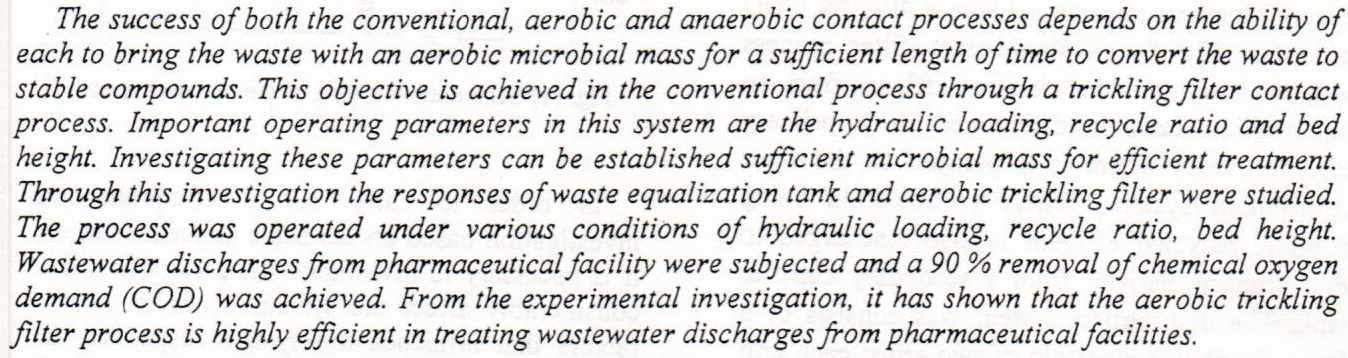
Aerobic Filter Treatment of Pharmaceutical Waste

Background: Although the new treatment methods developed in recent years are aiming to minimize the need for cooperation of the patients; however, the latter still important factor the treatment. The aim of the study was to evaluate the cooperation level of Class III maloc-clusion patients with orthodontic treatment. Materials and methods: This study followed a cross-sectional style; the targeted population was patients with Class III malocclusion who were treated with three different types of orthopaedic appliances. Four questionnaires were delivered to the patient, patient’s parents, and orthodontists. Statistical analyses of the study were performed with SPSS 20.0 software. Descriptive analyses were presented using fre-quency, percenta
... Show More (8)
(8)
 (6)
(6)


This study investigated the treatment of dairy wastewater using the electrocoagulation method with iron filings as electrodes. The study dealt with real samples collected from local factory for dairy products in Baghdad. The Response Surface Methodology (RSM) was used to optimize five experimental variables at six levels for each variable, for estimating chemical oxygen demand (COD) removal efficiency. These variables were the distance between electrodes, detention time, dosage of NaCl as electrolyte, initial COD concentration, and current density. RSM was investigated the direct and complex interaction effects between parameters to estimate the optimum values. The respective optimum value was 1 cm for the distance between electrodes, (6
... Show More
(5)
(3)
(16)
(12)
The main object of the current work was to determine the antifungal efficiency of secondary metabolites product called synephrine that extracted from Citrus sinesis peels and the ability of synephrine to biosynthesis gold nanoparticles from HAucl4 which consider environmentally favourable method, then determine their activity against pathogenic human dermatophyte. The identification of synephrine done by Thin layer chromatography (TLC), High Performance Liquid Chromatography (HPLC) and The Fourier Transform Infrared (FTIR). The characterization of gold nanoparticles by using Ultra Violet-Visible Spectroscopy (UV-Vis), Field – Emission Scanning Electron Microscopy (FESEM) and Fourier Transform Infrared (FTIR), confirmed the biosynt
... Show More
(3)
(1)

Stabilization of phenol trapped by agricultural waste: a study of the influence of ambient temperature on the adsorbed phenol
(32)
(17)
(7)
(17)
(7)
This work has been carried out to develop national drug product contains 2.5mg/ml clonazepam as oral drop; it is used for the treatment of epilepsy in infants and children.
Several formulations were prepared using oral drop base, flavor, buffer, sweeteners and preservatives. Selection of best formula relied solely on physic-chemical testing of samples.
Stability study was conducted on the product for six months at different temperatures to determine the expiration date and the best storage conditions.
From the study we obtained an oral drop of good clear solution. The expiry date calculated to be not less than 2 years.
(6)
(9)