Aerobic Filter Treatment of Pharmaceutical Waste
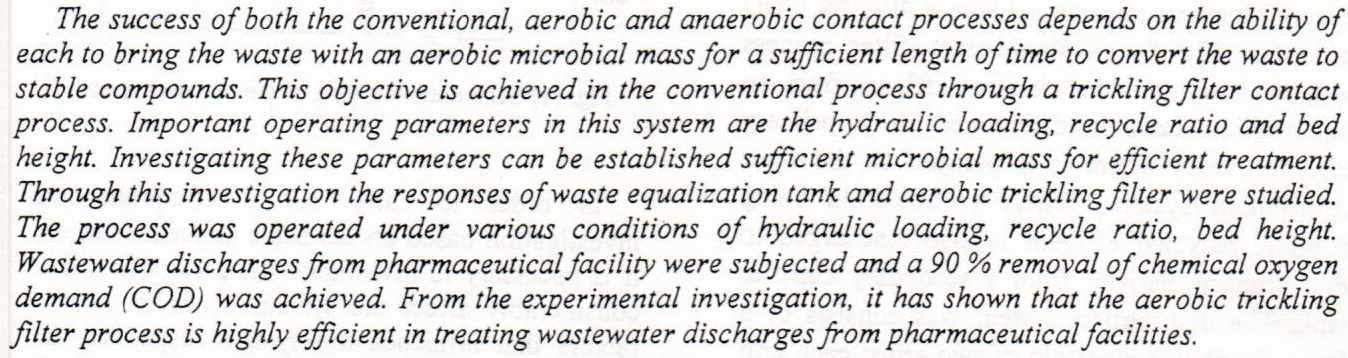

 (20)
(20)
 (6)
(6)



This research aimed to explore the use of foamed concrete (FC), a lightweight concrete, by replacing sand with crushed plastic from washing machines to improve environmental and thermal properties. The primary components included traditional materials like cement, water, and a foaming agent, along with the innovative use of waste plastic (WP). Utilizing Minitab software, the study applied the Response Surface Method to optimize mix designs, reducing the experimental mixtures to 31, which were then tested for dry density, porosity, water absorption, shrinkage, compressive strength, splitting tensile strength, and thermal conductivity. Results indicated a significant 24% reduction in dry density when using plastic as fine and coarse aggregate
... Show More
(1)
A simple, economical and selective method employing ion pair dispersive liquid−liquid microextraction (DLLME) coupled with spectrophotometric determination of carbamazepine (CBZ) in pharmaceutical preparations and biological samples was developed. The method is based on reduction of Mo(VI) to Mo(V) using a combination of ammonium thiocyanate and ascorbic acid in acidic medium to form a red binary Mo(V) thiocyanate complex. After addition of CBZ to the complex, extraction of the formed CBZ−Mo(V)−(SCN)6 was performed using a mixture of methylene chloride and methanol. Then, the measurement of target complex was performed at the wavelength of 470 nm. The important extraction parameters affecting the efficiency of DLLME were studied and o
... Show More
(11)
(5)
The using of waste products as a recycled material was one of the most important studies for saving money and reduces the pollution. Mortar and concrete mixes with (10, 20 and 30)% of brick, glass and tile powder as replacement by weight of cement was investigated. The concrete mixes using brick or glass as 10%replacement of cement exhibited enhancement in compressive strength about (6, 4.7 and 2.0)% and (7.2, 5.6 and 2)% at age 7, 28 and 90 days respectively compared to reference mix. The 20% replacement of glass powder also showed an increase in the compressive strength up to (8, 6.3 and 4) %at age 7,28 and 90 days respectively compared to reference mix. Finally concrete mix using (10, 20 and 30) % tile powder as replacement of cement sho
... Show MoreThe using of waste products as a recycled material was one of the most important studies for saving money and reduces the pollution. Mortar and concrete mixes with (10, 20 and 30)% of brick, glass and tile powder as replacement by weight of cement was investigated. The concrete mixes using brick or glass as 10%replacement of cement exhibited enhancement in compressive strength about (6, 4.7 and 2.0)% and (7.2, 5.6 and 2)% at age 7, 28 and 90 days respectively compared to reference mix. The 20% replacement of glass powder also showed an increase in the compressive strength up to (8, 6.3 and 4) %at age 7,28 and 90 days respectively compared to reference mix. Finally concrete mix using (10, 20 and 30) % tile powder as replacement of cement sho
... Show MoreThe behavior of AC conductivity (σac), loss tangent (tan δ), and relative permittivity (ε′) for composites of PVC-P/graphite electrode waste (GEW) was investigated, and a qualitative explanation was provided as a function of PVC-P weight fractions (0, 5, 10, 15, 20, and 25) wt. percent, temperature (30-90) °C, and frequency (100Hz-2MHz). The behaviors of the composites' ac. conductivity and impedance as a frequency function and temperature have been examined. The permittivity was shown to rise with increasing temperature (Tg). The relative permittivity increased as the GEW filler concentration increased and was highest in the low-frequency range; nevertheless decreased as the frequency increased.
(1)
The potential application of granules of brick waste (GBW) as a low-cost sorbent for removal of Ni+2ions from aqueous solutions has been studied. The properties of GBW were determined through several tests such as X-Ray diffraction (XRD), Energy dispersive X-ray (EDX), Scanning electron microscopy (SEM), and BET surface area. In batch tests, the influence of several operating parameters including contact time, initial concentration, agitation speed, and the dose of GBW was investigated. The best values of these parameters that provided maximum removal efficiency of nickel (39.4%) were 1.5 hr, 50 mg/L, 250 rpm, and 1.8 g/100mL, respectively. The adsorption data obtained by batch experiments subjected to the Three i
... Show More
(12)
The Current status of biomedical waste of solid, liquid and gaseous formulations from medical and educational laboratories in Iraqi universities and research centers was assessed using a well-structured questionnaire. The questionnaire was distributed to scientists, researchers, medical technicians and graduate students who are directly involved in laboratoiy daily activities. The responses were analyzed statistically and interpreted accordingly. The results showed diat the frequency of questionnaire respondent's affiliation gave the highest percentage frequency (69.4%) with the questionnaire of Technical Medical Institute/Al-Mansour while constitute die responses of the Dnig Control Department/Ministry of Sciences and Technology gave the l
... Show More
(1)
The using of waste products as a recycled material was one of the most important studies for saving money and reduces the pollution. Mortar and concrete mixes with (10, 20 and 30)% of brick, glass and tile powder as replacement by weight of cement was investigated. The concrete mixes using brick or glass as 10%replacement of cement exhibited enhancement in compressive strength about (6, 4.7 and 2.0)% and (7.2, 5.6 and 2)% at age 7, 28 and 90 days respectively compared to reference mix. The 20% replacement of glass powder also showed an increase in the compressive strength up to (8, 6.3 and 4) %at age 7,28 and 90 days respectively compared to reference mix. Finally concrete mix using (10, 20 and 30) % tile powder as replacement of cement sho
... Show MoreThe aim of present work is to study the removal of phenol present in aqueous feed solution by the emulsion liquid membrane technique using kerosene as a diluent, sodium hydroxide as a stripping agent, and sorbitan monooleate (Span 80) as a surfactant. The parameters studied were: surfactant concentration, volume ratio of membrane phase to internal phase, and stirring speed. It was found that more than 98% of phenol can be removed at the conditions were surfactant concentration 2% (v/v), volume ratio of membrane phase to internal phase 5:1 and stirring speed 400 rpm. Maximum phenol extraction efficiency at 7 minutes of process time was observed. It was found that there was a good agreement between the standard kerosene an
... Show More