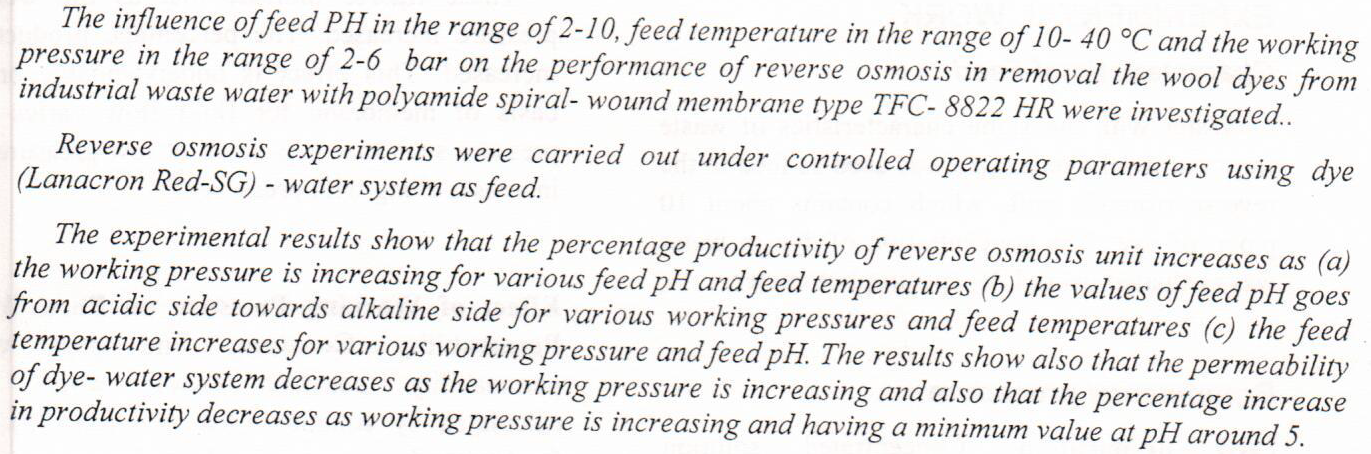
Removal of Wool Dyes from Industrial Wastewater by Reverse Osmosis Process

Biosorption of lead, chromium, and cadmium ions from aqueous solution by dead anaerobic biomass (DAB) was studied in single, binary, and ternary systems with initial concentration of 50 mg/l. The metal-DAB affinity was the same for all systems. The main biosorption mechanisms were complexation and physical adsorption of metallic cations onto natural active functional groups on the cell wall matrix of the DAB. It was found that biosorption of the metallic cations onto DAB cell wall component was a surface process. The main functional groups involved in the metallic cation biosorption were apparently carboxyl, amino, hydroxyle, sulfhydryl, and sulfonate. These groups were part of the DAB cell wall structural polymers. Hydroxyle groups (–O
... Show More (13)
(13)

 (1)
(1)
(1)
(1)

The main objective of this study was to evaluate the adsorption efficiency of two adsorbent materials, Iraqi chicken eggshells (ESh) and activated carbon (AC) derived from ESh powder for the removal of a cationic dye (Janus green B; JGD) from aqueous solution. Activated carbon was synthesised from ESh using a simple chemical activation method using phosphoric acid as the activating agent. The physicochemical properties of the adsorbents were characterised by the Brunauer–Emmett–Teller (BET) method, FT-IR spectroscopy, scanning electron microscopy (SEM), energy-dispersive X-ray spectroscopy (EDS), inductively coupled plasma optical emission spectroscopy (ICP-OES), and point of zero charge (pHpzc). The results of BET analysis confirmed th
... Show More
The main objective of this study was to evaluate the adsorptionefficiency of two adsorbent materials, Iraqi chicken eggshells (ESh)and activated carbon (AC) derived from ESh powder for theremoval of a cationic dye (Janus green B; JGD) from aqueoussolution. Activated carbon was synthesised from ESh usinga simple chemical activation method using phosphoric acid asthe activating agent. The physicochemical properties of the adsor-bents were characterised by the Brunauer–Emmett–Teller (BET)method, FT-IR spectroscopy, scanning electron microscopy(SEM), energy-dispersive X-ray spectroscopy (EDS), inductivelycoupled plasma optical emission spectroscopy (ICP-OES), andpoint of zero charge (pHpzc). The results of BET analysis confirmedthat AC has
... Show More
(54)
(52)

A spectrophotometric- reverse flow injection analysis (rFIA) method has been proposed for the determination of Nitrazepam (NIT) in pure and pharmaceutical preparations. The method is based upon the coupling reaction of NIT with a new reagent O-Coumaric acid (OCA) in the presence of sodium periodate in an aqueous solution. The blue color product was measured at 632 nm. The variation (chemical and physical parameters) related with reverse flow system were estimated. The linearity was over the range 15 - 450 µg/mL of NIT with detection limits and limit of quantification of 3.425 and 11.417 µg mL-1 NIT,respectively. The sample throughput of 28 samples
... Show More
(10)
(1)
(10)
(5)
(40)
Industry represents a cornerstone of the process of economic development and a measure of progress and contribute to increased prosperity and high standard of living.
The researcher analyzed the productivity indicators in industrial facilities large and small at several time periods ranging from 1970 to 2009, according to the economic situation that prevailed in each period.
Different impact of periods under discussion, it made Iraq the cash surpluses during the period 70-1980 then the effects of the war after 1980 and the economic blockade since 1990, and the subsequent events of the year
... Show More
Linked to the post-modern historical transformations sociological which raided the developed Western societies since the middle of last century, which consisted mainly in the emergence of what he called Alsosiologion (consumer society a) and (Affluent Society), as it appeared the new social lifestyle is not only characterized by the provision of the accumulation of capital and sparingly in spending, but rather a kind of extravagance and encourage consumption, prompting some to say that consumption is a community postmodern engine, and other labels for this period of economic backgrounds, such as the new capitalism and the system of the new capitalist Alseperntiqi technical and labels purist such as industrial post-society emerged, some a
... Show More