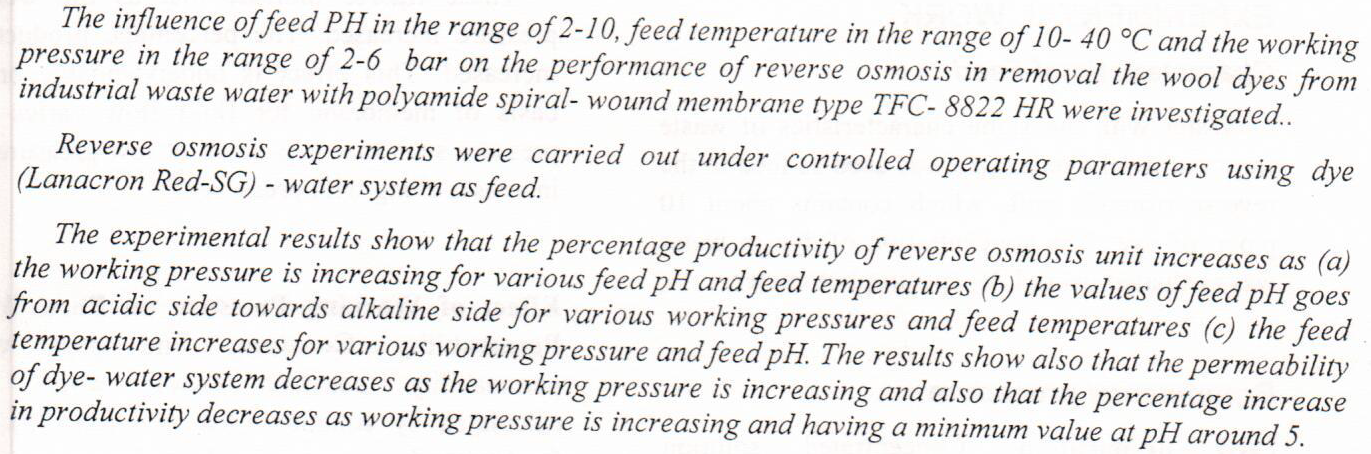
Removal of Wool Dyes from Industrial Wastewater by Reverse Osmosis Process

The present work is concerned with the finding of the optimum conditions for biochemical wastewater treatment for a local tannery. The water samples were taken from outline areas (the wastewater of the chrome and vegetable tannery) in equal volumes and subjected to sedimentation, biological treatment, and chemical and natural sedimentation treatment.
The Box-Wilson method of experimental design was adopted to find useful relationships between three operating variables that affect the treatment processes (temperature, aeration period and phosphate concentration) on the Biochemical Oxygen Demand (BOD5).
The experimental data collected by this method were successfully fitted to a second order polynomial mathematical model. The most fa
The current study investigated the stability and the extraction efficiency of emulsion liquid membrane (ELM) for Abamectin pesticide removal from aqueous solution. The stability was investigated in terms of droplet emulsion size distribution and emulsion breakage percent. The proposed ELM included a mixture of corn oil and kerosene (1:1) as a diluent, Span 80 (sorbitan monooleate) as a surfactant and hydrochloric acid (HCl) as a stripping agent without utilizing a carrier agent. Parameters such as homogenizer speed, surfactant concentration, emulsification time and internal to organic volume ratio (I/O) were evaluated. Results show that the lower droplet size of 0.9 µm and higher stable emulsion in terms of breakage percent of 1.12 % were
... Show More (5)
(5)

 (5)
(5)

The current study investigated the stability and the extraction efficiency of emulsion liquid membrane (ELM) for Abamectin pesticide removal from aqueous solution. The stability was investigated in terms of droplet emulsion size distribution and emulsion breakage percent. The proposed ELM included a mixture of corn oil and kerosene (1:1) as a diluent, Span 80 (sorbitan monooleate) as a surfactant and hydrochloric acid (HCl) as a stripping agent without utilizing a carrier agent. Parameters such as homogenizer speed, surfactant concentration, emulsification time and internal to organic volume ratio (I/O) were evaluated. Results show that the lower droplet size of 0.9 µm and higher stable emulsion in terms of breakage percent of 1.12 % we
... Show More
(5)
In the present work, a study is carried out to remove chromium (III) from aqueous solution by: activated charcoal, attapulgite and date palm leaflet powder (pinnae). The effect of various parameters such as contact time, and temperature has been studied. The isotherm equilibrium data were well fitted by Freundlich and Langmuir isotherm models. The adsorption capacity of chromium (III) that was observed by activated charcoal, attapulgite and date palm leaflet powder (pinnae) increased with the rise of temperature when the concentrations of Cr (III) were 600, 700 and 100mg/L respectively. The greatest adsorption capacity ofactivated charcoal, attapulgite and date palm leaflet powder (pinnae) at 10°C was 7.51, 5.39 and 0.77mg.gˉ¹ respective
... Show More
(16)
(18)
(2)
(2)
Release of industrial effluents comprising dyes in water bodies is one of the foremost causes of water pollution. Therefore, the proper and proficient treatment of these dyes contaminated left-over material before their release is crucial. Herein, an eco-friendly biological macromolecule Gum-Acacia (GA) integrated Fe3O4 nanoparticles composite hydrogel was manufactured via co-precipitation technique for effective adsorption of Congo red (CR) dye existing in water bodies. The as-prepared magnetic GA/Fe3O4 composite hydrogel was characterized by FTIR, XRD, EDX, VSM, SEM, and BET techniques. These studies discovered the fruitful fabrication of biodegradable magnetic GA/Fe3O4 composite hydrogel possessing porous structure with large surface are
... Show More
(23)
(20)

