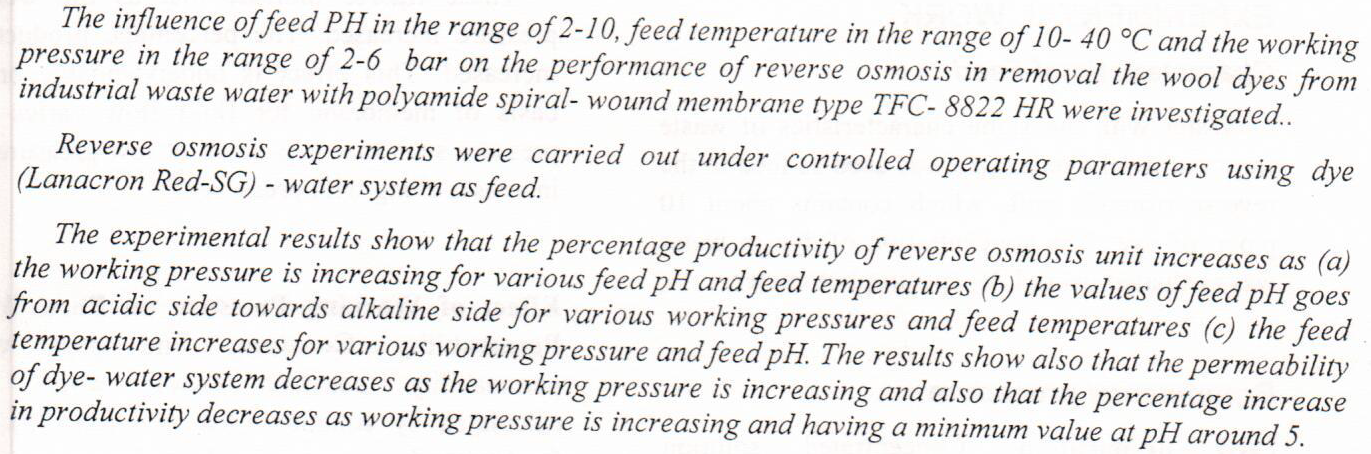
Removal of Wool Dyes from Industrial Wastewater by Reverse Osmosis Process


In the present study, activated carbon supported metal oxides was prepared for thiophene removal from model fuel (Thiophene in n-hexane) using adsorptive desulfurization technique. Commercial activated carbon was loaded individually with copper oxide in the form of Cu2O/AC. A comparison of the kinetic and isotherm models of the sorption of thiophene from model fuel was made at different operating conditions including adsorbent dose, initial thiophene concentration and contact time. Various adsorption rate constants and isotherm parameters were calculated. Results indicated that the desulfurization was enhanced when copper was loaded onto activated carbon surface. The highest desulfurization percent for Cu2O/AC and o
... Show MoreIn this study, nickel cobaltite (NC) nanoparticles were created using the sol-gel process and used as an adsorbent to adsorb methyl green dye (MG) from aqueous solutions. The adequate preparation of nickel cobaltite nanoparticles was verified using FT-IR, SEM, and X-ray diffraction (XRD) studies. The crystalline particle size of NC nanoparticles was 10.53 nm. The effects of a number of experimental variables, such as temperature, adsorbent dosage, and contact time, were examined. The optimal contact time and adsorbent dosage were 120 minutes and 4.5 mg/L, respectively. Four kinetic models—an intraparticle diffusion, a pseudo-first-order equation, a pseudo-second-order equation, and the Boyd equation—were employed to monitor the adsorpti
... Show More (38)
(38)
 (32)
(32)


This study examines the removal of ciprofloxacin in an aqueous solution using green tea silver nanoparticles (Ag-NPs). The synthesized Ag-NPs have been classified by the different techniques of SEM, AFM, BET, FTIR, and Zeta potential. Spherical nanoparticles with average sizes of 32 nm and a surface area of 1.2387m2/g are found to be silver nanoparticles. The results showed that the ciprofloxacin removal efficiency depends on the initial pH (2.5-10), CIP (2-15 mg/L), temperature (20-50°C), time (0-180 min), and Ag-NPs dosage (0.1-1g/L). Batch experiments revealed that the removal rate with ratio (1:1) (w/w) were 52%, and 79.8% of the 10 mg/L of CIP at 60, and 180 minutes, respectively with optimal pH=4. Kinetic models for adsorpti
... Show More
(1)
Environmental pollution is experiencing an alarming surge within the global ecosystem, warranting urgent attention. Among the significant challenges that demand immediate resolution, effective treatment of industrial pollutants stands out prominently, which for decades has been the focus of most researchers for sustainable industrial development aiming to remove those pollutants and recover some of them. The liquid membrane (LM) method, specifically electromembrane extraction (EME), offers promise. EME deploys an electric field, reducing extraction time and energy use while staying eco-friendly. However, there's a crucial knowledge gap. Despite strides in understanding and applying EME, optimizing it for diverse industrial pollutant
... Show More
(4)
(4)
تضمن هذا العمل تحضير ليكند قاعدة شيف جديدة مشتقة من مادة البولي أكريلاميد والكلوترالديهايد [(2S, 2'S) – N, N' - (pentane-1, 5-diylidene) bis (2- methylbutan amide)] مع بعض المعادن الثقيلة (Cr + 3 Mn + 3 , Fe + 3 , ,Co + 2, Ni + 2 ,Cu + 2 Zn + 2 , Cd + 2,) لتنتج المعقدات المقابلة. تم تشخيص قواعد شيف ومعقداتها المعدنية بأستخدام طيف الأشعة تحت الحمراء والأشعة المرئية وفوق البنفسجية، والتوصيلية ,وقيم المغناطيسية والتحليل الحراري الوزني وحيود الأشعة السينية ومجه
... Show More
(7)
(1)
Due to their recalcitrant characteristics, Azo dyes such as methyl orange (MO) are extremely poisonous substances, making their removal from textile industry wastewater a major problem. By employing various EC-Adsorption combined system configurations and reusing alum sludge as an adsorbent, the current study seeks to investigate the efficiency of these various systems in removing MO dye. To estimate their benefits and limitations, experiments were carried out utilizing nickel foam (NiF) and aluminum plate (Al plate) as anodes, and stainless-steel mesh (SS mesh) as cathode in the presence of alum sludge as an adsorbent in all systems. The EC-Adsorption combined system with NiF as anode and two SS meshes as cathodes with 10 g/L
... Show More
(2)
(3)
(3)
(3)