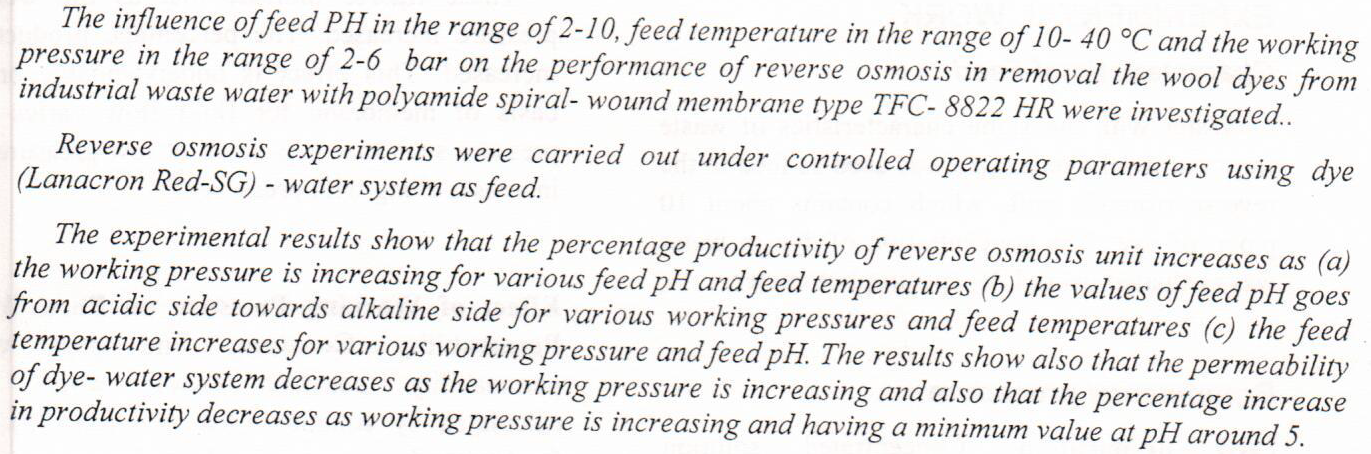
Removal of Wool Dyes from Industrial Wastewater by Reverse Osmosis Process

Non-thermal or cold plasma create many reactive species and charged particles when brought into contact with plant extracts. The major constituents involve reactive oxygen species, reactive nitrogen species and plasma ultra-violets. These species can be used to synthesize biologically important nanoparticles. The current study addressed the effect of the green method-based preparation approach on the volumetric analysis of Zn nanoparticles. Under different operating conditions, the traditional thermal method and the microwave method as well as the plasma generation in dielectric barrier discharge reactor were adopted as a preparation approach in this study. The results generally show that the type of method used plays an important rol
... Show More (1)
(1)

The electrical properties of pure NiO and NiO:Au Films which are
deposited on glass substrate with various dopant concentrations
(1wt.%, 2wt%, 3wt.% and 4wt.%) at room temperature 450 Co
annealing temperature will be presented. The results of the hall effect
showed that all the films were p-type. The Hall mobility decreases
while both carrier concentration and conductivity increases with the
increasing of annealing temperatures and doping percentage, Thus,
indicating the behavior of semiconductor, and also the D.C
conductivity from which the activation energy decrease with the
doping concentration increase and transport mechanism of the charge
carriers can be estimated.
 (1)
(1)

The aim of this work is to enhance the mechanical properties of the glass ionomer cement GIC (dental materials) by adding Zirconium Oxide ZrO2 in both micro and nano particles. GIC were mixed with (3, 5 and 7) wt% of both ZrO2 micro and nanoparticles separately. Compressive strength (CS), biaxial flexural strength (BFS), Vickers Microhardness (VH) and wear rate losses (WR) were investigated. The maximum compression strength was 122.31 MPa with 5 wt. % ZrO2 micro particle, while 3wt% nanoparticles give highest Microhardness and biaxial flexural strength of 88.8 VHN and 35.79 MPa respectively. The minimum wear rate losses were 3.776µg/m with 7 wt. % ZrO2 nanoparticle. GIC-contai
... Show More
(16)
In this work, silicon nitride (Si3N4) thin films were deposited on metallic substrates (aluminium and titanium sheets) by the DC reactive sputtering technique using two different silicon targets (n-type and p-type Si wafers) as well as two Ar:N2 gas mixing ratios (50:50 and 70:30). The electrical conductivity of the metallic (aluminium and titanium) substrates was measured before and after the deposition of silicon nitride thin films on both surfaces of the substrates. The results obtained from this work showed that the deposited films, in general, reduced the electrical conductivity of the substrates, and the thin films prepared from n-type silicon targets using a 50:50 mixing ratio and deposited on both
... Show More
|
Copper oxide thin films were synthesized by using spray pyrolysis deposition technique, in the temperature around 400°C in atmosphere from alcoholic solutions. Copper (II) chloride as precursor and glass as a substrate. The textural and structural properties of the films were characterized by atomic force microscopy (AFM), X-ray diffraction (XRD). The average particle size determined from the AFM images ranged from 30 to 90 nm and the roughness average was equal to 9.3 nm. The XRD patterns revealed the formation of a polycrystalline hexagonal CuO. The absorption and transmission spectrum, band gap, film thickness was investigated. The films were tested as an |
(1)
Eye loss may be caused as a result of eye trauma, accidents, or malignant tumors, which leads the patient to undergo surgery to remove the damaged parts. This research examines the potential of computer vision represented by Structure from Motion (SfM) photogrammetry in fabricating the orbital prosthesis as a noninvasive and low-cost technique. A low-cost camera was used to collect the data towards extracting the dense 3D data of the patient facial features following Structure from Motion-Multi View Stereo (SfM-MVS) algorithms. To restore the defective orbital, a Reverse Engineering (RE) based approach has been applied using the similarity RE algorithms based on the opposite healthy eye to rehabilitate the defected orbital precisely
... Show More
(2)
KE Sharqie, AA Al-Nuaimy, WJ Kadhum, SMJ, 2006 - Cited by 2